During the summer, I am sharing thematic posts bringing together responses on similar topics from the past 11 years. You can see all those collections from the first 10 years here.
Today’s theme is Reading Instruction.
You can see the list following this excerpt from one of the posts:
1. ‘Children Need Both Paper Books & Digital Texts’
Katie Keier, Stacy Nockowitz, Barbara Paciotti, and many readers share their thoughts on the debate between reading digitally or on paper. Read more.
2. Reading Digitally vs. Reading Paper
Daniel Willingham, Kristin Ziemke, Lester Laminack, and Kimberly Carraway explore that topic of reading digitally compared with reading on paper in this post. Read more.
3. Close Reading Can Be ‘Fun or Awful’
Christopher Lehman, Cris Tovani, Pernille Ripp, Jan Burkins, and Kim Yaris contribute their thoughts. Read more.
4. Close Reading Is a ‘Life Skill’
Sonja Cherry-Paul, Dana Johansen, Stephanie Harvey, Julie Goldman, Diana Sisson, and Betsy Sisson are the featured guests in this post. Read more.
5. Close Reading—Part Three
Kimberly Carraway, Katherine S. McKnight, Harvey F. Silver, Amy Benjamin, Nancy Boyles, Rita Platt—along with readers—share their ideas. Read more.
6. Teaching Literature Through ‘Choice’ & ‘Practice’
This post features responses from Regie Routman, Katherine S. McKnight, and Michael W. Smith. Read more.
7. Literature Can Be a ‘Gateway for Understanding Everything’
Several educators—Nancy Steineke, Sean McComb, Nancy Frey, Doug Fisher, Bill Himmele, and Pérsida Himmele—provide responses here. Read more.
8. A Good Reading Lesson Doesn’t ‘Put Standards Before Students’
In this post, guest responses come from educators Cheryl B. Dobbertin, Ilse O’Brien, Katherine S. McKnight, and Regie Routman. Read more.
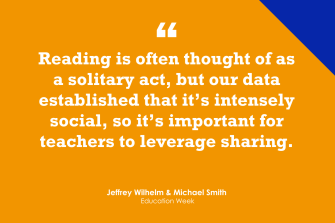
9. ‘Reading Is Intensely Social': An Interview With Jeffrey Wilhelm & Michael Smith
Educators Jeffrey Wilhelm and Michael Smith are co-authors of the new book Reading Unbound. Read more.
10. Ways to Engage Students in Reading
Jason Flom shares his ideas, as do many readers. I also add an intriguing chart. Read more.
11. Reading Is a ‘Means to Bigger and Better Things’
Educators Kristi Mraz, Marjorie Martinelli, Kathy Barclay, and Cindi Rigsbee contribute their thoughts. Read more.
12. Ways to Develop Lifelong Readers
Donalyn Miller, Mark Barnes, and Christopher Lehman contribute their responses. Read more.
13. Using the ‘Fun Factor’ to Encourage Student Reading at Home
Read educator/author Nancy Steineke’s ideas, as well as comments from many readers. Read more.
14. Getting Students to Read at Home by ‘Building a Daily Habit’
Dina Strasser and Ariel Sacks share their thoughts in this post. Read more.
15. Helping Students Develop a Desire to Read at Home
In addition to sharing my own response, you’ll find contributions from two other guests—educators Donalyn Miller and Myron Dueck. Read more.
More Q&A posts about reading instruction:
- ‘Teachers Know a Lot About Scaffolding’ for Complex Texts
- Teaching Complex Texts Requires ‘Getting to Know Your Students’
- Ten Elements of Effective Instruction
- Many Ways to Help Students Develop Academic Vocabulary
- Ways to Help Our Students Become Better Readers
- More Ways to Help Our Students Become Better Readers—Choice & Access
- Ways to Help Our Students Become Better Readers—Part Two
- Ways to Help Our Students Become Better Readers—Part Four
- Advice From the ‘Book Whisperer,’ EdWeek Readers, & Me About Teaching Reading
Explore other thematic posts:
- It Was Another Busy School Year. What Resonated for You?
- How to Best Address Race and Racism in the Classroom
- Schools Just Let Out, But What Are the Best Ways to Begin the Coming Year?
- Classroom Management Starts With Student Engagement
- Teacher Takeaways From the Pandemic: What’s Worked? What Hasn’t?
- The School Year Has Ended. What Are Some Lessons to Close Out Next Year?
- Student Motivation and Social-Emotional Learning Present Challenges. Here’s How to Help
- How to Challenge Normative Gender Culture to Support All Students
- What Students Like (and Don’t Like) About School
- Technology Is the Tool, Not the Teacher
- How to Make Parent Engagement Meaningful
- Teaching Social Studies Isn’t for the Faint of Heart
- Differentiated Instruction Doesn’t Need to Be a Heavy Lift