

There are many sounds in English that don’t exist in Spanish, and vice versa. Take the sound the letter “z” makes in English, or the rolled “r” in Spanish.
In the Southside independent school district in San Antonio, teachers highlight these differences for their Spanish-speaking students. It’s a key part of the school system’s approach to the “science of reading.”
Teachers in the district—where about 30% of students are multilingual learners—give early elementary schoolers systematic phonics instruction, a foundational piece of early reading lessons. They teach beginning readers which letters represent which sounds and how to blend them together into words, whether they’re teaching in English, or in Spanish in the district’s dual-language program.
These practices are common in schools that have adopted evidence-based approaches to teaching early literacy, a movement often referred to as the “science of reading.” But at Southside, teachers also use their knowledge of language structure to help students make connections between English and Spanish—and to identify where children might need more help.
“There’s no need to reteach the whole alphabet,” said Alejandra Ramirez, the district’s elementary reading and language arts coordinator. “If the first language of instruction is Spanish, then we [only] want to teach what doesn’t transfer.”
In its transition to the science of reading, Southside is centering the needs of its multilingual students—something that sets the district apart from many schools.
While at least 45 states and the District of Columbia have recently passed legislation mandating an evidence-based approach to reading instruction, only 10 discuss the needs of English learners in depth—mandating targeted preservice or in-service teacher training, or employing reading coaches for this group of students, according to a 2023 analysis from the Shanker Institute.
It’s a shortcoming that feels familiar for Ramirez, who was a dual-language teacher and bilingual literacy specialist before she moved into her current role. “Usually, our bilingual teachers don’t have enough resources. You go to a training and it’s, ‘We have everything for English, but Spanish is coming.’”


As states roll out training for educators in practices shown by research to support struggling readers, and create lists of approved materials, Ramirez would like to see more attention paid to how the reading revolution sweeping the country can better support English learners and students in dual-language programs.
Teachers deserve this information, she said. “If you don’t have an understanding of how language is built, or language acquisition, a program is only going to take you so far.”
Why some English learner advocates have pushed back against the ‘science of reading’
The “science of reading” movement stemmed, in large part, from parents of children with reading disabilities, and researchers who study how teachers can help these children learn to decode and comprehend text.
Studies show that explicit, systematic instruction in letters and sounds can help students who struggle with written language. But as states passed laws requiring this type of instruction, some English learner advocates raised alarm bells.
States were limiting literacy instruction “to an uninspired narrow focus on a few foundational reading skills,” wrote a group of English learner researchers and advocates, the National Committee for Effective Literacy, in a report in 2022. That focus, they argued, could crowd out time for the spoken language development that is crucial for students learning English—activities such as storybook read-alouds or practice using new vocabulary words in conversation.
Eventually, the National Committee for Effective Literacy and the Reading League, an organization that advocates for the science of reading, brokered a tentative peace, releasing a statement agreeing to several high-level principles to guide reading instruction.
English learners need intensive instruction in developing spoken English skills, the statement read, but they also need to be taught phonics and phonemic awareness, skills that unlock the written word and are a “crucial foundation for proficient reading.” It’s not an either or question; students need both, especially students who are struggling to learn to read.
“As a literacy specialist, and as an interventionist, the majority of the students that I served were bilingual students,” said Teresa Rodriguez, a former school district administrator in Texas who worked in roles overseeing English learners and English/language arts instruction. (Rodriguez was not involved with either of the statements.)
Often, those students didn’t have a “solid grounding” in foundational skills, in Spanish or English, said Rodriguez, who now works as a literacy consultant for a national organization. “We had bilingual students who didn’t have those opportunities to unlock the code,” she said.

While oral language is “the foundation” for reading, writing, and learning, students also need “very explicit, systematic” instruction in how to read written words—whether they’re learning in English or in Spanish, said Elsa Cárdenas-Hagan, a bilingual speech language pathologist and the director of the Valley Speech Language and Learning Center in Brownsville, Texas.
Also important is “bridging across languages, and comparing those language structures,” she said.
How interdepartmental collaboration supports English learners
In the Southside ISD, creating those bridges has required more collaboration between the English/language arts and bilingual departments—and a hefty chunk of educators’ time.
When Ramirez, the district’s elementary ELA coordinator, was tasked with implementing the science of reading, she reached out to researchers who worked at the intersection of English learners and systematic, explicit literacy instruction, and shared her findings with Melissa Martinez, the district’s bilingual programs director.
“We talked a lot about what are the major things that we need to consider when helping bilingual students,” Ramirez said.
In early grades, students in the dual-language program do most of their reading and writing in Spanish. So Martinez convened a group of teachers to comb through the state’s early reading standards and identify where the Spanish literacy skills students were learning wouldn’t translate directly to English—and how teachers could shore up that knowledge.
They kept a running list of English literacy skills to explicitly teach, from syllable types that don’t exist in Spanish to the differences in punctuation between the two languages. The district added a 20-minute English literacy development period to the Spanish ELA block to work on them.
“We need this—something that intentionally looks at the nontransferable skills,” said Diana Oviedo-Holguin, a 1st grade teacher at Heritage Elementary School in the district, who is part of Martinez’s teacher group.
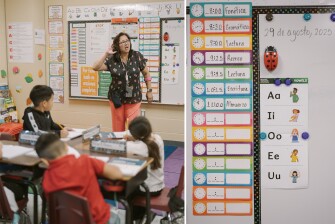
Oviedo-Holguin still works with her students on the oral language development she’s always prioritized, intentionally teaching vocabulary in both English and Spanish, and providing visual word banks around the room.
“My students, they start out quiet. And by the end of the year, they’re pretty chatty,” she said.
But now, with the help of a new English curriculum in foundational reading skills, Oviedo-Holguin targets the English letter-sound connections that don’t transfer from Spanish, too.
“Even my nonreaders have started to spell out some of the words,” she said.
Making cross-linguistic connections explicit
Dual-language programs provide natural opportunities for teachers to make explicit connections between students’ home language and English. And bilingualism has a host of cognitive benefits, said Cárdenas-Hagan.
“But that doesn’t mean our students can’t thrive in English as a second language,” she added. “They definitely can.”
Most English learners in the United States are in English-dominant settings, not dual-language programs. Teachers in these classrooms can draw cross-linguistic connections too, said Cárdenas-Hagan, if they have a working knowledge of the structure of their students’ home languages.
Her book, Literacy Foundations for English Learners, explains where the phonology, or system of speech sounds, of English overlaps and differs from the phonology of languages commonly spoken among ELs in the United States, including Spanish, Arabic, Vietnamese, and Chinese.
Schools shouldn’t treat English learners “as if they didn’t bring any knowledge to the table,” Cárdenas-Hagan said.
Her book includes techniques and scripts teachers can use to show students where sound-letter correspondences are similar and different between English and their home language. In one, a teacher explains how the letter “b” is pronounced in English.
“In Spanish, you have the sound /b/,” the suggested text reads, using the backslash to denote the sound the letter makes. “It is the same sound as the English sound. … We can use the word bat to help remember this sound. In Spanish, the word would be bate.”
Or, another: “The letter c exists in both Zulu and English. In Zulu, however, the c makes the /ch/ sounds, whereas in English it will make either the /k/ or /s/ sound.”
Adding a sentence or two of additional explanation to a lesson might seem simple, but many reading teachers haven’t been taught about the structural underpinnings of the languages their students speak, said Jim Addison, a literacy leadership coach at Wisconsin’s Cooperative Educational Service Agency 3. About half of teachers who work with English learners say they are not at all, or only somewhat, prepared to teach their students, according to a RAND Corporation survey published in June.
“I think back to myself; I didn’t have any guidance or learning or help to learn how to support English learners and how to use both languages as an asset,” Addison said.
Addison and Rodriguez, the literacy consultant, worked together to create a teacher’s companion to UFLI, a popular phonics program. The supplement highlights the cross-linguistic connections for teachers using the curriculum with Spanish-speaking English learners.
Expanding the EL reading instruction toolbox
Learning more about the similarities and differences between English and Spanish language structure has informed how Talita Austin teaches foundational skills.
Austin, an English learner teacher in the Belmont Community school district in Wisconsin, went through reading training from Addison several years ago.
With more than a dozen years of classroom experience, and a background as an English learner herself, Austin already had a toolbox of strategies to support her students. “I knew that I had to be really friendly with my language, use lots of synonyms, lots of actions with my hands,” she said.
Still, she said, the training reinforced the importance of foundational reading skills—and why it’s crucial to know how phonology differs across languages.
“When I first started [teaching], we focused a lot on sight words,” said Austin. “You thought that if you explained what those words were, their definitions, and got kids to practice them in writing, that was sufficient.”


But teaching the sounds each letter makes, especially vowels, is key to “building that base” in students’ word-reading ability, Austin said.
Because vowels in English function so differently from how they do in Spanish, her students sometimes need extra practice and reminders of these differences to be able to decode English words, she said.
“By default, you’re going to go with those sounds you know.”


