Lauraine Langreo is an Education Week staff writer, covering education technology, learning environments, future of work and student wellness issues. She previously worked as a digital producer and Morning Education newsletter writer at Politico.
Photos of board members decorate the walls inside LAUSD headquarters Wednesday, Feb. 25, 2026, in Los Angeles. The Los Angeles Board of Education recently voted to limit screen time in classrooms.
Students use their cellphones as they leave for the day the Ramon C. Cortines School of Visual and Performing Arts High School in downtown Los Angeles on Aug. 13, 2024.
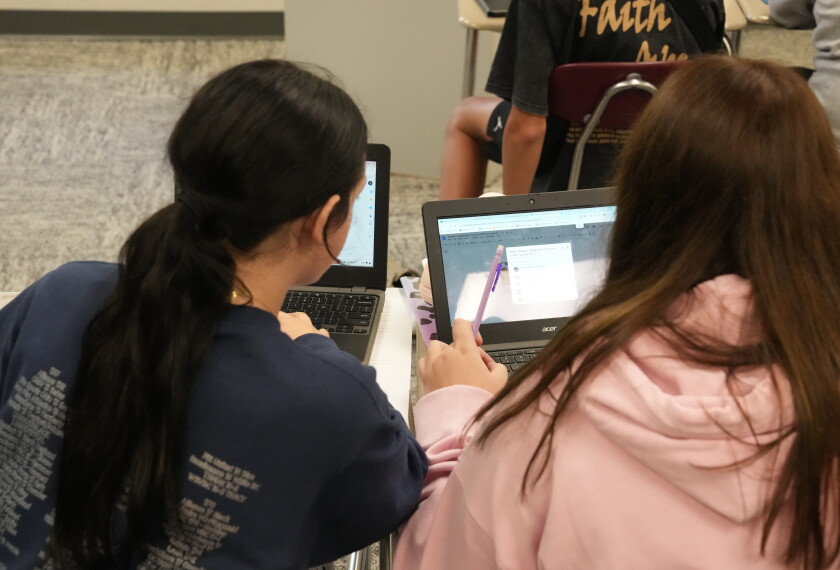
Sixth-graders work on laptops during a class at Cedar Park Middle School in Beaverton, Ore., on April 3, 2026. The school is experimenting with storing Chromebooks on a classroom cart, rather than assigning them directly to each student, to try to reduce the amount of time students spend on screens. Teachers and parents say the pilot program is working.
Students in a history class at Sapulpa Middle School in Oklahoma take a break from using technology, focusing instead on group activities involving worksheets and discussion on April 7, 2026. A growing number of schools across the country are using approaches to cut back on screen time in classrooms.
School counselor Laurinda Culpepper takes down students' work on a bulletin board at Walnut Grove Elementary School, on May 13, 2020, in Olathe, Kan. According to the American School Counselor Association’s State of the Profession 2025 report, many people who do not work in schools do not understand the role and value counselors have for school communities.
Cybersecurity experts recommend that schools should take steps now to protect student data as they wait for confirmation of a potential hack of Navigate360’s P3 Global Intel platform, which features a safety tip line.
"We're going to get to the standards ... but we have to make sure that our kids feel safe enough to come into our building," said Damon Lewis, the principal for Ponus Ridge STEAM Academy in Norwalk, Conn., and the National Middle Level Principal of the Year in 2025.
A student uses a laptop to work on an assignment during class on Aug. 28, 2024, in Aurora, Colo. New EdWeek Research Center data show that many students are already being taught AI literacy.
Plumes of smoke from two simultaneous U.S. air strikes rise over Tehran, Iran, on March 2, 2026. Providing age-appropriate opportunities for students to talk about war-related topics such as the current U.S.-Iran conflict can help them process those events in more meaningful ways.
Business students at the Donald M. Payne Sr. School of Technology in Newark, N.J., work in a computer lab on Feb. 25, 2026. A U.S. Department of Education grant was helping students in business and other fields at the school access enrichment programming, college courses, and financial support after graduation. But the department terminated the grant, along with 18 other similar awards across the country, last summer.
Digital Promise has a new initiative to identify barriers, design solutions, and scale practices around learner-centered career pathways. Abou Sow, the owner of Prince Abou's Butchery in Queens, shows students from George Westinghouse Career and Technical Education High School how to separate short rib from rib eye at Essex Kitchen in New York, on May 21, 2024.
Students playing basketball at Parkway Sports & Health Science Academy on Feb. 21, 2025, in La Mesa, Calif. Some schools are using sports as a way to help students develop social-emotional skills.
Microsoft is launching a program to connect educators with their peers and with resources about AI. Attendees watch a presentation at the Microsoft booth on how to incorporate artificial intelligence into classroom management at the ISTE conference on June 29, 2025 in San Antonio, Texas.