Reading isn’t just a set of skills. The most important factor in helping middle schoolers overcome literacy issues is creating strong relationships with students and families. As an administrator, I’m always using assistive technology to help guide curricular decisions and working to build structure so that students can access their education, but my best educators are the ones who stay laser-focused on developing meaningful relationships.
How to Support Struggling Readers in Middle School
The embarrassment of having a hard time reading can lead to evasive behavior and hopelessness. Here’s how my school steps in.
At the age of 13, around 65 percent of students who play competitive sports quit that sport and try a new sport. It’s because they stop winning or adopt some notion that they aren’t good enough. The same goes for reading. At Bay Area Technology School, we’ve found that 7th and 8th grades are the most crucial years in terms of making sure that kids don’t feel hopeless about their reading ability.
If we can identify struggling readers and keep them motivated, we can turn them around in life-changing ways. They might not be reading Faulkner or Shakespeare, but they can read their high school textbooks and graduate from high school. The challenge for our educators is that, by 7th grade, students might be hiding their challenges behind coping mechanisms that keep them from being discovered. Here’s how we find and help our middle schoolers who have trouble with reading.
Replacing Remediation with Advancement
As a former reading teacher, I know that language matters. For example, I want to strike the term “remediation” from the dictionary of education. No student is remediated. They are not sick or broken. What we are looking to do is to advance all learners. Our middle schoolers don’t want to be called out as being unintelligent or incapable, so when they hear that they’re in remediation class, they are more likely to lose hope and become withdrawn.
When I was teaching ELL students, a huge part of my job was to help kids fend off that feeling of hopelessness and stay motivated. So now as a superintendent, I ask my teachers not to talk about remediation, but instead to talk about advancing everyone toward excellence. That’s something students can buy into, and if an educator commits to that cause, they can turn around struggling readers. First, though, they have to identify them.
Starting With Smart Assessments
The first and most objective question we ask is, “How well is this student doing with assignments or group projects?” For one of our main reading assessments, we use Lexplore, which has an AI eye-tracking feature that helps educators identify students’ reading patterns to see if they might have dyslexia or another learning disability. It’s not a diagnosis, but positive data from Lexplore is a good enough reason to recommend further academic testing to a parent.
Our most recent round of testing was in mid-February, when we found that 15 percent of participating 6th through 8th graders were reading at a low level, with 41 percent below average and 44 percent average. Rather than reflecting a COVID slide, these figures were an improvement over the results we saw in fall of 2020, when 20 percent of students were reading at a low level, and only 40 percent were at average level.
Whenever we test, if an educator notices the red flags and has reason to believe their student is struggling with reading alone, they know they can help their student in a couple of different ways, such as using devices that measure phonemic awareness or comprehension.
What the Bathroom Log Really Means
Another way that educators can identify and help struggling readers is simply keeping a bathroom log. Last year, there was a 6th grade boy at my school who was always going to the bathroom, every single period. We noticed it right away and we also noticed that when he took his diagnostic examination for reading and math, he scored at a 2nd grade level.
We didn’t call him out on it, but we did some heavy intervention in reading using assistive technology. As he grew from 2nd grade to 4th grade level, his bathroom visits decreased. By the end of the year, he was up to a 6th grade level and he wasn’t on the bathroom logs at all, except at lunch.
Another student went to the bathroom every single day, 12 minutes into every class. That was when teachers were finished with explicit instruction and transitioning to group work. I got to know this boy, and at some point I just asked him, “Can you read?”
And he said, “No, not really. It’s kind of why I go to the bathroom all the time.” He absolutely, positively owned up to it, and we got him some help. He’s in a special reading-advancement class of only 10 kids this year. Even though it’s online, we have seen two grade levels of improvement, which is a big deal.
When we called home to tell his mother how proud we were that he grew in reading, she cried. This was the first time from kindergarten through 8th grade that anyone ever called her to say that he could read, even just a little bit.
What We Learn From Interactive Reading
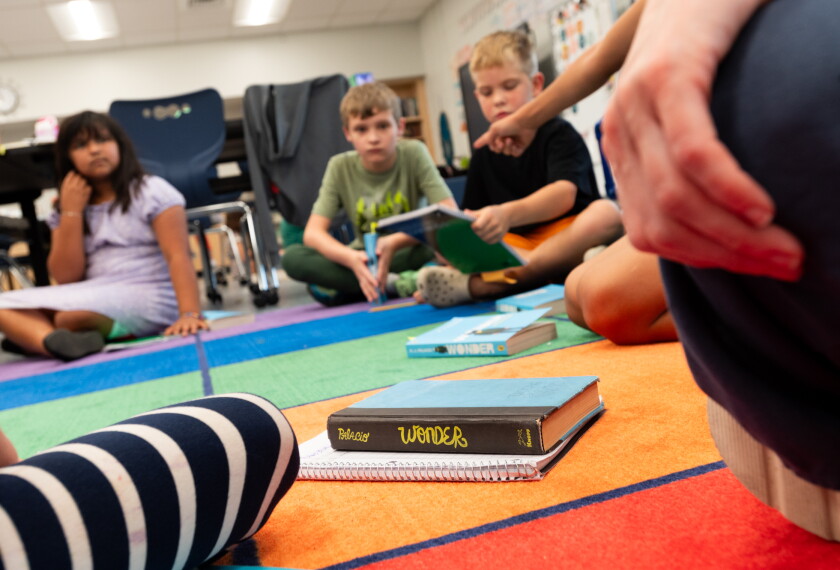
Educators can find out a lot by simply listening to a student read and then talking with them about what they’ve read after a page or two. When I was a teacher, I would sit with a student, ask them to close the book, then say, “You’ve made great progress. Can you help me recall three facts from that paragraph we just read?” That will tell you if a kid knows only how to make “reading noises” or if they also know how to recall, retain, and process the information they’ve read.
Our school starts each morning with 20 minutes of interactive reading. Educators need to find time to listen to how their students read and then ask them to share what they’ve read afterward. A student might be able to make the noises necessary to read, but are they also able to comprehend what the text is telling them?
One schoolwide strategy we teach is called the “inside, outside, outside” method. We tell students to first look inside the word, at the prefix and suffix. Then they look outside the word, at the sentence before and the sentence afterward. If they still can’t figure out what that word means, they look further outside using a thesaurus—not using a dictionary, because the thesaurus will help students learn other academic terms along the way and allow them to make academic connections to the new word they just learned.
This method isn’t just for middle schoolers. I recently had a former student call me and say that, after months of studying, she was taking her MCAT and didn’t recognize a word. “I started to sweat,” she said, “I even started to cry a little bit. But then I looked inside the word, and I recognized one of the roots. I looked at the sentence before and the sentence after, and I knew the answer was C and that I was going to pass this test and become a doctor.”
These methods not only give students a way to get unstuck, but they create the sort of bond where a student will call a teacher 10 years later.
A Laser Focus on Relationships
If you have a relationship with a student, you also build a level of trust, and that student will be less reluctant to read in front of you. No matter what subject you teach, you can act as a reading coach.
Reading isn’t just a set of skills. The most important factor in helping middle schoolers overcome literacy issues is creating strong relationships with students and families. As an administrator, I’m always using assistive technology to help guide curricular decisions and working to build structure so that students can access their education, but my best educators are the ones who stay laser-focused on developing meaningful relationships.