
Updated: The Texas State Board of Education approved a mandatory reading list that includes Bible passages for public school students on June 26, 2026. Read more here.
Debates over what constitutes the American literary canon—and whether Bible excerpts should be a part of it—erupted on Wednesday during a tense Texas State Board of Education discussion over a proposed list of books, plays, poems, and other literary works that all students would be required to read in grades K-12.
After hours of public comment and deliberation, the board voted 13-1 to delay voting on the list until April, to provide more time for feedback and potential revisions.
But if some version of the requirement is approved, Texas will be the first state in the country to mandate that every student in its schools read the same texts—including, controversially, 10 different selections from the Bible and several Christian parables.
Such a move would greatly increase the amount of centralized control the state has over the English/language arts curriculum, especially at the high school level, where individual districts or teachers are usually free to make their own text selections.
And it could dramatically reshape the classroom reading diet for many of the more than 5.5 million students in the state’s public schools. Publishers, too, could be affected, given Texas’ standing as the second-largest K-12 market in the country.
The list, prepared by the Texas Education Agency at the direction of the state board, is the result of a law passed in 2023 that requires the board to select “at least one literary work to be taught in each grade level.” But TEA’s proposed plan goes much further. It specifies, for instance, five full-length novels and plays in 11th grade, with nearly 20 accompanying shorter works in that year.
These texts serve as “foundational knowledge,” a canon of literature that all students should read and understand, said Shannon Trejo, TEA’s deputy commissioner of school programs, during Wednesday’s board meeting.
But some board members and public commenters took issue with the selections, arguing that the list lacked racial and gender diversity and prioritized older works over contemporary classics.
“This list does not represent the students of Texas,” said Tiffany Clark, a Democratic board member. “For so many years, students of color have had to endure a European-centered philosophy, history, without representation of their own history being recognized. That is exactly what we see continuing to happen with this list.”
Do religious texts belong in the canon?
The idea that students might benefit from reading a canon of important literary works is far from a new idea—several universities, for instance, have “great books” programs designed around this principle.
In the 1980s, English professor E.D. Hirsch Jr. proposed that all K-12 students needed a shared curriculum that taught about key topics in literature, history, math, science, and the arts.
The theory was controversial at the time, but has since been taken up again by proponents of what’s known as “knowledge-building curricula”—reading programs that aim to teach literacy skills through social studies and science content, in addition to the fiction that typically makes up the bulk of English/language arts classes.
Advocates of these programs point to studies showing that students with more general background knowledge do better on tests of reading comprehension.
But exactly what knowledge do students need, and who decides? These are contested questions—and ones at the heart of recent debates over curriculum in Texas.
In 2024, the state board of education voted to approve Bluebonnet Learning, a state-developed curriculum that includes Christian teaching in elementary school lessons. Proponents of the materials argued that the Bible is a core text in American culture, and that religious stories like Jesus’ Sermon on the Mount are core knowledge students need to have to understand literature and history.
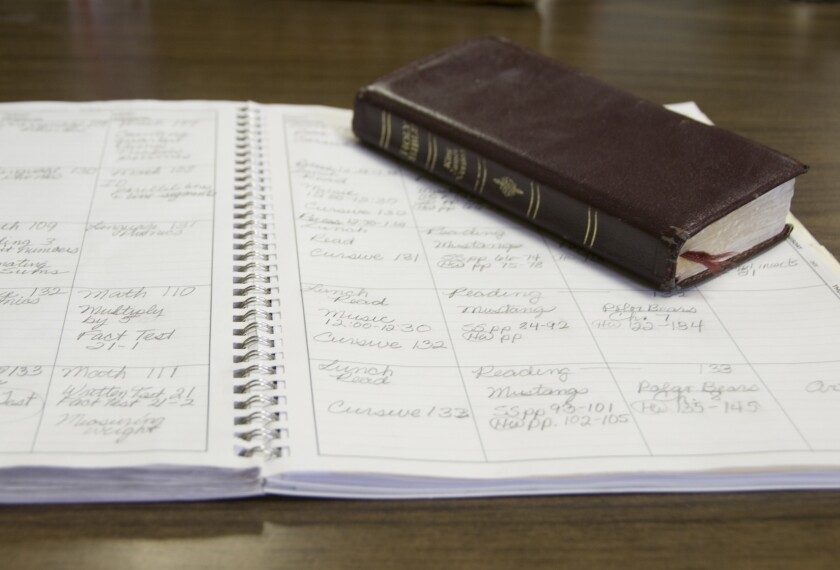
But opponents countered that the materials proselytized to students—an argument that played out again on Wednesday, in relation to proposed excerpts from the Old and New testaments on the required book list, which include Psalm 23, the Eight Beatitudes, and the story of the tower of Babel, among others.
“Religious readings belong in Sunday school, not in public schools,” said Kevin Jackson, a parent who spoke against the list.
Brandon Hall, a Republican board member, said that the inclusion of Bible excerpts was based on their “cultural impact.”
“Some of these passages of scripture that you mentioned have had a huge impact on our state, on our country,” he said.
Commenters cite list’s lack of racial, gender diversity
Also at issue was the racial and gender diversity of the list. Many commenters critiqued what they saw as a collection that overrepresented white men who lived and wrote centuries ago, to the exclusion of women, people of color, and authors working today.
Core texts in 9th grade English, for example, include Animal Farm by George Orwell, “Antigone” by Sophocles, Great Expectations by Charles Dickens, The Odyssey by Homer, and Night by Elie Wiesel. Tenth graders’ core texts would include Beowulf, Fahrenheit 451 by Ray Bradbury, Frankenstein by Mary Shelley, A Separate Peace by John Knowles, and Shakespeare’s “Julius Caesar.”
“I have a great respect for the classics, and taught many of them as an English teacher. However, this list is so old-fashioned that most of the works are from before I was born in the 1950s,” said Sara Stevenson, a former teacher and school librarian. “It’s not as if literature then became extinct. There are so many wonderful contemporary classics from a wide range of authors.”
None of the core high school texts were written by Hispanic authors, a decision María Del Carmen Unda, a postdoctoral fellow at the University of Texas at Austin, called “alarming.” The list “reflects a profound disconnect between curriculum design and student demographics,” she said during public comment.
Frank Strong, a teacher in Austin and a co-director of the Texas Freedom to Read Project, said he favors a mix of traditional classics and newer works. “At my school, students read The Great Gatsby, they read the Odyssey, Night, Shakespeare,” he said. “But they also read diverse texts by authors like Jesmyn Ward, Elizabeth Acevedo, and Leslie Marmon Silko.”
But with five required core works at each grade level weighted toward white men, Strong said, he wouldn’t have time in the year left for his own additions that diversify the curriculum.
“What that means is that the wide world of diverse, and interesting, and beautiful texts that students are currently reading will start to disappear from classrooms if you adopt this list,” he said. “It’s somewhat unimaginable to me, to have a list this long and this prescriptive.”
Still, some supporters of the list argued that attempts to diversify the list would weaken its educational value.
“Intellectual-sounding words such as ‘critical literacy’ or ‘culturally relevant pedagogy’ will be used to try to persuade you that books should be included that are either not suitable, or have lesser literary value,” said Matthew McCormick, the education director at the Texas Public Policy Foundation, which has advocated against diversity, equity, and inclusion initiatives in schools.
The end result, he said, would be a “watered-down curriculum where literacy and appreciation of literature are replaced by shallow invocations of identity and political correctness.”
In response, board member Marisa Pérez-Díaz, a Democrat, asked McCormick whether he was arguing that culturally relevant reading constitutes a watered-down curriculum.
“If I am reading a book in school, my job should be to figure out what the perspective of the author is. My job shouldn’t be to see myself,” he said.


