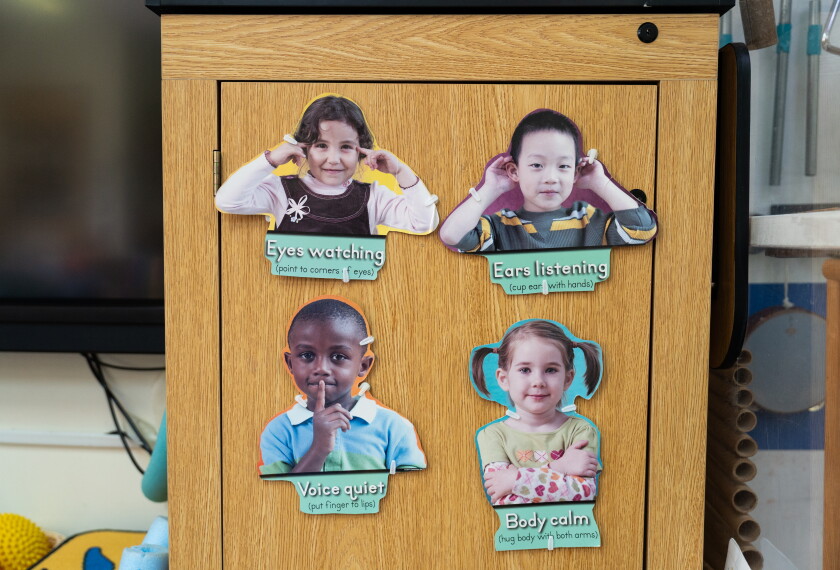
We expect toddlers to have temper tantrums. A lack of oral-language skills, the inability to regulate emotions, and inexperience with socializing in group settings can all lead to outbursts in 2- and 3-year-olds. This behavior isn’t considered developmentally appropriate for kindergarten-aged children—but according to educators, it’s becoming more common.
“We’ve seen a large increase in the inability for students to cope when things don’t go their way. We see a lot of crying, yelling, shutting down, gross overreactions,” said Ian Knox, the principal of Hamagrael Elementary School, part of the Bethlehem central school district in upstate New York. “Teachers are kind of at the end of their rope. It’s disrupting to the climate in classrooms.”
Knox’s observations align with results of the EdWeek Research Center’s 2024 State of Teaching survey, in which a nationally representative sample of P-3 teachers reported that, compared with five years earlier, students show more, or much more, difficulty with social-emotional skills including listening and following directions, sharing, cooperating with others, and taking turns.

Last year, experts, from educators to mental health professionals, largely blamed the pandemic. But this year’s incoming kindergartners were infants during the height of the pandemic, and students have been back to in-person classroom instruction for at least three years. Can we continue to hold COVID-19 responsible for what appears to be a serious regression among our youngest learners, or are other factors at play?
The answer to both of those questions appears to be yes. Just as the habits, behaviors, and attitudes adopted or amplified during the pandemic continue to exert an influence on the lives of teenagers and adults today (think mindless phone scrolling and less in-person socialization), some experts believe a “trickle-down” effect extends to younger children—even those who were barely born during the height of the pandemic.
Still socially unprepared for school
Children who have recently begun or will be entering elementary school this fall may not have experienced firsthand the abrupt school closures that occurred during the pandemic. But the pandemic did prevent many young children from attending day care and preschool, where they would have been with their peers for hours each day, picking up the social cues and norms of being part of a group.
Between 2019 and March 2021, nearly 16,000 child-care centers and licensed family child-care programs closed permanently, according to a report from Child Care Aware of America, a not-for-profit research and advocacy organization. Among 3- and 4-year-olds, preschool attendance dropped between 2019 and 2021—from 48% to 40%, respectively, but rebounded to 47% in 2022, the most recent year this data is available.
Even children too young to have attended preschool during that period could have suffered social-emotional consequences indirectly, say experts.
“If these kids had older siblings who never socialized with other children, and were trapped at home not building their social skills, that could rub off on the younger children,” said Marc Brackett, the founding director of the Yale Center for Emotional Intelligence and a professor in the Child Study Center at Yale University.
Nothing a teacher asks [students] to do will be able to match the engagement of an iPad.
The lack of social preparedness shows, say educators.
“Coming out of COVID, it was those social skills—the playing and the sharing and independence and emotional regulation—that were hard for students,” said Amber Nichols, a former kindergarten teacher and the 2023 West Virginia Teacher of the Year. “I think this is something that we’re going to be talking about for a very long time.”
Children picking up on parents’ (bad) examples
Another possible reason for the surge in young children’s difficulty self-regulating: Their parents may struggle to regulate their own emotions.
“Parents are stressed out about economics. They’re stressed out about things in society, about making ends meet. They’re not regulating,” Brackett said.
Parents also are spending a lot of time on their screens, which can make them “psychologically absent” to their children, noted Brackett.
“They’re distracted. They’re on their phones all day long,” he said. “They’re not really spending time with their child in terms of supporting their healthy emotional development.”
Increasingly, children spend large swaths of time routinely looking at screens at ever younger ages. By age 2, 40% of children own a tablet. By age 4, 58% do. And an estimated 1 in 5 children aged 8 and younger use mobile devices for emotional regulation, meal times, or to fall asleep, according to a February 2025 report by the nonprofit Common Sense Media that surveyed 1,578 parents of children younger than 9.
“For a lot of kids coming to school who are 4 or barely 5-years-old, we’re asking them to sit in the classroom for six hours,” Hamagrael Elementary’s Knox said. “Nothing a teacher asks them to do will be able to match the engagement of an iPad.”
Solutions to kindergartners’ strong emotions
Expecting young students to manage demands that they’re not used to, such as being attentive for a period of time or cooperating with their peers, could trigger a tantrum. How teachers respond could escalate, or de-escalate, the situation, Brackett noted.
“When teachers are triggered at these heightened levels, they may resort to ineffective strategies, like: ‘Calm down, pay attention!’ he said. “They may get very top-down and controlling about it, as opposed to finding out what the kids’ need is that isn’t being met and giving them a strategy to help cope with it.”
Brackett and his colleagues at the Yale Center for Emotional Intelligence have developed an approach to social and emotional learning that includes physical tools, or resources, to help students better understand their emotions and learn coping strategies for when they threaten to become overwhelming. The mood meter, for instance, is a chartlike device that students can reference in order to identify how they’re feeling in that moment.
There’s also the emotional-regulation wheel, which lets students spin a physical wheel—somewhat like a traditional board game—and choose an appropriate option to manage a feeling. Choices include strategies like, “sit by myself and do some breathing exercises,” and “draw the experience.”
“It’s a way of distracting the student from the strong emotion and then asking them a question: ‘What would be most helpful to you right now?’” Brackett said. “You’d be surprised. Kids are remarkably good at telling you what will help them in that moment.”

The Bethlehem Central school district in New York is hoping to head off some of students’ strong emotions that may arise out of a lack of exposure to school by offering a pre-readiness kindergarten camp this summer. The district invited incoming kindergartners who may be less prepared than their peers to enter a full-day kindergarten, especially those who haven’t attended any sort of preschool.
The three-week camp is held for two hours a day, three times a week, and it’s free. It’s run by district teachers, including a teacher experienced with English learners, who make up a majority of attendees.
“They’re learning routines and the procedures of being a student, like how to unpack your bag during the school day, how to transition to different classes, how to get in line,” Knox said. “It’s really been an incredible experience watching them prepare for being students, because some of them really don’t know what it means.”