

Today’s post is the latest in a series sharing ideas on how districts and schools can do better jobs of retaining teachers.
Professional Learning Communities
Bobson Wong and Larisa Bukalov teach math at Bayside High School in New York City. They are co-authors of The Math Teacher’s Toolbox: Hundreds of Practical Ideas to Support Your Students and Practical Algebra: A Self-Teaching Guide (3rd edition) and winners of the Math for America Muller Award for Professional Influence in Education:
Having taught for 19 and 27 years, we’ve faced many challenges during our teaching careers—different leaders, mandated curricula, oversized classes, and a pandemic. Nevertheless, we still enjoy teaching because we’ve been fortunate enough to have a community of educators supporting us throughout our careers. We believe that in order to retain teachers, districts and schools need to nurture professional learning communities—spaces where teachers can work together on education-related issues by reflecting on their work and collaborating to improve instruction.
In our experience, belonging to a teacher community has several advantages. Teachers reduce their workloads by coordinating pacing calendars, lesson plans, and assessments. We often implement new ideas from colleagues that we modify for our classes. Getting exposed to new ways of thinking is especially important for teachers who may feel isolated and bored as they struggle alone with the same issues and teach the same courses year after year. The need for community is especially important for teachers in rural areas or small schools, where they may be the only teacher in their subject or year. PLCs are a vital source of social-emotional support since teachers can share stories with and get advice from colleagues.
PLCs have made us feel like we belong in a community of individuals working toward common goals. We are fortunate enough to be part of an outstanding PLC of math teachers in New York City run by an organization called Math for America (MfA). MfA provides a useful model for building a teacher-led learning community that schools and districts can follow.
First, it fosters professional development by teachers for teachers. Teachers create and run most of MfA’s workshops, which are selected and organized by MfA staff. Teachers choose the workshops that they want to attend based on their needs and interests. Workshop facilitators benefit by developing their leadership skills and refining their ideas as they share them with colleagues. Attendees benefit by participating in sessions that are relevant to their concerns.
Districts can support PLCs at multiple levels. Schools can organize PLCs that run within or across departments in their building. Districts can also run districtwide professional development sessions. Finally, districts can encourage teachers to share or implement their ideas across the district or at the state or national level. With support from their districts, teachers can influence local or state educational policy, write articles or books about their work, and present at educational conferences. Creating a multitiered learning community would give teachers ways to build up their profession. As they refine their ideas, they can share them with a wider audience.
In order for PLCs to be effective, schools and districts need to give time for teachers to meet and for facilitators to plan. Workshops can take place in person or online, depending on space availability. Ideally, teachers should be compensated for their work in PLCs. (MfA teachers receive an annual stipend that supplements their annual salary.) Compensation isn’t limited to money, especially if districts don’t have it! Teachers who plan or participate in sessions can also receive credit to meet professional development or salary-step requirements. Compared with other ideas for improving teacher retention, such as increasing salaries or modernizing school facilities, creating PLCs requires much fewer resources.
In short, PLCs are a cost-effective way to significantly improve teacher retention. They give teachers opportunities to take more ownership of their work. As a result, teachers feel more involved and less fatigued. PLCs also reduce teacher burnout by encouraging teachers to grow professionally without leaving the classroom.

Expand Mentorship Programs
Michelle Cummings is the chief academic officer at Brisk Teaching. She is the author of The First-Year Teacher’s Survival Guide, 5th Edition published by Jossey-Bass and a consultant for districts, universities, and ed-tech companies:
Leadership and mentorship make a significant difference in the recruitment and retention of teachers. To support teachers to remain in the profession, districts must take action to strengthen administrator leadership and expand mentorship programs for new teachers. Systems get the results they are designed to achieve, and teachers will continue to leave broken systems.
Teachers seek out opportunities to work with inspiring and supportive leaders who articulate a compelling vision for education. Effective leaders have both the interpersonal and technical skills to build relationships and create schools where teachers—and students—thrive. School principals must forge authentic relationships with teachers, prioritize time in classrooms, provide high-quality positive and constructive feedback, and ensure that teachers know that their principal cares about them as people.
This is accomplished through any number of promising practices. For example, some principals walk from the parking lot into classrooms to engage with teachers before school and visit classrooms during the first period, attending to their highest-priority work before going into the office. Other principals do a raffle drawing at staff meetings for one hour off and then cover the winner’s class for an hour the next week. During walk-throughs, many principals leave positive, specific notes for teachers. As the storyteller-in-chief, principals share positive anecdotes that uplift teachers and embody the school’s values in action. They know and support the whole teacher, both as a professional and as a person.
Beyond interpersonal skills, strong administrators have the technical expertise to strategically investigate the root causes that erode retention; they take action to address them with innovative thinking, creative partnerships, and collaborative strategic planning. Low compensation, poor working conditions, isolation, scarce support services, and negative school climate are among the concerns that drive teachers out of the profession.
Principals can allocate time in a school schedule to enable collaboration. Administrators can provide some flexibility with work-from-home options on grading days. Principals can lead schoolwide adoption of social-emotional learning and positive behavior systems to improve students’ self-regulation skills. School leaders can promote teacher voice, choice, and agency in decisionmaking through informal and formal structures such as a principal’s advisory committee that sets agendas for staff meetings and addresses issues as they arise throughout the year.
Beyond leadership, mentorship programs help retain teachers. Feeling isolated and overwhelmed causes first-year teachers to burn out quickly. The highest-quality mentoring programs pair a new teacher with both a formal mentor and a school-based buddy-teacher for the first three years. All participants receive stipends—the recently retired teacher who meets weekly with the new teacher, as well as the school-based colleague who responds to urgent questions in real time. Mentorship ensures that new teachers receive meaningful onboarding and know that they are not alone.
Maintaining systems and schools that meet the needs of teachers as professionals and as human beings creates conditions in which teachers will choose to stay. In fact, there will be a long list of applicants hoping to compete for an open position in such a school or district.

‘Teachers Need to Be Supported’
Dale Ripley, Ph.D., has taught for over 40 years at the elementary, secondary and postsecondary levels, primarily in high-needs schools:
As someone who served as a principal at five schools and as a superintendent in two districts, this is a question I have had to address at both the school level and the district level.
At the district level, I believe that superintendents begin with the wrong question if they ask, “How can we retain teachers?” Rather, I think it is a wiser course of action to begin with this question, “What kinds of teachers do we want to attract, and given how we answer that question, how can we tailor our recruitment strategies to attract those kinds of teachers?”
In Corruptible: Who Gets Power and How It Changes Us, Brian Klaas describes the recruitment strategies used by a police department in Doraville, Ga., (circa 2006) and compares them to the recruitment strategies implemented by the New Zealand police in 2017. The Doraville strategy included a website with the image of a skull and a video showing six officers emerging from an M113 armored personnel carrier, their assault weapons drawn and ready for use.
In contrast, the New Zealand police-recruitment campaign shows a video of two officers in pursuit of a suspect who has stolen a purse. However, one of the officers stops his pursuit to help an elderly man using a walker to safely cross the street. The chase resumes and ends with a closeup of one of the officers yelling, “Drop it!” The camera then shows a fluffy border collie barking as it drops the handbag it was carrying in its teeth. “Do you care enough to be a cop?” flashes on the screen. You can view this video, called Freeze! on YouTube.
Klass uses these contrasting recruitment examples to make the case that often, we get the kind of candidates that our recruitment strategies appeal to. In the case of Doraville, they attracted mostly men who wanted to be able to carry weapons and act like urban soldiers. In the case of New Zealand, they attracted both men and women who were primarily interested in being of service to the public.
What kinds of teachers do you want in your school district, and how can you tailor your recruitment strategies to attract these kinds of teachers? That is the question that needs to be asked first at the superintendent level.
At the school level, retaining teachers is much more about the interpersonal relationships that teachers have with their students, colleagues, administration, and parents. As a principal, I placed teachers into three categories: teachers who I had to lead from in front (meaning that they often needed to be pulled along and required a lot of guidance and assistance); teachers who I led from beside (meaning they needed my help on occasion); and the “rock star teachers” who I led from behind (meaning that I got out of their way). My job with the rock star teachers was to ask, “What do you need?” and then to make sure they got it.
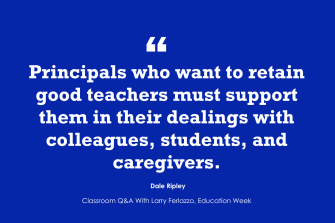
Besides ensuring that teachers have the materials they need to successfully teach the curriculum, principals who want to retain good teachers must support them in their dealings with colleagues, students, and caregivers. Teachers need to know that when they are dealing with student misconduct—and doing so in ways that are ethical and within policy—that their school administrators will support them, always and without question.
Teachers also need to know that when the occasional caregiver becomes abusive or demands things that are unreasonable, their school administrators will have their backs, always and without question.
When teachers are given the resources necessary to be successful in their teaching and the support they need to deal with both student and caregiver misconduct, they have what is essential for success in the classroom. The rest is up to them.
Teachers need to be supported. And teachers who are supported are more successful in their teaching; they have fewer classroom-management issues and issues with caregivers. Overall, they are satisfied at their place of work and are able to achieve the goals they have set for themselves. They know early in the school year that they are going to feel good about their accomplishments at the end of the year because they have everything they need to be successful in their work. Their school is a great place to work. Why leave?
Thanks to Bobson, Larisa, Michelle, and Dale for contributing their thoughts!
Today’s post answered this question:
What are specific actions districts and individual schools should take to retain teachers?
In Part One, Erica Buchanan-Rivera, Diana Laufenberg, and Jehan Hakim shared their suggestions.
In Part Two, Douglas Fisher, Nancy Frey, Andrea Terrero Gabbadon, and Dennisha Murff contributed their ideas.
I shared some ideas in Part Three.
In Part Four, Carissa McCray,, Craig Aarons-Martin, Amanda Muffler, and Lauren Arzaga Daus offered their responses.
In Part Five, Jen Mott, Renee Jones, Joseph Jones, T.J. Vari, Connie Hamilton, and Abby Baker shared their answers.
Consider contributing a question to be answered in a future post. You can send one to me at lferlazzo@epe.org. When you send it in, let me know if I can use your real name if it’s selected or if you’d prefer remaining anonymous and have a pseudonym in mind.
You can also contact me on X at @Larryferlazzo or on Bluesky at @larryferlazzo.bsky.social
Just a reminder; you can subscribe and receive updates from this blog via email. And if you missed any of the highlights from the first 13 years of this blog, you can see a categorized list here.


