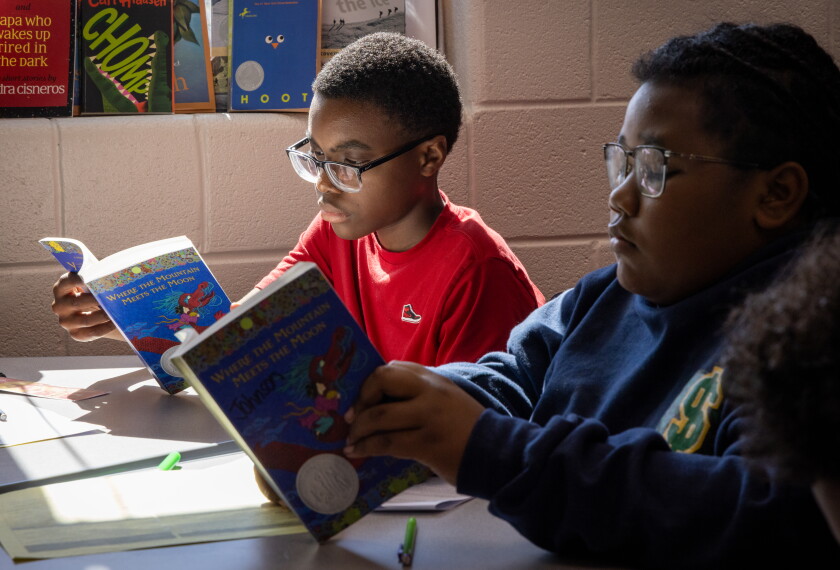
Most Fridays, Mary Lee Hahn, a 5th grade English and language arts teacher at Wright Elementary School in Dublin, Ohio, has her students pick a poem and recite it to the class. She’s been doing this with her students for the past six years. Early in the school year, she starts by picking one or two of her favorite poems to share with the students, and then she gradually increases their comfort with poetry by having them give their own oral presentations.
The idea behind the activity is that pausing once a week to reflect on poetry, even if only for five minutes, can keep the genre from getting lost amidst other instructional demands.
As schools shift to the Common Core State Standards, which require more nonfiction reading than most students have traditionally been doing, many teachers are saying they feel compelled to cut imaginative literature from their curricula. And often, the least intrusive place to start is poetry.
But poetry-enthusiast teachers like Hahn contend there’s no need to give up the genre. “If you dig into the [standards], you’ll realize that the standards are a road map, not an exact program you must follow,” said Hahn, a contributor to The Poetry Friday Anthology (Common Core K-5 edition): Poems for the School Year With Connections to the Common Core, a book by Sylvia Vardell and Janet Wong. “The choices I make for the actual delivery of the standards are mine,” she said.
Read additional stories from our Common-Core Instructional Opportunities package.
According to Hahn, poems can work well for meeting standards such as comparing and contrasting texts or understanding metaphors and similes.
“Poetry reading is a skill that students need to know,” said Hahn. Among other things, it can help with their vocabulary development, close reading, understanding of metaphorical language, and ability to process meaning from text, she emphasized. Critical reading of complex texts is another emphasis of the new standards.
Vardell, who co-wrote The Poetry Friday Anthology and regularly conducts teacher workshops on poetry instruction, also said the notion that the common standards require teachers to limit their use of poetry is “misinformed,” since poetry reading is included in the standards. She thinks that people who haven’t read the standards are just focusing on the buzz around the nonfiction requirements. But the nonfiction emphasis doesn’t mean that other all other types of literature need to downplayed, she argued.
“Some teachers might say to themselves, ‘How do I teach poetry to these wiggly 3rd graders, and cover these mandated standards at the same time?,’ but the two are not mutually exclusive,” said Vardell. Once teachers read through the standards, they see for themselves how the core focuses on literature in many forms, she said. “In addition, the standards emphasize cross-genre connections, so we have to include more than one genre to make connections.”
Georgia Heard, a poet and the author of Poetry Lessons to Meet the Common Core State Standards, contended that there are even ways to incorporate poetry into the teaching of nonfiction. For example, if a class is learning about World War II, she said, a teacher can find poems from the time period that personalize a battle or recount developments.
Heard works with schools that have created packets of themed poetry anthologies, including poems for several different disciplines, like history or science. Because of time constraints, some teachers might introduce a poem only on Fridays or every other week, she said, but they can still make the effort to devote some time to poetry and have their students write responses to the poems.
Poetic License
Heard pointed out that the common-core standards also touch on every “poetic craft tool” that students need to learn about, from sensory tools like imagery, sensory, simile, and metaphor to musical tools such as rhythm, meter, alliteration, rhyme, and repetition.
She is disappointed, however, that the standards only highlight particular poetic devices in each grade. The “danger” in that, she said, is that teachers could put too much emphasis on the devices assigned to their grade level and neglect to include the many others. For example, the standard for 2nd grade calls for teaching how regular beats, alliteration, and repeated lines supply rhythm and meaning in a story, poem, or song. But, Heard said, these concepts are not mentioned again in the common-core standards until the 7th grade.
She recommended that teachers “keep teaching things like meter and verse in other grades, even if it’s not highlighted in the standard for their grade level.”
In addition, Heard said that while the common-core standards do a “good job of looking at word relationships and craft and structure,” they neglect the importance of discussing the emotion and “heart” of a poem. “You can’t throw out the other piece, the passion in a poem,” said Heard. “They have to go together for it to work. It’s like [how] if you only teach grammar, you lose the life of a sentence.”
Finally, Heard acknowledged that she wishes poetry writing had been included in the standards. “Teachers will miss an opportunity to teach a powerful form of voice, and to teach students how to express their feelings,” said Heard.
Ohio elementary school teacher Hahn is not deterred, though. She’s already had her 5th graders write short poems during writing workshops this year. And with poetry month coming up in April, Hahn said she might have her students take a break from oral presentations and try their hand at writing their own haikus. “I might challenge them to join me in writing a poem a day,” she said.