
Special Education Video

How One School Fosters Belonging for Students With Disabilities

By Caitlynn Peetz Stephens — May 30, 2024 3 min read
  • Save to favorites
  • Print

Fostering a sense of belonging in school takes a lot of intentional effort, especially when it comes to students with disabilities, who have traditionally been excluded from many mainstream classes and activities.

That’s according to a principal who has dedicated her career to that cause.

Cathi Davis, principal of Ruby Bridges Elementary School in Woodinville, Wash., near Seattle which opened in 2020, runs a school that is designed so students with disabilities spend nearly all of their time in general education classes learning alongside their peers, rather than being pulled out for specialized instruction.
See Also

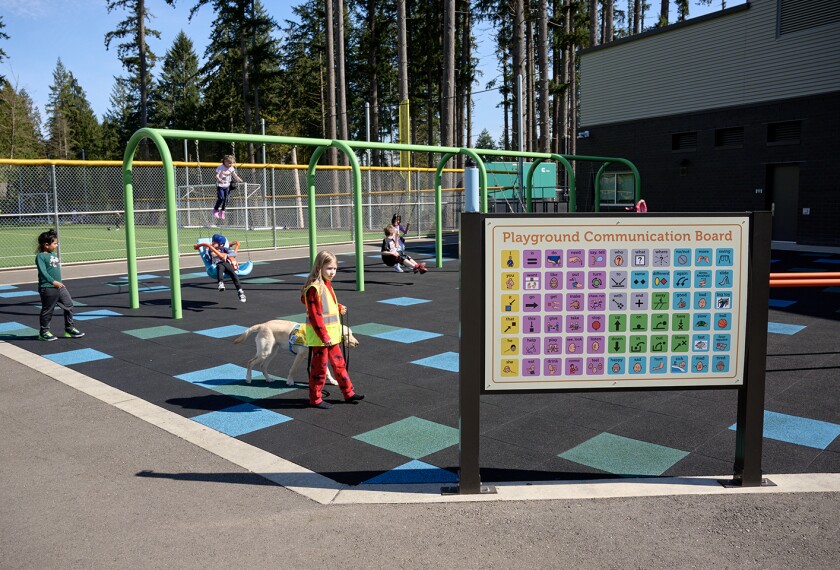
During recess at Ruby Bridges Elementary School in Woodinville, Wash., students have cards with objects and words on them so that all students, including those who cannot speak, can communicate. Pictured here on April 2, 2024.
During recess at Ruby Bridges Elementary School in Woodinville, Wash., students have access to cards with objects and words on them so that all students, including those who do not speak, can communicate. Pictured here, a student who has been taught how to lead and use commands with a campus service dog does so under the supervision of a staff member on April 2, 2024.
Meron Menghistab for Education Week

It’s one of 16 schools in Washington state that partner with the Haring Center for Inclusive Education at the University of Washington with the goal of demonstrating that all students benefit when schools are intentionally designed with the needs of students with disabilities at the forefront.

“We did a lot of planning to think about how we could really facilitate an opportunity for students to see themselves throughout the school, and to know that we thought of them in the design of the school,” Davis said during a webinar hosted by Education Week on May 23. “Really, that was less about architecture—that wasn’t about paint, that wasn’t about the parking lot. It was about our mindsets and our heart work that we were doing as a staff to think about how belonging could come off the page for each and every student.”

The approach diverges from the traditional K-12 education model through which students with Individualized Education Programs, or IEPs, are pulled out of classes with their peers into separate settings where they receive individualized or small-group instruction.

Ruby Bridges’ approach helps students with disabilities form relationships with their classmates and others in their school, and helps general education students build empathy and compassion. Several studies over the years examining these more inclusive practices have found either neutral or positive effects on all students’ performance in core subjects like math and reading.

“We know that all students benefit from that general education access,” Davis said. “We know learning’s not linear, and I think more and more we understand that our students are more engaged when learning is tailored to fit their needs and their strengths.”

See Also

Image of a group of students meeting with their teacher. One student is giving the teacher a high-five.
Laura Baker/Education Week via Canva

In Ruby Bridges classrooms, all students have access to supports traditionally outlined in students’ IEPs or 504 plans, like the ability to take breaks when feeling overwhelmed, or the opportunity to learn in a small group with the teacher, while others might work independently on a tablet with headphones on.

During one recent phonics lesson she was observing, Davis recalled one student who was participating in a group lesson, but was bouncing on a trampoline at the same time to help regulate their senses.

“It’s that sense of truly being welcomed into a community, not like, ‘You get to be here, too, but over there,’” Davis said. "…But rather, we are all being together and kind of framing our identity around what that means for us.”

One of the keys to how Ruby Bridges works is its staffing model, which emphasizes collaboration.

For example, rather than having a designated paraprofessional assigned to each student who needs extra support, paraprofessionals work with different students all the time, meaning they could be providing math support in the morning and teaching phonics lessons to English learners in the afternoon.

In practice, the adults in the school are encouraged and required to work together to support students’ learning. “No one person is independently trying to support all of the learning of any one student,” Davis said.

See Also

At Ruby Bridges Elementary School in Woodinville, Wash., special education students are fully a part of the general education classrooms. What that looks like in practice is students together in the same space but learning separately – some students are with the teacher, some with aides, and some are on their own with a tablet. Pictured here on April 2, 2024.
A student works with a staff member at Ruby Bridges Elementary School in Woodinville, Wash. on April 2, 2024. Special education students at the school are fully a part of general education classrooms.
Meron Menghistab for Education Week

“We’re looking at, what do kids need in this moment to be successful in their learning, and how do we support that best with the right person at this time?” Davis said. “How can we collectively share the load?”

For more on the discussion of creating communities of belonging for all students—including those with disabilities—and its academic and social benefits, check out the video above and Education Week’s recent special report about building strong student-school connections.

Events

This content is provided by our sponsor. It is not written by and does not necessarily reflect the views of Education Week's editorial staff.
Sponsor
College & Workforce Readiness Webinar
Smarter Tools, Stronger Outcomes: Empowering CTE Educators With Future-Ready Solutions
Open doors to meaningful, hands-on careers with research-backed insights, ideas, and examples of successful CTE programs.
Content provided by Pearson
Reading & Literacy Webinar Supporting Older Struggling Readers: Tips From Research and Practice
Reading problems are widespread among adolescent learners. Find out how to help students with gaps in foundational reading skills.
This content is provided by our sponsor. It is not written by and does not necessarily reflect the views of Education Week's editorial staff.
Sponsor
Reading & Literacy Webinar
Improve Reading Comprehension: Three Tools for Working Memory Challenges
Discover three working memory workarounds to help your students improve reading comprehension and empower them on their reading journey.
Content provided by Solution Tree

EdWeek Top School Jobs

Teacher Jobs
Search over ten thousand teaching jobs nationwide — elementary, middle, high school and more.
View Jobs
Principal Jobs
Find hundreds of jobs for principals, assistant principals, and other school leadership roles.
View Jobs
Administrator Jobs
Over a thousand district-level jobs: superintendents, directors, more.
View Jobs
Support Staff Jobs
Search thousands of jobs, from paraprofessionals to counselors and more.
View Jobs

Read Next

Special Education Letter to the Editor Aligning General and Special Education for Student Success
Involving all educators can make a big difference.
1 min read
Education Week opinion letters submissions
Gwen Keraval for Education Week
Special Education What a New Dyslexia Definition Could Mean for Schools
An updated definition put forth by an international group of researchers could identify more students.
5 min read
Students in the online blended learning class at the ALLIES School in Colorado Springs, Colo., work with programs like ST Math and Lexia, both created for students with dyslexia, on April 7, 2023.
Under a new definition, students wouldn't need to have "unexpected" learning gaps to be identified for dyslexia services. Students in the online blended learning class at the ALLIES School in Colorado Springs, Colo., work with literacy programs created for students with dyslexia, on April 7, 2023.
Jaclyn Borowski/Education Week
Special Education Parents Should Continue to File Disability Rights Complaints, Say Special Ed. Advocates
Continuing to file them puts pressure on the Ed. Dept. to enforce special ed. laws.
4 min read
Image of a hand raising a red flag.
DigitalVision Vectors
Special Education Fragmented Federal Education Plan Could Harm Students With Disabilities, Advocates Warn
Parceling out Ed. Dept. work to other agencies risks weakening enforcement of disability rights laws, groups warn.
5 min read
Human hands surrounded boy reading book with kindness.
iStock/Getty
