

Explicitly teaching students social-emotional skills, like social awareness and goal-setting, can lead to stronger relationships, academic gains, and a greater sense of well-being, research shows.
Experts say that may be especially true for students with disabilities—but they’re not always considered when schools are designing or implementing SEL curricula.
That’s a missed opportunity, given that most students with learning differences spend the majority of their time in general education classrooms. It’s also a critical disconnect because SEL instruction often targets skills that these learners might especially need help with, like self-regulation, remaining resilient in the face of mistakes, and advocating for themselves.
“Oftentimes, students with learning disabilities have had negative experiences with schooling to date because they have struggled with academics or with reading or with math,” said Nicole Fuller, the associate director of policy and advocacy at the National Center for Learning Disabilities, a nonprofit that advocates for equal opportunities for students and young adults. “Enabling them to see the growth that they’ve made or that they can continue to make is really critical. And social-emotional learning is a critical piece in doing that.”
Social and communication skills can also be difficult for students with learning or attention disorders to master. Children with attention deficit hyperactivity disorder, for instance, might have a hard time listening without interrupting, waiting for their turn to speak, or controlling their impulses. Students with a nonverbal learning disorder or autism might miss jokes or social cues. Students with dyslexia might struggle to retrieve the right words in conversation, which could lower their confidence in social settings and make them hesitant to speak up.
SEL emphasizes these social- and self-awareness and relationship skills, a focus that can help both students with disabilities and without better relate to each other.
“We know inclusion of students with disabilities in public schools is so important,” Fuller said, “and fostering the ability to do that through social-emotional learning really does help students to develop a sense of belonging.”
Yet, how well SEL programs and curricula incorporate the needs of students with learning differences is unclear. Students with disabilities are underrepresented in the research on SEL programs, according to a meta-analysis, in which researchers reviewed 269 studies on elementary school SEL programs and interventions from 2008 to 2020.
While just 4.1% of the studies explicitly excluded students with disabilities, most studies didn’t explicitly include them, either. Only 7.4% of the studies reviewed looked at how SEL-intervention outcomes differed for students with disabilities or specifically focused on intervention effects for these learners.
“That is concerning,” Fuller said. “When you are studying curriculum, when you are studying programs and interventions, how do you know that it works for all students?”

And data on the social outcomes for students with disabilities suggest they might not be getting as much help as they need.
For instance, in 2024, the National Center for Learning Disabilities surveyed a national sample of young adults (ages 18 to 24) with learning differences about their high school experiences. Half of them reported being bullied by a peer because of their disability. Young adults who experienced bullying were more likely to leave high school before graduation or think about dropping out.
“Those kind of findings do really underscore the need for social-emotional learning,” Fuller said. “In terms of what happens if we’re not implementing programs effectively or designing them with students with disabilities in mind—these are the kind of outcomes that we’re trying to move away from.”
Exposing students with disabilities to broader, holistic skills isn’t just important to support their social development. It can also help put them on track for success in college and in their careers, she said.

What noninclusive SEL can look like in classrooms
In order to make SEL programs and curricula truly universal or inclusive, they must incorporate a degree of flexibility in what’s being taught, and how, said Christina Cipriano, an associate professor at the Yale Child Study Center in the Yale School of Medicine and the lead author of the meta-analysis.
For example, “emotional regulation is taught across nearly all SEL programs, but ... there’s a huge range in what profiles of regulation can look like,” Cipriano said. “When you take a student who has an [individualized education program] or a 504 [plan] and has a different way of regulating their emotions, and we put them in a program that maybe isn’t teaching their way of regulating emotions, or even acknowledging or affirming their regulation as acceptable—this is where we run into a problem.”
Typically, a teacher teaching emotional regulation might encourage taking a deep breath, silently counting to 10, or practicing a brief meditation—activities that can be done while sitting quietly. But a student with autism or ADHD might need to move their body, or fidget, to self-regulate, she said. And that’s OK, too.
Another disconnect may come when educators are designing activities. Many SEL programs include practice on how to speak freely, without preparation—say, by giving a prompt in a “turn and talk” or asking students to go around the circle to share something.
In a general education classroom, a student with anxiety sitting in that circle may have “nothing to say by the time we get to them,” Cipriano said. “And that’s not a meaningful learning experience.”
Similarly, a student with executive function challenges who’s being given a prompt in a classroom discussion for the first time and then is told, “OK, go ahead, talk about it,” may struggle to immediately articulate their experiences—or listen to what a partner in class is doing, Cipriano said. The activity, she said, is “setting them up at a disadvantage.”
‘Everybody needs coping skills’
At the Girls Athletic Leadership School, or GALS, in Denver, a public all-girls charter middle school, the social-emotional programming was designed with the needs of students with learning differences at the forefront, said Leah Bock, the head of school.
When designing SEL curricula, “it’s going to go better if you realize that no two people are the same and no two people have the same needs,” Bock said. “You have to design with: What is your [desired] outcome, and then am I going to get there?”
That means figuring out first how educators are going to support the students with the most significant needs, and then considering how they can also help students who already have some skills but need to deepen their understanding.
“And how can I do both of those things at the same time in a classroom and still foster a sense of community and inclusiveness?” Bock said.
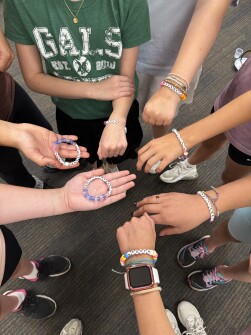
Differentiation is key. At GALS, the school psychologist often co-teaches SEL courses with general education teachers to make sure the skills being taught and modeled are appropriately differentiated for students with disabilities.
For example, Bock pointed to a goal-setting lesson that’s centered around running a mile. Some more athletic students might set a goal to run a mile in a certain number of minutes. But educators should work with other students—including those with physical disabilities or a mental block against running—to help them set a more attainable goal, like running a certain distance before stopping.
It has also helped for all the school’s teachers to develop a common language around social-emotional skills, Bock said, which they do through frequent collaboration between general education and special education teams.
Take a 6th grade SEL course that teaches self-awareness and respecting boundaries, which some students with learning differences need more help with. The lessons are reinforced when all teachers give feedback in the same way, Bock said—like, “Please take two steps back, so I can protect my personal space,” or “I love how Imani saw that I was on my computer and decided to not come up and talk to me.”
All students, in Bock’s view, need social-emotional support. And students with disabilities benefit from receiving those lessons in general education classrooms because then they’re not getting a message that “something’s wrong with you,” the Denver school leader said.
“You need to learn this coping skill—everybody needs coping skills, right?” Bock said. “Yours might be a little different than theirs, but that’s true for everybody.”


