

Vice President Kamala Harris and other Democratic candidates would push for universal prekindergarten, expanded career and technical education, a reduced emphasis on standardized testing, and efforts to improve teachers’ working conditions if elected later this year.
Delegates to the Democratic National Convention voted to approve the party’s 2024 platform on Monday, the opening day of the party’s four-day gathering in Chicago. The platform doesn’t veer from the Biden administration’s approach to K-12. In fact, it passed without Democrats updating the document to reflect that Harris has replaced President Joe Biden as the top name on the ticket.
Many of the U.S. Department of Education’s initiatives under Biden, which have shown up in the president’s budget proposals in various forms for the past four years, are reflected in the platform’s education section.
It nods to building up social-emotional supports at schools and tackling chronic absenteeism, as well as providing intensive tutoring and after-school and summer learning. It also calls for investments in the community schools model through which schools provide on-site health and social services to students and families.
The platform contrasts starkly with the Republican Party’s 2024 platform, which calls for universal school choice, expanding parental rights over education, ending teacher tenure, and prohibiting transgender girls from playing girls’ sports.
The DNC platform calls on Democrats to oppose private school choice, claiming such programs “divert taxpayer-funded resources away from public education.” It also calls for charter schools, which are publicly funded but privately run, to be held to the same public transparency standards as traditional public schools.

Historically, K-12 education has not played a decisive role in presidential elections, as it is an issue largely regulated at the state and local levels. But the 2024 party platforms give voters a sense of what policies elected officials might champion once in office.
Here’s a breakdown of the key parts of the Democrats’ education agenda.
The platform highlights strategies schools have used to reverse historic declines in academic achievement
The platform refers to a number of the strategies schools have used to counter students’ academic slide following pandemic-era building closures, largely with the help of $190 billion in COVID-19 relief funds.
The document cites the expansion of social and emotional supports for students, efforts to fight chronic absenteeism that is still higher than it was pre-pandemic, and investments in intensive tutoring. While it celebrates those strategies, largely decided on by districts at the local level, it doesn’t propose any specific policies for maintaining and expanding them, particularly once the last round of federal relief funds expires on Sept. 30.
The platform also calls for full funding of the Individuals with Disabilities in Education Act. When the federal government first mandated special education services in K-12 schools with the 1975 Education For All Handicapped Children Act, Congress promised to gradually increase investments to ultimately cover 40 percent of the nation’s average per-pupil expenditure for public schools to pay for special education.
Congress has never met that benchmark, falling billions of dollars short annually, but IDEA funding has increased over time. Since Biden took office, annual IDEA funding has increased by 10 percent, or $1.3 billion, according to the administration’s 2025 budget request.
The Democratic platform also calls for improved education for English learners and expanded multilingual education, which has been a top priority for Education Secretary Miguel Cardona. Biden requested $940 million, an increase of $50 million, for the federal English Language Acquisition program, and $72 million to help schools hire bilingual teachers in his 2025 budget proposal. Bilingual teaching positions are some of the hardest for school districts to fill.
Democrats call for rethinking standardized testing
The platform calls on Democrats to help “schools to lift student achievement, rather than punishing them based on state standardized tests,” and further argues for “efforts to provide more timely, well-rounded, actionable feedback on student learning and progress to educators and to families that will support instruction and student success, while upholding rigorous academic standards.”
The policy agenda is a departure from the No Child Left Behind era’s focus on standardized testing for school accountability and reflects the Biden administration’s overall attitude that standardized tests should be merely one measure of school performance, not the determining factor.
In a 2023 speech, Cardona argued that standardized tests should be “a flashlight” on what works in education rather than “a hammer” to force outcomes, but the Biden administration hasn’t made any significant policy moves to reduce federal standardized testing requirements. Such a shift is a policy priority for teachers’ unions—the American Federation of Teachers passed a resolution to “end over-testing in schools” during its annual convention in July.
But many civil rights organizations and advocates, including Sen. Patty Murray, D-Wash., and Rep. Bobby Scott, D-Va., architects of the Every Student Succeeds Act that replaced No Child Left Behind, have insisted that federal standardized testing is necessary to hold schools accountable.
The DNC platform doesn’t go into specifics on how Democrats should tackle standardized testing policy.
The platform calls for better working conditions for teachers
The DNC platform refers to teachers, education support professionals, paraprofessionals, and all other school personnel as “the heart and soul of our communities.”
In general terms, the party pledges to recruit more teachers, paraprofessionals, and other educators by expanding high school training programs and raising teacher pay. (The platform also touts the Biden administration’s student debt relief efforts’ effects on teachers.) The platform doesn’t call for a minimum annual teacher salary or back specific teacher pay legislation, but bills from Sen. Bernie Sanders, I-Vt., and Rep. Frederica Wilson, D-Fla., that push for a $60,000 minimum teacher salary are pending in Congress.
When campaigning for president in 2020, Harris called for a $13,500 raise for every teacher.
“And what is [a teacher’s] job? The most noble work of teaching other people’s children, and God knows we don’t pay you enough as it is,” Harris said during a speech at the AFT convention just days after she rose to the top of the Democratic ticket.

The platform shines a spotlight on an area of bipartisan agreement: career and technical education
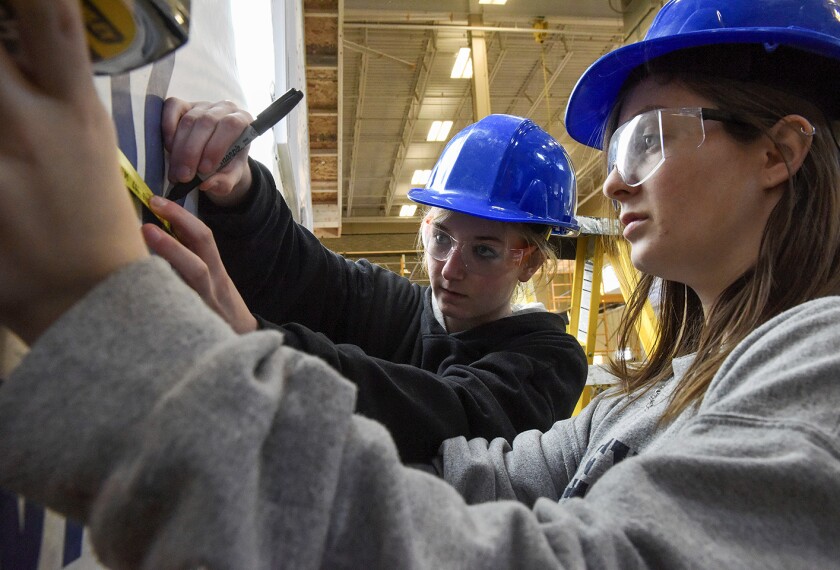
In an acknowledgment that "[f]our-year college is not the only pathway to a good career,” the platform calls for an expansion of career and technical education, including job-training partnerships involving high schools, local businesses, and labor unions, to prepare students for in-demand industries. It also proposes making trade school and community college free for all Americans and investing in registered apprenticeships to train students for jobs in in-demand industries.
Of all education issues, career and technical programs have historically had significant bipartisan support. Expanding career education has also been a major focus for Rep. Virginia Foxx, R-N.C., who chairs the House’s committee on education and the workforce, and members of both parties have signed onto legislation proposing to expand career education.
The agenda includes a continued push for universal pre-K
The DNC platform calls for free, universal preschool for 4-year-olds across the country, something Biden has pushed for since he took office.
In 2021, he proposed the $1.8 trillion American Families Plan, which would have extended pre-K access to all 3- and 4-year-olds, relying on federal-state partnerships. That plan didn’t pass, however.
Biden tried again with different variations of the proposal in his 2024 and 2025 budget proposals, neither of which passed as proposed.
Universal pre-K has gained momentum on the state level in recent years, with state programs taking a number of different forms, relying on private and public settings and incorporating parent choice.
As of the 2022-23 school year, 14 states and the District of Columbia had passed universal pre-K policies, meaning that funding would allow all 4-year-olds to access pre-K, according to the National Institute for Early Education Research. Only six of those states—Florida, Iowa, Oklahoma, Vermont, West Virginia, and Wisconsin, as well as the District of Columbia—had fully implemented such programs by that time.


