

Former U.S. Secretary of Education Betsy DeVos can’t wait to see a second Trump administration finish what she helped start.
DeVos, a billionaire philanthropist and veteran school choice activist, joined former President Donald Trump’s Cabinet after a historically grueling confirmation process that required Vice President Mike Pence to cast a tie-breaking vote in her favor. She hoped to help him deliver on a dramatic proliferation of school choice and a major rollback of the federal education bureaucracy.
But the first Trump administration saw only modest progress on both fronts. And DeVos—who’d notched major policy victories as the founder of the American Federation for Children, a school choice advocacy organization—became a political lightening rod who faced so many threats of physical violence that she became the first education secretary to be given the protection of federal marshals.

DeVos resigned early from Trump’s cabinet on Jan. 7, 2021, citing the president’s role in inciting a mob to storm the U.S. Capitol and disrupt its certification of President Joe Biden’s victory the day before.
But nearly four years later, she said in a wide-ranging interview with Education Week that she sees huge potential for a new Trump term to finally bring about the changes to K-12 policy she’s pursued for decades—inside government and out.
This conversation has been edited for clarity and brevity.
The beginning of Trump’s first term looked like a big moment for school choice. But ultimately, there was only a modest legislative movement. Why was that? Do you expect things to be different in his second term?
I think the second Trump term agenda is very, very consistent with what we started. It’s a continuation of the first term.
We got as much as possible done to advance the notion of school choice federally, given the construct of Congress. Democratic majorities absolutely closed off their ears when we even began to talk about that subject.
This really is an opportunity to advance that federal tax credit because there is so much more support for it today, certainly among Republican members, but just broadly. The pandemic really did change and open people’s eyes to what schools were really like and how they weren’t working for so many kids.
[Note: Republicans held both chambers in the first two years of Trump’s first term, but the Senate was only narrowly under GOP control. The U.S. House of Representatives flipped to a Democratic majority after the 2018 mid-term election.]
It wasn’t just Democratic opposition, right? During Trump’s first term there was opposition among Republicans to a federal school choice program because they saw it as an expansion of the federal role in education, even though it would have been in support of a policy they favored. Has that shifted?
There was a nascent effort to get a federal tax credit into tax overhaul legislation. There, frankly, wasn’t enough support within the Republican caucuses then.
The environment is completely changed.
I think more members of Congress and [their staff] are more informed about what education freedom really is, and what it means, and how it can actually be implemented through a federal tax credit, not creating any new federal bureaucracies or departments or agencies or anything.
And many [lawmakers] have seen massive changes in education. Education freedom programs advanced in their own states, and they’re beginning to see the fruit of that.

What else do you see rising to the top of Trump’s second-term K-12 agenda?
Let’s talk about fixing Title IX. The rule that we passed has withstood legal challenges. The rule that the Biden administration has tried to force on everyone has been enjoined in more than half the states and has thrown a lot of things into chaos.
Normal people across the country are scratching their heads at the issue of men in women’s sports and in women’s private spaces [such as locker rooms and bathrooms].
Just a couple of years ago people said [of transgender athletes in women’s sports], “Oh, that’s not really happening. That’s not really a thing.”
Well, no. Yes, it is really a thing. We’ve seen it continue to proliferate in ways and places that nobody ever would have thought possible.
The second Trump administration needs to clarify these issues promptly and put an end to allowing this invasion into women’s sports.

And the FAFSA process needs to be completely reimagined. That has been a disaster. It’s been horrible for the students and families, particularly the lower-income families who’ve been most harmed because of the absolute ineptitude of this administration in that process.
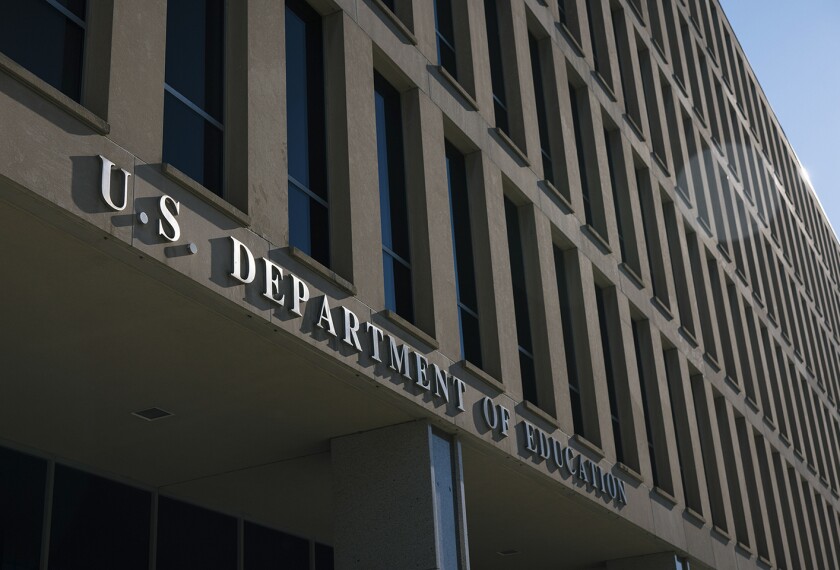
Another Trump proposal is getting rid of the U.S. Department of Education. That’s been historically difficult. Could Trump actually make it happen?
Let’s just say, four decades of data show us that all this federal intervention does not work, has not worked. I think more and more folks today are realizing that than they did [when Trump took office], and I think it’s ripe for discussion about how that happens and how the Department of Ed. is de-powered.
That’s not saying education is not important, that we do not want to support education. On the contrary, we want to empower state and local leaders to be able to use the resources most effectively and to target them in the ways that are going to work best for students in their state or their local district.
The federal Department of Education has not worked for students. It’s worked for political interests, but it has not worked for students.
You resigned from Trump’s Cabinet after Jan. 6, citing the president’s role in inciting a mob to disrupt congressional certification of President Joe Biden’s victory. Can you talk about any fears you might have about how a second Trump term will impact the future of democracy?
I think President Trump in his second term is going to do a great service and great things to focus on families and students.
If you recall, my resignation was specifically out of concern for putting myself in the seat of young kids and families. There was an opportunity to lead in a different way, to say things at more opportune times. I felt strongly that we had accomplished many good things, and that we should be talking about those things as we left office.
I know that President Trump has a heart for America and Americans. And he has a very tender heart for kids and families who want the best for their kids.
Would you want to serve as his secretary of education again?
I have been really clear about what I think needs to be the agenda, which is to get the federal tax credit passed and to de-power the Department of Education. If President-elect Trump wanted to talk to me, I would be very open to talking.
But I think there’s also a lot of folks [who could do the job well].
I think about an ideal secretary of education, what their experience might be. A governor who’s led in their state on education reform issues. That would be a very good profile. Someone who could do the things that need to be done, could come in and hit the ground running. The federal Department of Education is a labyrinth, a maze, and I think someone who has accomplished real reforms on a state level would be really fit and suitable for that position.

Do you want to throw out a name?
I don’t want to throw out a name, though I have several in mind. I know that there are a number of governors and former governors who have really done important work and who would have the vision for what needs to happen, and the ability to tackle all of the intricacies of the department very quickly.
What would your No. 1 piece of advice be for this incoming secretary?
My No. 1 piece of advice would be to champion getting the federal tax credit done and look for every single way to de-power the Department of Education by empowering state and local leaders. Get Title IX clarified and fixed, and address the student-lending FAFSA debacle.
What would you tell that person to do if they faced angry crowds, the way you often did?
Change is hard. You just have to be willing to deal with the noise and stay focused on the vision for students.


