School & District Management

How Principals Can Boost Teacher Morale

By Olina Banerji — May 15, 2025 4 min read
Vector illustration of a large handing holding an open book with silhouetted women and men standing on the pages of the open book.
  • Save to favorites
  • Print

The teacher role has changed drastically in recent years. They teach in more diverse classrooms where they deal with a multitude of student needs. To add to that, now, are concerns about how federal funding cuts and policy changes will affect the classroom.

It can be hard for principals to boost teacher morale through such uncertain times and make sure they are supporting—and retaining—their teachers.

Still, some principals, like Mary Pat Cumming, feel like they’ve turned a corner when it comes to teacher morale, which hit an all-time low during the pandemic. “Our autonomous nervous systems have relaxed. We aren’t living in a fear-based mode anymore,” she said, speaking at Education Week’s Virtual Leadership Symposium on May 6.

Cumming is the principal of FAIR High School in Minneapolis. Even with state and district budget cuts on the horizon, she is confident that her close-knit group of teachers will keep showing up for their students.

Cumming’s perception aligns with the EdWeek Research Center’s Teacher Morale Index, which jumped to +18 this school year, up from -13 last year. The index is on a scale of -100 to +100, and this year’s score suggests that teachers, overall, now view their jobs more favorably.

James Allrich, the principal of Argyle Middle School in Layhill, Md., and a fellow speaker on the panel, said principals can weather dips in teacher morale if the overall culture of their schools feels supportive to teachers. Longevity plays a role here.

“We have a consistent group. Several staff have been with me since I started [a decade ago]. Having that kind of group helps a lot,” Allrich said. The veteran teachers often become advocates on behalf of the school and the administration to newer teachers, who may struggle with a new environment or rules.

If a teacher is facing a challenge or feels as if they can’t go to the principal with a problem, having older teachers “vouch for you” is a good indicator of positive teacher morale, Argyle said. “If they say to new teachers, ‘He’s OK, just give him a try. Just go talk to him,’ that’s a game changer.”

Principals need a trusted liaison

Not all schools, though, are able to retain a consistent set of teachers. Teacher turnover, while down from the peak of the pandemic, can affect a school’s climate and culture. The main challenge with an influx of new staff members is that they don’t get the same amount of time to build trust with their principals, said Allrich and Cumming.

Although some principals choose to have an open-door policy, the panelists said, they must stay aware of how their staff sees them—as authority figures who frequently evaluate their performance.

“Administration is not a neutral position because principals are evaluators. Sometimes, teachers have new ideas or just need help with things, … but they don’t want to tell their evaluators because it’s connected to their job security,” said Sara Ullmer, an instructional coach and health teacher at FAIR School.

Instead, it can be helpful for teachers to take their ideas and concerns to a liaison or a “go-between” like Ullmer.

See also

The concept of joint teamwork, building a team. Working people connecting pieces of puzzles. Metaphor of cooperation and staff partnership.
Anastasiia Boriagina/iStock

Ullmer’s been in that role for over three years and helps teachers access the resources or advice they need, for instance, to manage their classrooms better.

She is also a conduit of information for Cumming and can push back against administrative policies she thinks teachers won’t get on board with.

Go-betweens like Ullmer can also help teachers see the bigger picture and better understand the principal’s role.

“I am in more conversations about what’s happening at the school level. I can tell teachers to step up and stop complaining because I can explain why this [policy or directive] is important for the school,” Ullmer added.

Principals can model modes of well-being

It’s important that principals lead by example when it comes to well-being, the panelists said. Allrich said he makes time during lunch every day for teachers who may want to share an idea or challenge with him. He has also created a staff well-being room where teachers can take a few minutes to refresh if they’re feeling overwhelmed.

Allrich also instituted a system where teachers can “tap out” in the middle of a class by informing the front office.

“Teachers can let us know online if they need a break or need some support during a class,” he said. An administrator will come to relieve them.

Allrich said he uses the same strategy to tap out when he feels overwhelmed and is open about it with his teachers. If teachers see that principals also need a break, or make mistakes, they may feel more at ease to share their own problem or a new idea, he added.

Finally, a simple way to boost teacher morale is to praise their work, Ullmer said.

“We need to hear good things we’re doing because our kids don’t always tell us,” she said. “We’re talking about budget cuts, but giving praise to staff is free. They are willing to step up then.”

Events

This content is provided by our sponsor. It is not written by and does not necessarily reflect the views of Education Week's editorial staff.
Sponsor
Special Education Webinar
Bridging the Math Gap: What’s New in Dyscalculia Identification, Instruction & State Action
Discover the latest dyscalculia research insights, state-level policy trends, and classroom strategies to make math more accessible for all.
Content provided by TouchMath
This content is provided by our sponsor. It is not written by and does not necessarily reflect the views of Education Week's editorial staff.
Sponsor
School Climate & Safety Webinar
Belonging as a Leadership Strategy for Today’s Schools
Belonging isn’t a slogan—it’s a leadership strategy. Learn what research shows actually works to improve attendance, culture, and learning.
Content provided by Harmony Academy
This content is provided by our sponsor. It is not written by and does not necessarily reflect the views of Education Week's editorial staff.
Sponsor
School & District Management Webinar
Too Many Initiatives, Not Enough Alignment: A Change Management Playbook for Leaders
Learn how leadership teams can increase alignment and evaluate every program, practice, and purchase against a clear strategic plan.
Content provided by Otus

EdWeek Top School Jobs

Teacher Jobs
Search over ten thousand teaching jobs nationwide — elementary, middle, high school and more.
View Jobs
Principal Jobs
Find hundreds of jobs for principals, assistant principals, and other school leadership roles.
View Jobs
Administrator Jobs
Over a thousand district-level jobs: superintendents, directors, more.
View Jobs
Support Staff Jobs
Search thousands of jobs, from paraprofessionals to counselors and more.
View Jobs

Read Next

School & District Management Opinion Why Bad Bunny’s Half-Time Performance Was a Case Study for School Leadership
The megastar’s show was an invitation in a challenging moment. Did you catch it?
3 min read
Bad Bunny performs during halftime of the NFL Super Bowl 60 football game between the New England Patriots and the Seattle Seahawks, Sunday, Feb. 8, 2026, in Santa Clara, Calif.
Charlie Riedel/AP
School & District Management Texas Leader Named Superintendent of the Year
The 2026 superintendent of the year has led his district through rapid growth amid a local housing boom.
2 min read
Superintendent Roosevelt Nivens speaks after being announced as AASA National Superintendent of the Year in Nashville, Tenn. on Feb. 12, 2026.
Superintendent Roosevelt Nivens of the Lamar Consolidated schools in Texas speaks after being named National Superintendent of the Year in Nashville, Tenn. on Feb. 12, 2026, at the National Conference on Education sponsored by AASA, The School Superintendents Association.
Kaylee Domzalski/Education Week
School & District Management On Capitol Hill, Relieved Principals Press for Even More Federal Support
With the fiscal 2026 budget maintaining level K-12 funding, principals look to the future.
7 min read
In this image provided by NAESP, elementary school principals gathered on Capitol Hill recently to meet with their state's congressional delegations in Washington
Elementary school principals gathered on Capitol Hill on Feb. 11, 2026,<ins data-user-label="Madeline Will" data-time="02/12/2026 11:53:27 AM" data-user-id="00000175-2522-d295-a175-a7366b840000" data-target-id=""> </ins>to meet with their state's congressional delegations in Washington. They advocated for lawmakers to protect federal K-12 investments.
John Simms/NAESP
School & District Management Q&A Solving Chronic Absenteeism Isn't 'One-Size-Fits-All,' This Leader Says
Proactive, sensitive communication with families can make a big difference.
7 min read
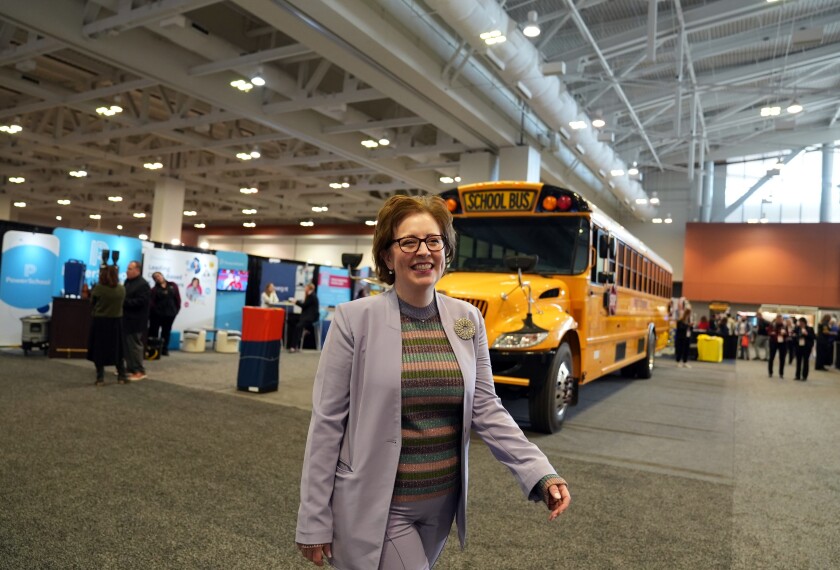
Superintendent Mary Catherine Reljac walks around the exhibition hall of the National Conference on Education in Nashville, on Feb. 12, 2026. Reljac is the superintendent for Fox Chapel Area School District in Pennsylvania.
Mary Catherine Reljac walks around the exhibition hall of the National Conference on Education in Nashville on Feb. 12, 2026. Reljac, the superintendent for Fox Chapel Area school district in Pennsylvania, is working to combat chronic absenteeism through data analysis and tailored student support.
Kaylee Domzalski/Education Week