School districts are wrestling with how to solve the problem of chronic absenteeism, which remains stubbornly higher than pre-pandemic levels despite declining slightly in recent years.
But there isn’t a one-size-fits-all solution, and a school’s response should be tailored to students’ specific needs, says Mary Catherine Reljac, the superintendent of the Fox Chapel Area school district in Pittsburgh.
Nationally, about 23% of K-12 students were chronically absent in the 2024-25 school year, meaning they missed 10% or more of school days for unexcused or excused reasons, according to a tracker by the American Enterprise Institute.

When students are chronically absent, they are less likely to do well academically, less likely to feel connected to their peers and school communities, and more likely to eventually drop out of high school. Research shows that high rates of absences even affect the students who do attend class. Many times, teachers need to repeat or review lectures to ensure all students can move forward, slowing progress for students who attend class regularly.
The top reasons students miss class are due to illness (67%), feeling down or experiencing anxiety (10%), oversleeping (9%), and being uninterested in attending (7%), according to a 2025 RAND Corp. survey of 1,300 K-12 students aged 12 and up. Recently, increased immigration enforcement activity has contributed to students staying home, too.
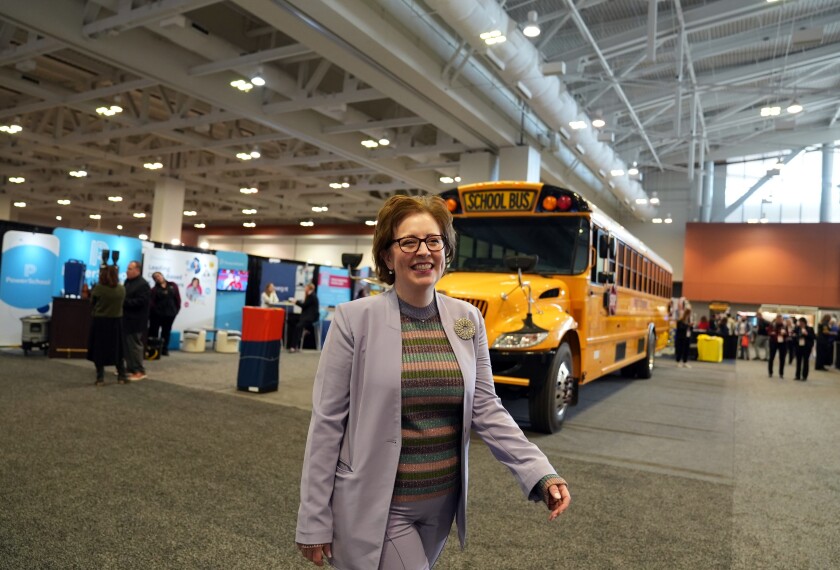
Reljac was scheduled to share the strategies her district used to tackle chronic absenteeism at the National Conference on Education, hosted in Nashville, Tenn., this week by AASA, the School Superintendents Association. In advance of her session, Education Week spoke with Relijac about how educators can best support and communicate with students and families to get them to come to school. The conversation has been edited for length and clarity.
What is your district’s approach to addressing chronic absenteeism?
To be as robust and as comprehensive as possible. We tailor our responses based on the needs of the students.
We spotlight the importance of regular school attendance for students and for their families, as well as alert our staff to be more mindful of how frequently a student may be absent from school or the reasons that could cause a student to be absent from school.
The first thing that we’ve done is to make it important for our district. I have embedded with our administrative team multiple checkpoints during the year to review attendance data. We talk about what they’re seeing as successful with their students and share [those takeaways] collaboratively across the district.
The second thing we did is make contact on a more regular basis with families whose students may be struggling with attendance and changed some of our supports that we have to try and get to the root cause of why a child is struggling with attendance.
Are there any examples where educators were able to successfully intervene if a student was chronically absent?
Often, young children miss their school transportation, and there might not be transportation from their family. Some of our educators have worked on helping a student to set alarms or to tell time. We’ve had educators who have called children in the morning to make sure that they are up on time to get ready and catch the bus.
Those small touches not only show that we care but also can make a big difference to support a child and a family as they’re trying to come to school.
At the middle and high school level, it is trying to figure out what is the difficult part of getting into school. Is it because they’ve worked late the night before? We’ve helped students to advocate for a different work schedule or [considered] how we can change their school schedule. Their first period may be something like a study hall, if that is possible, or they have a different start time. We’ve worked with them to adjust their course schedules to perhaps be online or done in a different format.

We’ve sometimes found students are having difficulties [with attendance] that aren’t related to school, but through the school resource officer developing a positive relationship with them, they’ve been able to share and then we can help them in whatever way it is available to us.
How can educators best communicate with parents when a child is frequently absent?
Educators have to communicate the importance of being in school and that they are co-collaborators with a family to help get that accomplished. Sometimes when families receive a call from educators, it may be an unsettling situation for them based on their own personal needs or what’s going on—so it has to be as nonjudgmental as possible. It has to be from a place of support, student-centered, and as creative as possible.
A good example of that is we redesigned the official attendance letters that go home. Our former letters were filled with a lot of official language and citing statutes or requirements. We felt that that may not be the most effective approach and instead we shifted the letters to be more informative.
We say: “Did you know that your student has been absent for X number of days? The typical student at your child’s school has only been absent for this number of days at this point in the year. We know how important it is for them to be there, and we miss them when they’re not there. How can we work together?”
In general, what are some common misconceptions about chronic absenteeism?
Some common misconceptions are that it’s students who are refusing to come to school, or it’s an issue that is more prevalent in a socioeconomic category or in an area of the country. I found that to be false.
We’ve learned that some students meet the criteria for chronic absenteeism, and their families may not even realize it. Students may miss a day every other week, every Friday, or around holidays. It may be a family that just doesn’t realize how quickly those add up, and the cumulative effects year after year.
What are red flags that could lead to chronic absenteeism?
We looked at our attendance data and noticed that students who are absent in the first 20 days of school are at a higher risk for becoming chronically absent as the year progresses. That’s not for every student. Some students just become ill in the first 20 days and need to be home for a day. But knowing that was a pattern that we could see over multiple years, we recognized that it was an opportunity for us to engage earlier in the cycle.
We look at the percentage of school that a child has missed every quarter of the school year, and when that percentage seems to be rather high, we do a deeper dive as a team into that student-specific pattern of attendance.
We also are looking at attendance on Mondays and Fridays, which tend to be days that are more frequently missed in our community. We’re also looking at some of the other red flags, like when we aren’t getting excuses or written documentation from families. If we’re seeing that they are reluctant to engage with us, that’s something that we try to build.
What challenges does your district still have with absenteeism?
It’s always a challenge with absenteeism to balance the requirements of students and families in school. There are things that are very disruptive in a family’s life. It’s challenging to continue to focus on attendance [when] a bigger thing is getting in the way.
Some students who have developed multiple years of chronic absenteeism patterns are very challenging to change. That’s why we then celebrate the improvements we can make, as we’re trying to take a child who’s not attending regularly and help them to attend regularly.
Being able to share information about a child that comes up in one classroom that might affect their attendance pattern but may not be evident in other classrooms—it’s a logistical challenge behind the scenes for us. It’s one we can overcome with a lot of different strategies, but that continues to be a challenge. Sometimes, someone may know that there’s more going on. Can we get that information to the right people who can then try and support it?
We’ve done some outreach with our educators to explain all of the supports that we have within the district, as well as the community partners that we work with, to give them more awareness so they can articulate when they notice a child that could benefit from some of those resources. They can advocate for them.