
Artificial Intelligence From Our Research Center

Teachers Desperately Need AI Training. How Many Are Getting It?

By Lauraine Langreo — March 25, 2024 2 min read
Illustration of AI and classroom tools.
  • Save to favorites
  • Print

Even though it’s been more than a year since ChatGPT made a big splash in the K-12 world, many teachers say they are still not receiving any training on using artificial intelligence tools in the classroom.

More than 7 in 10 teachers said they haven’t received any professional development on using AI in the classroom, according to a nationally representative EdWeek Research Center survey of 953 educators, including 553 teachers, conducted between Jan. 31 and March 4.

The survey data shows that teachers who are in urban districts, those in districts with free/reduced-price meal rates of more than 75 percent, and those who teach elementary grades are more likely than their peers to say they haven’t received any AI training.

A previous EdWeek Research Center survey found that one of the major reasons teachers aren’t using AI in their work is because of a lack of knowledge and support for how to use AI tools effectively and appropriately.

Some experts say that educators can’t ignore this technology that is predicted to be a huge force in the world. They say that it’s important for teachers to learn more about AI, not just so they can use it responsibly in their work, but also to help model that use for students who are already interacting with this technology and will need to become smart AI consumers.

Districts have ‘competing priorities’

For Justin Sealand, a math teacher for Woodford County High School in Versailles, Ky., getting training on AI is important because “the kids are going to be looking for” it, and “I would personally like to be able to provide that.”

While his district has provided two professional learning sessions focused on AI so far, Sealand still wants more training.
See Also

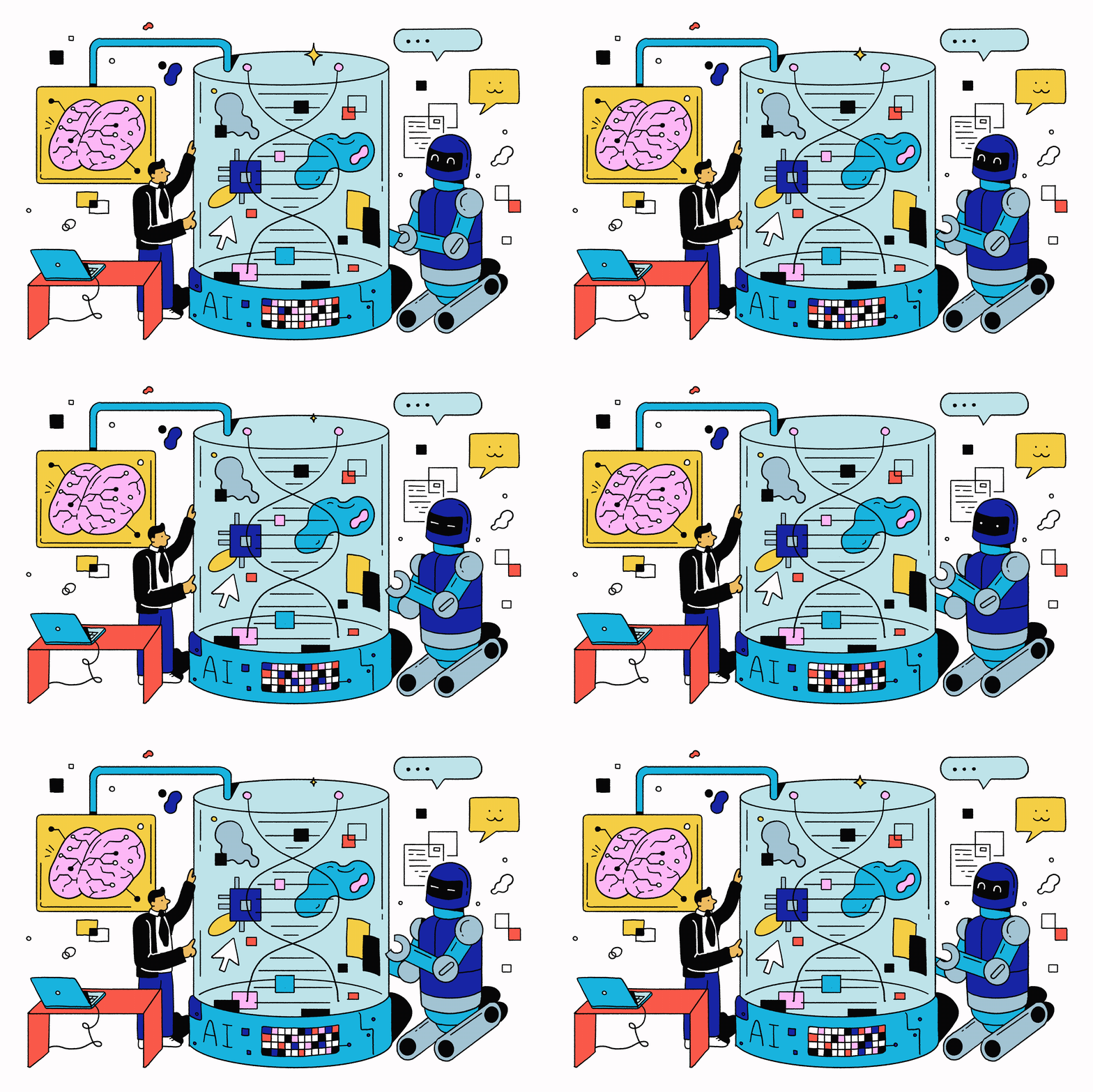
A person and a robot study a giant cylinder filled with AI elements
Kathleen Fu for Education Week

“I want it to be way more tailored to what I’m trying to accomplish,” he said.

For instance, for his class, he writes a lot of code for graphics or manipulatives and curates datasets for statistics examples, but he would like to “figure out how to better leverage AI for those content-specific things.”

But it’s not surprising that many districts have yet to provide AI-specific training, said Tara Nattrass, the managing director of innovation strategy at the International Society for Technology in Education and the Association for Supervision and Curriculum Development.

“Districts are focusing on a lot of different areas right now,” Nattrass said. “There’s a focus on the science of reading. There’s a focus on social-emotional learning. There are a lot of competing priorities when we look across school districts, and AI is one piece of that.”

Looking for PD opportunities elsewhere

Sealand said he understands why his district hasn’t had any other training on AI beyond the basics.

“I might be the only person in my entire district interested in that hyper-specific type of prompt writing,” he said. So in his own time, he’s been researching ways to leverage AI tools to create graphics, visualizations, and manipulatives to use for demonstrations with his students.

See Also

Photo collage of computer with pixelated image of girl.
F. Sheehan for Education Week / Getty

Other educators are also looking for professional development opportunities outside of the district. More than 3,500 educators have signed up for ISTE’s professional learning course on AI, according to the organization. Others are also participating in the organization’s webinar sessions on AI, Nattrass said.

This isn’t a bad thing, according to Nattrass. Teachers should have “a variety of ways” to engage in AI learning, such as district-led professional development opportunities, courses from other organizations, and networking with other educators.

Related Tags:

Events

Artificial Intelligence Live Online Discussion A Seat at the Table: AI Could Be Your Thought Partner
How can educators prepare young people for an AI-powered workplace? Join our discussion on using AI as a cognitive companion.
Student Well-Being & Movement K-12 Essentials Forum How Schools Are Teaching Students Life Skills
Join this free virtual event to explore creative ways schools have found to seamlessly integrate teaching life skills into the school day.
This content is provided by our sponsor. It is not written by and does not necessarily reflect the views of Education Week's editorial staff.
Sponsor
Special Education Webinar
Bridging the Math Gap: What’s New in Dyscalculia Identification, Instruction & State Action
Discover the latest dyscalculia research insights, state-level policy trends, and classroom strategies to make math more accessible for all.
Content provided by TouchMath

EdWeek Top School Jobs

Teacher Jobs
Search over ten thousand teaching jobs nationwide — elementary, middle, high school and more.
View Jobs
Principal Jobs
Find hundreds of jobs for principals, assistant principals, and other school leadership roles.
View Jobs
Administrator Jobs
Over a thousand district-level jobs: superintendents, directors, more.
View Jobs
Support Staff Jobs
Search thousands of jobs, from paraprofessionals to counselors and more.
View Jobs

Read Next

Artificial Intelligence Opinion AI in K–12: A New Year Reality Check for School Leaders
AI is a boon in later grades, less so in K-5, argues author and educator Michael Horn.
6 min read
The United States Capitol building as a bookcase filled with red, white, and blue policy books in a Washington DC landscape.
Luca D'Urbino for Education Week
Artificial Intelligence Opinion AI in the Classroom: What a Skeptic and an Optimist Can Both Agree On
Pedro and Enrique Noguera recommend four steps for embracing chatbots—with guardrails.
Pedro A. Noguera & Enrique Noguera
5 min read
Composite artwork sketch image collage of intelligence assistant creative device internet icon ai hand type laptop cogwheel magnifying glass
iStock/Getty
Artificial Intelligence Fed Regulation of AI Is Virtually Nonexistent. Is This a Problem for Schools?
The Trump administration wants to unleash AI to let it innovate in education and other sectors.
4 min read
Art teacher Lindsay Johnson, center, has students explore how to use generative AI features in Canva at Roosevelt Middle School, on June 25, 2025, in River Forest, Ill. The Education and Workforce Committee held a hearing on Wednesday over the lack of federal regulation and guidance for how schools and other organizations should use AI.
Art teacher Lindsay Johnson, center, has students explore how to use generative AI features in Canva at Roosevelt Middle School, on June 25, 2025, in River Forest, Ill. The U.S. House of Representatives' Education and Workforce Committee held a hearing on Wednesday over the lack of federal regulation and guidance for how schools and other organizations should use AI.
Nam Y. Huh/AP
Artificial Intelligence Opinion This Professor Won the ‘Nobel for Education.’ Here's What His Work Means for Educators
What skills do students need to make sense of complex systems in the age of AI?
7 min read
The United States Capitol building as a bookcase filled with red, white, and blue policy books in a Washington DC landscape.
Luca D'Urbino for Education Week
