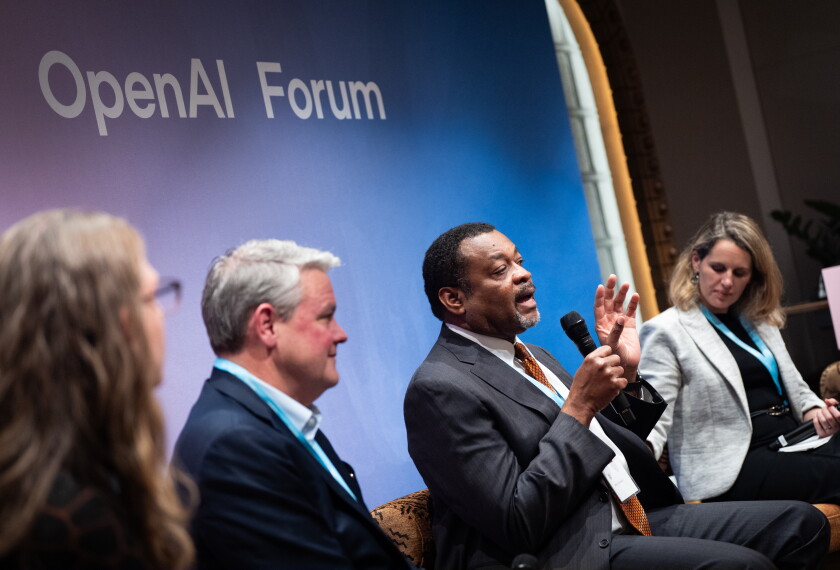
Educators have a lot of questions about AI. Well, when I want practical insight on ed tech, I frequently turn to the ever-thoughtful Michael Horn—lecturer at the Harvard Graduate School of Education, co-founder of the Christensen Institute, co-host of the Future U podcast, and author. As we navigate big talk and dire warnings about what AI means for schools, I reached out to Michael for a reality check. Here’s what he had to say.
—Rick
Rick: Michael, educators have heard a lot about what AI means for schools over the past few years. But all the hype and worry can make it tough to tell what’s really going on. Districts brag about strategic plans and cheerleaders warn that schools can’t afford to be left behind, even as educators wrestle with rampant cheating and unreliable chatbots.
So, where the heck are we? For starters, just how much has AI really seeped into K–12 education at this point?
Michael: Great question! It’s hard to know for sure. But if you define AI as more than chatbots and even large language models, which you should, then K-12 schools are just about saturated with AI. Just a few examples. Some estimates suggest Google Classroom is used by nearly 70 percent of U.S. schools—and Google Classroom integrates a variety of Gemini-powered, AI tools. Roughly 700,000 U.S. teachers use MagicSchool, an AI platform that automates tasks such as lesson planning, creating materials, writing and grading assessments. And if you ask teachers and students directly, the polls tell you that over 50 percent of both groups say they use AI for school. And the older the grade level, the more teachers and students say they use AI.
Rick: Those are some startling numbers. Given all that, right now, what’s the right posture for schools when it comes to AI?
Michael: It probably won’t surprise you that I’ll say, “It depends.” Mindlessly layering “AI” for its own sake into a school or classroom doesn’t make sense. And it could very well be detrimental. I worry a lot about the lack of coherence in schools without technology, and it seems to me that the problem is just getting worse and worse. On the other hand, there are places where I think it can help. Would I tell a school not to use something like Amira Learning, an AI-powered app for building literacy that has good efficacy studies behind it? Not at all. It could make a lot of sense if it’s part of a coherent instructional model. Should schools use something like Timely, an AI optimization tool, to better develop their master schedules and make better use of their time and resources? You bet. Should administrators use thoughtful AI-powered tools to help them better communicate with parents? I think that could be smart. Should teachers be leveraging tools that help with the administrative components of their job and save themselves time? I think so.
Rick: OK, if you’re coaching educators on when and how to use AI in that way, is there an example that comes to mind?
Michael: Sure, for instance, should schools use tools like M7E AI—an ed-tech platform (where I’m an adviser) that evaluates and revises math curricula to remove language barriers for multilingual learners—to ensure access to rigorous content? That seems smart to me.
Rick: In the past, you’ve raised some concerns about districts developing an “AI strategy,” but your view on this has evolved. Want to say a word about that?
Michael: When ChatGPT 3 first entered the scene, school districts rushed to develop an “AI strategy.” I disagreed then because I saw AI as a tool, not a strategy. However, after many conversations with K–12 schools, I now see that they do need a strategic orientation for how AI supports teaching and learning. That’s been an evolution for me.
Rick: What’s driven that evolution?
Michael: There are a few considerations, but I’ll just highlight one point. Without a clear stance on AI, confusion reigns. Schools need clear guidelines on AI use for student work: what’s allowed, what’s not, and how and why to use AI across curricula. Teachers must be part of that process, as each discipline prompts different questions around AI use. Without clear guidance, schools will continue to struggle. Although, in general, I do wish schools started with first principles around what kind of education we are even trying to offer in the first place, thought about their education model itself, and then asked how AI-powered tools could help or hinder that.
Rick: On that score, I think a lot of educators are concerned that AI may shape education, rather than educational needs shaping the approach to AI. They’ve been told that AI will introduce 24/7 tutoring, gamified learning, and other big shifts—and I frequently hear from teachers and school leaders who feel like they’re being pulled along, sometimes in troubling ways.
Given that, when you say there’s a need to figure out educational first principles before introducing AI, what do you have in mind? And is that even practical, given the extraordinary rate at which AI has taken root on our devices, in homes, and in schools?
Michael: It’s a good question. And I think if we’re being perfectly honest, no one knows. Humility is important, and one-size-fits-all statements are probably counterproductive.
The way I’m currently thinking about it is this: Educators need to be mindful of what kids are using at home as they do their work, independent of how much guidance their teachers are offering around what the appropriate uses of AI are. So, they will need to adjust assignments, assessments, and class time to make sure students are learning the objectives in front of them.
I do think schools should, in most cases, probably stop giving younger students Chromebooks to take home, which likely encourages counterproductive work with AI. The principle might be thought of in the same way as calculators; we learned to do the fundamentals of math before we used the devices.
Rick: Some tech enthusiasts argue that much traditional academic content is now obsolete and that it’s time to fundamentally overhaul school curricula in light of AI. As you know, I’m skeptical. But I’m curious to hear your take.
Michael: My sense is with you in that, in many ways, the K–5, maybe K–8, building block objectives of learning shouldn’t change much. Foundational knowledge, skills, and socialization remain essential, and we still need to strengthen them. Reading, writing, numeracy, civics, history, and shared cultural understanding remain critical. I wouldn’t back off any of that.
I have been puzzling over the speed of knowledge acquisition. We know humans learn best through stories, so I wonder if we could structure learning around narrative arcs to accelerate mastery of these fundamentals and make learning history, science, and so forth much more engaging than we do today.
Rick: So, it sounds like you think more change may be appropriate in later grades. Is that the case? If so, what sort of changes should be considered?
Michael: I think middle and high schools should change to provide greater exposure to occupational pathways and possibilities. Too many students graduate without knowing what kinds of work and tasks energize them. What do they like doing and where do they excel? A series of short sprints or hands-on experiences across fields could help them develop that awareness. And I think AI should probably be used as an aid in those projects, as part of the reason for this experiential learning at those ages is an acknowledgement that work is likely to change in some material ways. Helping expose and connect students to it so they can gain real experience and build real social capital will be important.
This piece has been edited for length and clarity.