The debate over how much screen time kids should have has been a hot one for decades. But it has grown even hotter in recent years with the widespread use of smartphones, tablets, laptops, and other digital devices and their correlation with worsening youth mental health.
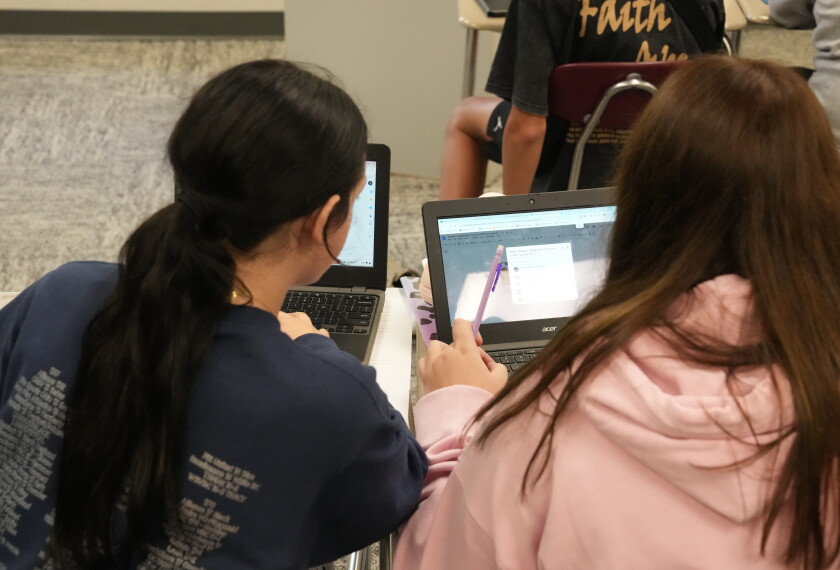
The debate is now raising important questions about how schools should manage screen time, especially as the use of digital devices in classrooms has increased dramatically over the past five years.
One way school districts are dealing with screen-time concerns is by limiting cellphone use during school hours. At least 31 states and the District of Columbia require districts to ban or restrict students’ use of cellphones in schools, according to an Education Week tally.

A new report from the Consortium for School Networking examines the different ways screens are used and experienced in classrooms and homes and how educators, families, and policymakers can work together to mitigate the negative impact of too much screen time on children. The report also provides a toolkit to support educators in navigating conversations about screen use within their school communities.
“From my experience as a teacher, I knew that one of the toughest pieces of the puzzle here that I didn’t see very many people talking about was how to navigate those conversations [about screen time] with parents, community members, and students,” said Cooper Sved, the author of the report and a 6th grade teacher who is currently doing a fellowship for CoSN.
In an interview with Education Week, Sved discussed the role schools can play in managing kids’ screen time and how technology can be used more thoughtfully and effectively within classrooms.
This interview has been edited for length and clarity.
What kinds of conversations have you had with parents about their kids’ screen time?
I found that [parents] were conflating different kinds of screen [time] as one kind of harmful. The idea going into the conversation, from the parents’ perspective, is that:
- One: Screens are harmful.
- Two: We need to keep kids away from screens.
- And three: Schools, in some way, were making it worse.
That is why I wanted to clarify the conversation a bit. There is a huge difference between educational technology that is being used in the classroom for pedagogical purposes by a trained veteran teacher and the kinds of content [kids] are consuming on TikTok or YouTube, which is generally algorithmically generated and has a monetary incentive rather than a pedagogical incentive.
How are teachers managing this challenge?
The primary ways that educators are using screens in their classrooms are for differentiated activities. For example, if I’m a teacher and I am pulling a small group to the back and I have some kids reading and some kids writing, a really high-quality, differentiated activity that’s targeting specific student needs would be a phonics program or a math program. These are designed to cater to students’ specific academic deficits automatically without teacher input—and that, combined with high-quality small-group and high-quality whole-group instruction, creates an environment where students are accessing grade-level material while also getting targeted instruction. That’s something that is not nearly as possible without using educational technology programs.
We may also use screens in special education and as aids for multilingual students. Some students need access to a screen in order to communicate with their teachers. Some students need access to a screen in order to translate grade-level material. If we don’t give kids access to technology, access to these screens, they are not able to access the same kind of rigor that a general [education] student might be able to.
Do you think schools need to limit screen time?
There is no universal answer to that question. It’s dependent on the needs of that particular community in this particular period of time. Now, saying we need to move away from screens, that is a harmful perspective, because it eschews so many of the important functions that screens might have in a classroom on a day-to-day basis. If a teacher is using technology thoughtfully and with intention and balance, then we don’t need to worry about necessarily moving away from screens as a long-term project. [Editor’s note: Some research has shown that poor use of educational technology by teachers can amplify bad instruction.]
What we have here is an opportunity, especially with AI, to teach students how to incorporate technology into their work in ways that are responsible. Denying them access to artificial intelligence in the long term may be harmful, because then they will not have had access to AI in an educational environment, in a professional environment; therefore, they will lean on AI in ways that are irresponsible later on in their lives.
Of course, this requires training and high-level understanding by teachers of how these resources can be used thoughtfully and pragmatically. But just saying flat out, “Hey, we can’t use technology because screens are bad.” That’s not being thoughtful about how screens are used right now, and it’s not being responsive to the needs of learners beyond their time in K-12.
We want people to be able to use these resources thoughtfully as adults. Therefore, we need them to have access to these resources at a young age, being taught by a trained professional who understands how they can be used with intention.
What challenges do educators face when it comes to teaching kids how to manage their screen time?
We are working against the media environment that does not have the same goals that we do. For example, YouTube and TikTok are about getting viewership. They are about grabbing people’s attention. They are about keeping people’s attention for long periods of time. We, as educators, want to use technology thoughtfully for pedagogical reasons.
What do teachers need in order to use technology thoughtfully in their classrooms?
It’s about teacher training. What can be most effective is training programs for teachers that are not universal [but] are contextual, so teachers are able to understand how to leverage technology, not just generally, but in their classrooms, in their specific communities, within the framework of their administration and their district-level leadership expectations.
If teachers are given a resource to use but don’t know how to apply it to the structures that have been mandated for them, or the structures that are in place from their administrations or districts, then it’s a wash.
What are the next steps in the screen-time conversation?
The next step is for families and for school communities to begin having conversations with each other and to better understand each other. That way, schools can better strategize based on parent needs, and educators can better understand where parents are coming from and where parents may have concerns. And, in turn, parents are able to better understand how technology is leveraged in school and the kinds of outcomes we are expecting by using technology at school.