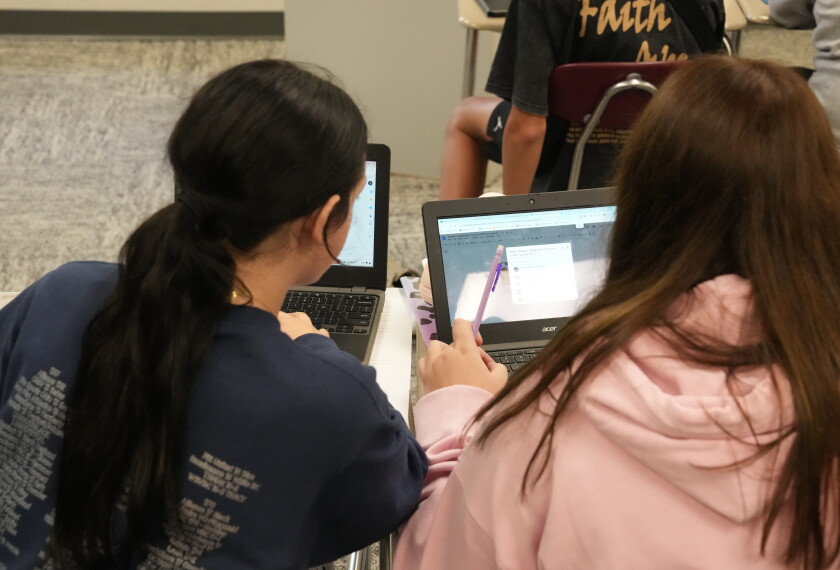
While some students still meet up in person after school to prepare for a test or do homework together, many now meet online to work on assignments through platforms like Discord or GroupMe.
“Sitting with other people and having a study group—that’s been a way that we have been learning for a long time,” said Christine Elgersma, a senior editor of learning content strategy at Common Sense Media, an entertainment and technology media organization. “Technology has just afforded us a little bit more convenience if you can’t all be in the same physical space.”
Research shows that peer-to-peer learning positively affects academic achievement. When students are teaching one another, they engage with material more deeply and develop effective group work skills, according to the National Education Association.

Online platforms could offer new opportunities for peer-to-peer learning, according to the Collaborative for Academic, Social, and Emotional Learning, or CASEL. Students can develop leadership, accountability, and organization skills while working with their peers.
But “just as with in-person discussion, students often need scaffolds and support to practice effective communication online,” CASEL staff said. “Educators will need to explicitly teach and model responsible digital communication.”
How technology has changed student learning
Online groups can function as body doubling, the practice of having another person in the same space to enhance learning, Elgersma said. Online platforms recreate this effect in different ways, she said.
For example, one online platform that some students are using to communicate and work with their peers is called Discord. This platform allows students to join “servers,” or groups, both within school and outside it. These servers can focus on units of a specific subject or a particular class.
The approach is similar to participating in a group chat with other students working on the same content, Elgersma said.
According to a spokesperson for Discord, the platform is primarily used by teachers “leading robotics programs and technology courses” to “help students meet, collaborate on homework, and discuss class materials.” Additionally, high school esports teams use Discord to “coordinate tournaments and communicate while gaming.”

At Universal Learning Academy, a charter school in Westland, Mich., students utilize Discord for both schoolwork and extracurricular activities. Abraham Ali, 16, a junior and the National Honor Society vice president there, said he started using Discord at the beginning of high school to join a study group. Now he uses it for his Advanced Placement classes and to communicate about agendas and meetings for NHS.
His classmate, Lara Moussa, 17, a senior and NHS president, said she’s used different servers on Discord to meet other students from cities around the country who are also taking AP U.S. History to enhance her learning.
“The fact that there is an easier platform out there that both raises student accountability and confidence across all ages, whether they start APUSH in 9th grade or whether they start it in 12th grade,” she said. “You have never seen networking or connection like that.”
Students and educators have important roles in technology usage
Soumaya Abi Abdallah, an NHS chapter co-adviser and the coordinator of tutorial, English-as-a-second-language, and Title III programs at Universal Learning Academy, has encouraged students to use Discord to communicate with each other about school activities and classwork.
“We [educators at school] definitely try to shed light on these platforms and encourage students simply by providing them equitable access and consistent access at school,” she said.
Educators who are in the Discord servers can actively monitor student engagement, she said. The school-sponsored use of these platforms can also provide opportunities for educators to spread awareness about issues like cyberbullying, Abdallah said.
In instances where teachers aren’t a part of Discord groups, students can monitor the chat, said Angelina Hallis, 17, a senior and the NHS secretary at Universal Learning Academy. In the past, Angelina served as a monitor for a server—gaining service hours through her school.
“It was a good way to have student initiative and in such a large community,” she said.
Many times, the various groups on Discord include chat boxes that filter messages and have age requirements, Angelina said.

Still, educators should be aware that digital platforms can also expose students to online threats or inappropriate content. In April, the New Jersey attorney general filed a lawsuit against Discord, alleging that its direct messaging feature failed to protect minors from exposure to harmful content and online predators.
And from an academic perspective, Elgersma said it’s important that teachers who introduce Discord into their classrooms communicate their expectations clearly. For example, students should be told in advance if an assignment can be done collaboratively or not.
“There’s a big difference between a study group on Discord where ideas are being discussed and a group where answers are being swapped,” Elgersma said. “It’s really all about being attuned to what’s happening in your classroom—online, offline—as much as possible.”