
College & Workforce Readiness

For These Black Women in STEM, Teachers’ Encouragement Went a Long Way

By Lauraine Langreo — February 22, 2024 3 min read
A science teacher in elementary or middle school showing a student how to use a microscope.
  • Save to favorites
  • Print

Ciara Sivels had her heart set on becoming a pastry chef and attending culinary school after graduation, until her high school chemistry teacher encouraged her to pursue chemical engineering after realizing how good she was at the subject.

“I was like, ‘No, I don’t even know what that is. I’m going to culinary school. I have no interest in that,’” Sivels said. Still, her chemistry teacher asked her to try the Advanced Placement chemistry class.

Sivels found that she liked chemistry and the idea of “atoms and elements and putting them together and making something new.” She connected it back to cooking and baking, because there’s a similar process of “taking all these different ingredients and coming up with something delicious.”

After high school, Sivels attended Massachusetts Institute of Technology, where a mentor steered her toward nuclear engineering. She got her Bachelor’s Degree in nuclear science and engineering at MIT, earned her Master’s Degree in nuclear engineering at the University of Michigan, and then became the first Black woman to earn a Ph.D. in nuclear engineering at Michigan.

“Those little nuggets of wisdom that people had or [teachers and mentors] taking the time to listen and hear what I’m interested in changed my trajectory,” Sivels said. “That’s how I ended up where I am today.”

Sivels was one of the panelists at the Feb. 21 National Math and Science Initiative webinar about how to encourage diversity in science, technology, engineering, and math industries. The webinar also featured former NASA astronaut and electrical engineer Joan Higginbotham, who was the third Black woman to go into space.

STEM occupations are projected to grow by almost 11 percent by 2031, according to the U.S. Bureau of Labor Statistics. And while there’s a high share of women in science-related healthcare jobs, they continue to be underrepresented in engineering, computer science, and physical science jobs.

See Also

Photo of students working on computer boards.
E+ / Getty

Higginbotham, who mentors some high school and college students, said they’ll ask her questions about “how to handle being the only woman of color in the room” or “how to handle people thinking they’re only in the room because of a diversity initiative.”

“It breaks my heart, because 30 years later, after I dealt with that kind of nonsense, the students today are still dealing with that nonsense,” she said.

To encourage more students of color, especially girls, to go into STEM careers, Sivels and Higginbotham said it’s important to expose students to those careers as early as possible and to make those subjects fun and relevant to their everyday lives.

For students who are interested in STEM careers, Higginbotham’s advice is to “study hard and believe in themselves.”

Setbacks will happen, but “don’t let that hold you back,” Higginbotham said.

Sivels’s advice is for students “to learn to have confidence” by working on their hard skills, or job-specific knowledge, and to “sit in that confidence.”
See Also

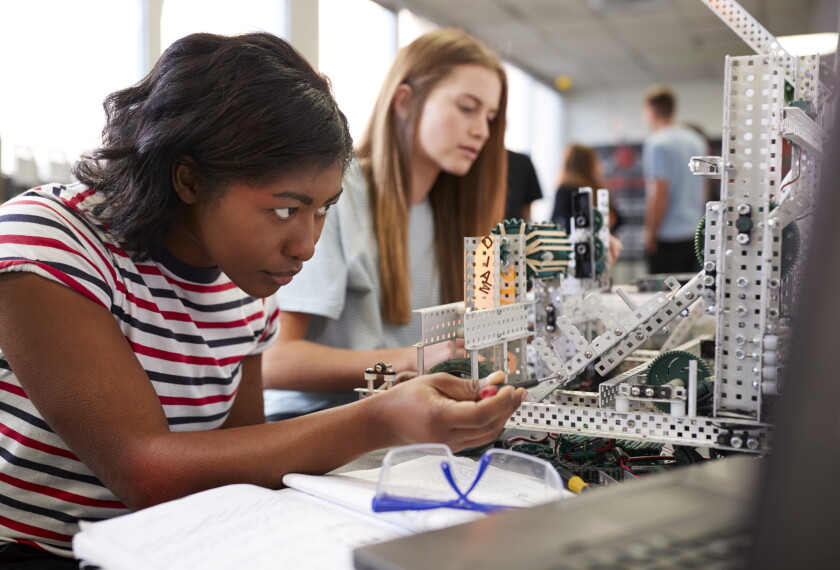
Two Female College Students Building Machine In Science Robotics Or Engineering Class
iStock/Getty

It’s also important that students have a good support system. A 2022 Girls Who Code and Logitech survey found that parents and teachers are influential in determining whether girls will pursue a career in STEM. In Sivels’ and Higginbotham’s journeys, their support systems have been instrumental in their success.

Changing a student’s life ‘just by one little comment or suggestion’

Their advice to educators is to continue to listen, guide, and advocate for their students.

“There is a level of effort that goes into really understanding your students, but you just really never know the life that you can change just by one little comment or suggestion,” Sivels said.

For Higginbotham, her STEM teachers’ passion for the subjects “left an impression” on her, so her advice is for teachers to be “authentic” and know that students are paying attention to what they’re doing.

“It may take 20 years for them to realize it, but it will make an impression,” she said.

Events

This content is provided by our sponsor. It is not written by and does not necessarily reflect the views of Education Week's editorial staff.
Sponsor
Artificial Intelligence Webinar
From Passive to Active Reading: Student Engagement in the Age of AI
What the research tells us about active reading and student engagement—and what it means for teaching in an AI-enabled world.
Content provided by Pearson
This content is provided by our sponsor. It is not written by and does not necessarily reflect the views of Education Week's editorial staff.
Sponsor
Professional Development Webinar
Micro-Learning, Macro Results: Reimagining Professional Learning
Rethink professional learning with 3 strategies that personalize professional learning, validate expertise, and support educator retention.
Content provided by Mira Education & Modiv EDU
This content is provided by our sponsor. It is not written by and does not necessarily reflect the views of Education Week's editorial staff.
Sponsor
School Climate & Safety Webinar
There But Not Present: Rethinking Student Engagement
Learn how to recognize the early signs of disengagement and what the behavioral science reveals about which interventions actually work.
Content provided by Frontline Education

EdWeek Top School Jobs

Teacher Jobs
Search over ten thousand teaching jobs nationwide — elementary, middle, high school and more.
View Jobs
Principal Jobs
Find hundreds of jobs for principals, assistant principals, and other school leadership roles.
View Jobs
Administrator Jobs
Over a thousand district-level jobs: superintendents, directors, more.
View Jobs
Support Staff Jobs
Search thousands of jobs, from paraprofessionals to counselors and more.
View Jobs

Read Next

This content is provided by our sponsor. It is not written by and does not necessarily reflect the views of Education Week's editorial staff.
Sponsor
College & Workforce Readiness Quiz
Quiz Yourself: How Much Do You Know About Dual Enrollment?
Answer 7 questions about dual enrollment.
Content provided by Pearson
College & Workforce Readiness Transportation Is a Challenge for CTE Programs. How Districts Are Solving It
One district found innovative ways around this barrier.
4 min read
A school bus crosses over U.S. 160 from the Navajo Nation, left, onto the Hopi reservation, right, Monday, March 4, 2024, in Tuba City, Ariz. U.S. Highway 160 is the de facto border between the Navajo and Hopi Indian reservations and two time zones. Mind-bending time calculations is what people in the largest Native American reservation in the U.S. have to endure every March through November. The Navajo Nation, which stretches into Utah and New Mexico, will reset clocks for one hour later despite the rest of Arizona remaining on standard time.
A school bus crosses over U.S. 160 from the Navajo Nation, left, onto the Hopi reservation, right, on March 4, 2024, in Tuba City, Ariz. For school districts that offer offsite work-based learning experiences, transportation is a key challenge.
Matt York/AP
College & Workforce Readiness Why Schools, Colleges, and Employers Aren't Connected on Career-Technical Education
Too much data on education and the labor market exist in silos, a new report finds.
6 min read
South Career and Technical Academy student ambassadors and student councils hand out wristbands to new students as they arrives at CCSD’s newest high school, opening its doors for the 2025-2026 school year, on Aug. 11, 2025 , in Las Vegas .
South Career and Technical Academy students hand out wristbands to new students as they arrive at their school system's newest high school on Aug. 11, 2025, in Las Vegas. A new report recommends that school, college, and workforce leaders break down silos in their data, in order to better coordinate career-technical education goals.
Bizuayehu Tesfaye/Las Vegas Review-Journal via TNS
College & Workforce Readiness How Can Schools Connect Students to Careers? A New Compact Has a Plan—and Money
The compact comes at time of rising uncertainty for young workers due to AI.
5 min read
Leaders in education have a panel discussion about offering a path for students from schools into careers.
Industry leaders discuss the new Compact for America’s Youth during a launch event in Washington on Sept. 10, 2026. The compact brings organizations together to work on solutions to scale up career-connected learning.
Courtesy of CareerWise
