

Pop quiz: How many times has the federal government fulfilled its original commitment to supply 40 percent of the average per-pupil expenditure to pay for the costs of special education?
Answer: Never. In fact, only once—in 2009—has federal funding even exceeded 20 percent, despite a promise in the first version of what is now the Individuals with Disabilities Education Act to reach 40 percent by 1982.
Today, the nation’s special education law merely authorizes—and no longer requires—the federal government to reach the 40 percent threshold. And there’s plenty of debate over whether the 40 percent threshold is even an accurate representation of the true cost of providing special education services.

Whatever the true costs of special education and the legal situation, the lack of originally promised federal funding comes at a cost—literally—for school districts that are, in turn, tasked with finding ways to offset the shortfall while fulfilling their legal commitment to provide every student with disabilities a free, appropriate public education, education leaders said during a webinar on Feb. 24 hosted by the IDEA Full Funding Coalition, a group of organizations advocating for additional IDEA funding.
The coalition is pressing its case at a time of significant uncertainty at the federal level. At her confirmation hearing, Linda McMahon, who’s likely to be the next secretary of education, discussed shifting oversight of IDEA to the U.S. Department of Health and Human Services as part of dissolving the U.S. Department of Education. And an infusion of new IDEA funding in the short term seems unlikely as the Trump administration cuts federal spending and a new budget blueprint under consideration in Congress requires significant spending reductions.
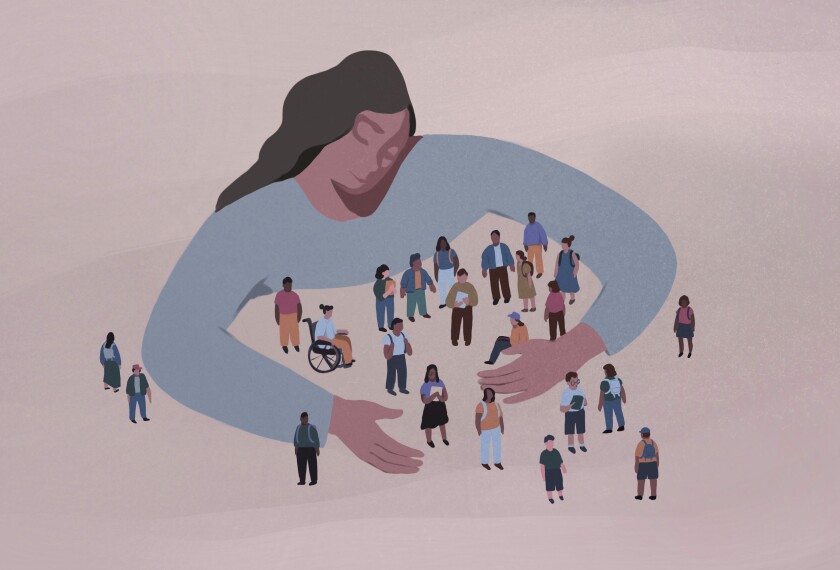
Often, as they face the need to pay for legally required special education services, the solutions districts turn to mean programs for all students are slimmed down or schoolwide staffing is reduced. Sometimes, schools can’t provide the most up-to-date and innovative assistive technology for students with disabilities. In some places, the shortfall puts extra responsibility on local taxpayers to make up the difference.
‘Tough decisions have to be made’ when districts are short on funding
When districts are forced to pull funding for students with disabilities—who, under IDEA, are guaranteed to receive a free appropriate education that is tailored to their needs—from other places in the budget, all students are affected.
One recent analysis found that districts in the 2020 fiscal year received only about 12 percent of what they spent on special education from the federal government, a far cry from the original 40 percent commitment. State funding covered about 26 percent, according to the analysis, leaving the majority of the responsibility—62 percent—to individual districts.
(In their analysis, the researchers used years prior to the infusion of federal pandemic-relief funds, which affected total spending in the short-term. Researchers also noted the analysis was not comprehensive of all states and districts, and figures were difficult to track because states have inconsistent reporting methods.)
Schools are required to provide education for students with disabilities, even without all the money that Congress promised a half-century ago.
“Year after year, we fall short as a nation. We leave states, school districts, and their families to bear that burden,” said Jacqueline Rodriguez, the CEO of the National Center for Learning Disabilities. “It’s a question of fairness, of opportunity, and of an unmet, longstanding commitment from the federal government to support the education of students with disabilities.”
As a result, students in special education might go without the latest and best technologies and programs to boost their learning. Students in general education may see arts, music, or extracurriculars cut to redirect the funds to special education.
“Tough decisions have to be made all the time,” said Mike Barnes, superintendent in Mayfield Heights, Ohio.

Insufficient funding makes it difficult to be competitive in hiring, retaining teachers
It’s also becoming increasingly difficult for districts to be competitive in hiring and retaining qualified, effective special education teachers, Barnes said. And the special education teachers schools do have are likely to experience burnout because of their increasing workloads that districts can’t help ease due to “fewer resources to add staff,” Barnes said.
Federal surveys in recent years have consistently shown that special education teacher vacancies are among the most difficult for schools to fill.
“Fewer and fewer people are deciding to go into teaching, yet the needs for students with disabilities seems to be continuing to increase,” Barnes said. “So the competition between school districts for the best and the brightest … to go into the classroom and make a lasting difference on the lives of our children continues to pose a problem with the lack of funding.”
Class sizes in some places may be larger, too, added Danielle Kovach, a special education teacher in Hopatcong, N.J., as schools try to combine classes rather than cut programming when they don’t have enough teachers.
“It does make a difference, not only to our students who are receiving the special education services, it makes a difference with all of our students in the classes,” she said.
Some have argued schools should use contract employees to provide special education services, rather than making big budget investments in permanent staffing, which can relieve districts of the burden of recruiting and managing specialized workers.
Yet others have suggested a complete restructuring of federal special education funding: The conservative policy agenda Project 2025 suggests that federal special education funding be distributed into education savings accounts that parents can choose to use at private schools or for other educational expenses outside of the public school system.
Full funding would allow schools to ‘dream bigger’ for students with disabilities
When schools are forced to cut and move funding around to meet the legal requirements of educating students with disabilities, compliance “becomes more about meeting legal requirements, rather than truly optimizing” students’ opportunities, Barnes said.
If the federal government met its original IDEA funding commitment, it would allow districts to “dream bigger” and achieve some of their most aspirational goals in educating students with disabilities, panelists said. Schools could provide more early intervention services that keep some problems from worsening later on, and they could bolster professional development for staff.
For Kovach, it would mean more cohesive, complete programming for her students.
Every time a new student comes to her class, they have unique needs that require a unique approach. Sometimes, they need a specific program or equipment that her school doesn’t have and can’t afford, and she has to get creative to provide what her students need.
“Sometimes, I may get piecemeal things, and have to take, borrow, and steal from other teachers,” Kovach said. “‘You have this. I’m looking for this.’ I even look to our other schools as well to piece it together. Being fully funded would definitely benefit my students in the programs that we’re implementing in the classroom.”


