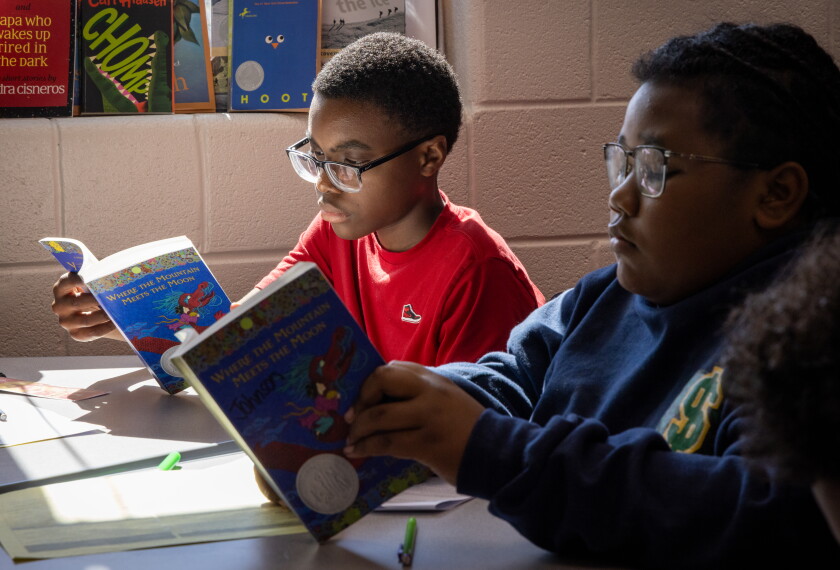
Virginia is now the first state in a recent wave of reading legislation to require schools to offer dedicated support for struggling readers through 8th grade—an expansion of the state’s literacy law aimed at serving older students who haven’t mastered foundational reading skills.
Last year, Virginia joined the 24 other states that have passed legislation over the past four years mandating schools use evidence-based approaches to teach early reading. Most of these laws—including Virginia’s—focus on materials and methods used in the first few years of elementary school, when children are first learning how to read.
The Virginia Literacy Act, passed in 2022, required school districts to provide intervention services to struggling readers in grades K-3 and provided funding for school boards to hire elementary reading specialists. It also required schools to provide teacher training.
But there are many older students who need these interventions too, especially after the school disruptions of the pandemic, said Carrie Coyner, a Republican state delegate who co-sponsored the bipartisan bill.
“Our data showed us that our COVID children, who were in those youngest levels of learning in their COVID years, they’re in the lowest level of reading. And yet our literacy laws that were just passed aren’t going to impact them,” Coyner said.
The literacy act’s expansion, signed into law by Republican Gov. Glenn Youngkin in March, will now require schools to provide intervention services and reading specialists for students through 8th grade who show substantial deficiencies in reading, identified either through scores on the state reading test or a literacy screener.
Older elementary and middle school teachers will also have to go through training in evidence-based reading practices, and the state department of education will be required to provide recommendations for core reading curriculum for these grade levels.
The legislation includes funding for training, coaching, screeners, and the materials list selection process. A proposed budget amendment would cover the cost of additional reading specialists, if passed. The law goes into effect in the 2024-25 school year.
Studies of students with reading difficulties have shown that older kids tend to struggle with multiple parts of the process. Many students who have difficulty comprehending text also have problems with word-level reading—especially decoding longer, multisyllabic words.

But most middle school teachers are not trained in how to provide help in foundational reading skills to these students. And as students progress through upper elementary and middle school English/language arts, where the content demands become more rigorous, it can be challenging for educators to find time to attend to gaps in basic skills.
“When we think about why kids are having a problem comprehending [in upper grades], it’s either decoding, language comprehension, or background knowledge,” said Emily Solari, a professor of reading at the University of Virginia who advised on the legislation.
Interventions for older kids should be targeted to the specific issues they’re having, and they should be developmentally appropriate, she said. “But the core problems are the same,” she added.
Special considerations for older struggling readers
Developmental appropriateness can be a sticking point for interventions with older students. Many materials that offer practice on basic skills are designed with young readers in mind—decodable books with simple storylines that educators say older kids can find babyish, for example.
Researchers have said that getting these kind of details right is necessary for legislation aimed at improving reading instruction to actually move the needle on student achievement.
Still, some specific strategies have a strong evidence base with older children, said Jeanne Wanzek, an associate professor of special education at Vanderbilt University. (Wanzek was not involved in shaping the Virginia legislation.)
One of these strategies is focusing on multisyllabic words. Students need to know how to break these words down—both to decode them, but also to make sense of different prefixes and suffixes, she said. Explicitly teaching what prefixes like “un-” or “dis-” mean can help students understand bigger words they will encounter in more complex text.
Some districts in other states without mandates have begun these kinds of lessons with older elementary students.
In Bernards Township School District in New Jersey, teachers started integrating short, whole-class lessons on morphology—analyzing the structure of words—with 3rd grade students, said Lisa Vitale-Stanzione, the school system’s supervisor of K-5 intervention and special education. Next year, the 4th and 5th grade teachers will start to use these lessons as well.
In the lessons, students learn about the meaning of common prefixes and suffixes. They’ll learn to draw connections between words with the same root—like industrial and industrious, for example. It’s meant to be a small part of ELA class that supports kids’ reading, not the main focus: “It doesn’t mean they’re not going to read literature,” Vitale-Stanzione said.
Researchers have long warned that the effects of reading difficulties can compound over time. Children who struggle early on and don’t receive support get stuck in less complex texts, while their peers move on. These struggling readers then get less access to new ideas and knowledge, and less practice with more sophisticated types of analysis—making it even more challenging for them to make sense of new material.
That’s why it’s especially important that reading interventions for older students make explicit connections to grade-level classroom content, said Wanzek. The interventions need to give children access points to the core curriculum.
Interventions aimed at older students should also attend to motivation and recognize students’ frustration, Wanzek said. “Many of those students might have been struggling for years,” she said.