Teachers: White, Female, Middle-Aged
It’s no surprise to those who spend time in schools that America’s teaching workforce is largely white, female, and middle-aged. But the degree to which those characteristics describe teachers as a group might come as a shock.
Ninety percent of public school teachers were white during the 2000-01 school year, with the proportion of black teachers having declined since the 1990-91 school year from 8 percent to 6 percent. More than three-quarters (79 percent) were female, which corresponds to the lowest representation of males in 40 years. And the median age of teachers was 46.
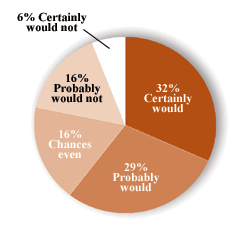
Willingness to Teach Again The pie chart shows the percentage of teachers in 2000-01 who said they would choose the same profession. |
|
| SOURCE: “Status of the American Public School Teacher 2000- 2001,” National Education Association |
The figures are all drawn from a survey of a representative sample of public school teachers conducted every five years since 1961 by the National Education Association, the nation’s largest teachers’ union. The 371-page report, issued last month, contains hundreds of facts about teachers and their views in 2000-01.
A sampling:
A greater proportion of teachers had classified themselves as politically conservative than politically liberal in every survey since 1971, with 56 percent saying in 2000-01 that they were conservative or tended toward conservatism. Still, 45 percent of teachers said they were registered as Democrats, 29 percent Republicans, and 27 percent said they were not affiliated with either party.
Teachers had an average of 15 years of full-time experience, and 56 percent held master’s degrees, the latter an all-time high.
Sixty percent of teachers said they would become teachers again. Among teachers who planned to leave before retirement, the top reasons given were low salaries (37 percent) and working conditions (20 percent).
For a copy of the survey, call the NEA at (202) 822-7200.
Beat the Clock
A national organization that wants to make a point about professional development is looking for a dedicated dozen.
Believing that high-quality training for educators is the most promising path toward better student achievement, the National Staff Development Council is seeking 12 schools that want to use teacher learning to beat the No Child Left Behind Act clock. The federal law has set a 2014 deadline for all children to become proficient in reading, writing, mathematics, and science, but the council says that the 12 years the law allowed is too long for low- achieving students to wait.
To show how the achievement gap can be closed sooner, the Dallas-based council has designed the “Twelve Under Twelve” national project. It involves a collaboration between the council and 12 schools, which must each promise to commit at least $5,000 to the project. In return, the resources of the council will be available to the schools along with constructive criticism and networking help. The project is being facilitated by Hayes Mizell, a well- known expert in school improvement.
Nominations will be accepted until Sept. 30. Mr. Mizell can be reached at (803) 787-0760 or hmizell@msn.com.
Metamorphosis
A few short months ago, the library at Gridley Street Elementary School in the Los Angeles district could not hold more than a few students at a time, and most of its book collection remained in boxes.
But last month, the facility was transformed. Now filling the space of two former classrooms, the library is stocked with new books, an amphitheater invites groups of students to sit and read, and quiet corners are available for volunteers to work with children one-on-one.
“The environment is much more conducive for kids to get interested in reading,” said Assistant Principal Ace Guzman.
That was the goal when school officials applied for the Wonder of Reading, a program sponsored by a Los Angeles-based nonprofit organization that has been helping to renovate and restock school libraries in the 775,000-student district for more than eight years. The project includes a volunteer tutoring program and after-school access to the library for students and their families.
“We want to transform the school library into an inviting, cozy space to encourage the little ones to curl up with a good book,” said Beth Michelson, the program’s executive director.
At a time when federal and state policies are focused sharply on raising reading achievement, school librarians have been lamenting the lack of attention and resources. In California, where school libraries are allotted less than $1 per student annually from the state-compared with the national average of more than $7 per student-many schools have outdated collections and manage without school library media specialists. In Los Angeles, school libraries average just eight books per student, compared with the national average of 18.
To qualify for the Wonder of Reading program, schools must raise $20,000 and rally support among the school community. The organization pitches in with renovation costs and provides $10,000 for new books.


