
At the beginning of a recent math class, students spent six minutes discussing a topic they knew well: themselves.
What’s their favorite food? Answers came in English and Spanish—“todo” (everything), or “naranja” (orange).
Then, students used the commercial platform Kahoot to review a previous lesson on stretching and compressing graphs. As answers were revealed, 10th grader Joel Fabian Severino, an English learner, shouted “yo sabia!” (I knew it).
At Annandale High School in Virginia, just outside of Washington, D.C., Algebra I Plus is a double-block, daily class offered in English and designed for multilingual learners. Many students say it’s their favorite course. Joel credits his teachers with offering clear explanations of concepts, consistent support, and a level of rigor that feels challenging—but manageable.
One of the biggest barriers for secondary English learners in math is not computation, but language. The subject’s complex vocabulary can undermine both confidence and engagement. Teachers at Annandale address this by prioritizing classroom community, small group instruction, and creative forms of support to increase student understanding.
At Forest Grove High School in Oregon, educators take a different approach: Teaching math entirely in students’ home language, which in this case is Spanish.
While uncommon, offering math in Spanish reflects a broader effort to meet students where they are and accelerate learning, said Karen Thompson, an associate professor at Oregon State University. The school’s mix of Spanish-language courses, English instruction, and targeted supports appears “well-tailored” to its community, she noted.

“Math can be really challenging, and especially learning math in a new language,” said Anna Kyle, an ESOL and math teacher at Annandale High School who leads the Algebra I Plus class.
“My number one goal is to make sure that kids feel like they can ask questions, that they can make mistakes, and that they like feel comfortable enough to learn, because learning can’t take place if you’re really uncomfortable.”
Nationally, gaps persist. Eighth grade math scores for English learners continue to decline faster than for their peers, according to the 2024 report card from the National Assessment of Educational Progress.
William Zahner, an associate professor at the Center for Research in Mathematics and Science Education at San Diego State University in California, has been studying how to make math accessible for English learners.
Some of his work focuses on how classroom designs can incorporate structured student interactions. Essentially, creating ways students can work together to solve math problems while encouraging them to use the English language in class, said Zahner.

“Building a classroom community” through math
A major hurdle for English learners is their lack of confidence in their language abilities, said Zandra de Araujo, the director of mathematics and a research scientist at the Lastinger Center for Learning, at the University of Florida.
Students new to the country may hesitate to participate in class, so teachers must intentionally encourage engagement with lessons and use tools that lower communication barriers.
At Annandale, where about 35% of students are English learners, Algebra I Plus serves newcomers who in many cases haven’t previously completed coursework in the U.S. Each class follows a consistent structure: discussion, review, new content, and assessment prep—all of it anchored in participation and language development.

It’s about “building a strong classroom community, and not just in the beginning of the year, but throughout,” said Kyle. That sense of belonging boosts engagement and encourages peer support when teachers are busy.
Students regularly work in small groups, graph equations, and present solutions. Kyle’s communication with students happens in English, while peer conversations flow between English and Spanish.
Visuals and sentence frames support understanding, and writing becomes a tool for thinking, not just assessment. For example, students working together write out what they are doing as a way to scaffold their learning.
Kyle also works with teachers from Algebra 1 general education classes to make sure English learners and native English speakers are on similar tracks in reaching academic goals.
The class is a really positive learning environment, said Kyle. “They see each other every day—it becomes basically another homeroom,” she added.

One school’s model: algebra entirely in Spanish
At Forest Grove High School in Oregon, algebra and geometry for English learners are taught entirely in Spanish, a program launched four years ago. English learners make up 41% of all students at the school, located west of Portland.
Before this shift, students with limited English were placed in English-only classes, often with teachers who didn’t speak Spanish.
“It led to a lot of students disengaging because they felt like they couldn’t connect or couldn’t ask questions,” said algebra teacher Katy Carrillo.
Now, engagement has surged. Students are more motivated, participatory, and eager to prove themselves, said geometry teacher Ashley Weinmann.
Teaching in Spanish creates a shared, supportive environment, especially for students adjusting to a new country. Still, scaling the model is difficult. A key barrier is finding qualified bilingual teachers capable of teaching advanced math. As a result, at Forest Grove High School, upper-level courses remain in English, with the goal that students transition successfully using strengthened math foundations.
“Our goal is that they’ll know enough English to be able to continue using their strong math skills,” in that language in their junior and senior level classes, which are entirely in English, said Weinmann.

A major challenge: building conceptual understanding
Helping students think conceptually, not just procedurally, is central to math learning. But language barriers make accomplishing this harder for English learners.
Teachers aim to create lessons where students generate ideas, processes, and language themselves, though such lessons are more complex to design, said Haiwen Chu, a senior research associate of mathematics at WestEd, a nonpartisan research organization.
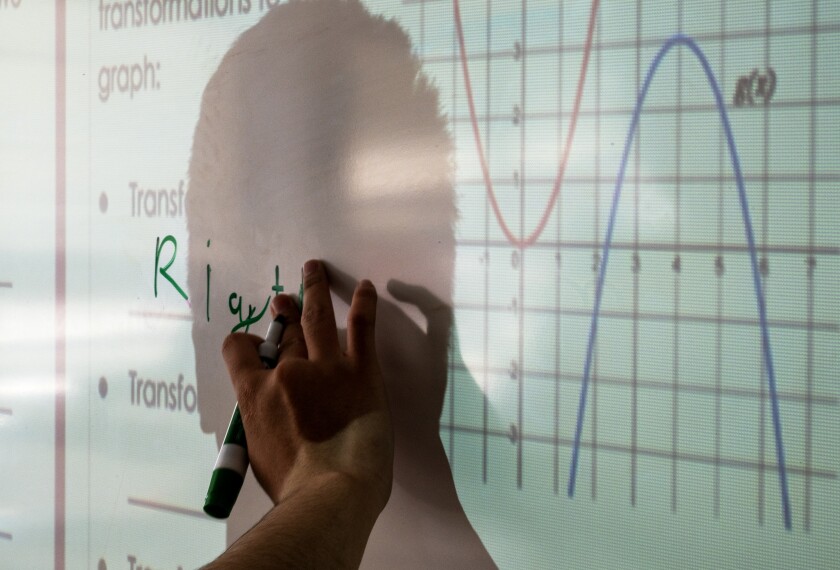
At Annadale, Kyle uses gestures and visuals to make abstract ideas tangible. For example, with graph transformations, she physically demonstrates stretching and compression.
By making the lessons visual, students “can associate a certain motion with something that we’re talking about,” she said.
Even so, vocabulary remains a challenge. Everyday words like “table” take on new meanings in math. University of Florida’s Araujo noted that in a math class, a table means “some kind of array of numbers arranged in a particular way to show a relationship.”
Translation adds another layer. Weinmann pointed out that while textbooks translate “division” as “dividir,” many students understand it as “entre.”
“There are times where I have to skim through the textbook,” Weinmann said, “and make sure [a word] is trans-adapted, not just translated.”


