Middle and High School Math: How to Get Struggling Learners on Track
May 4, 2026

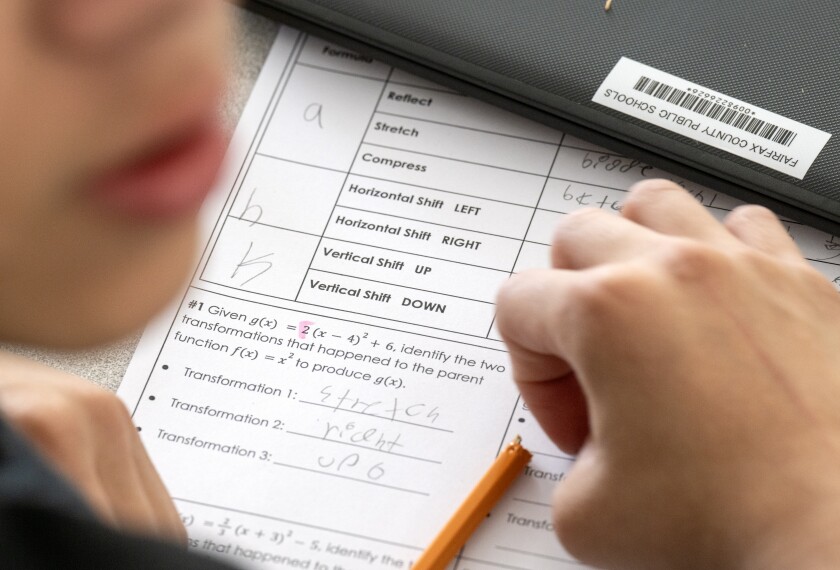
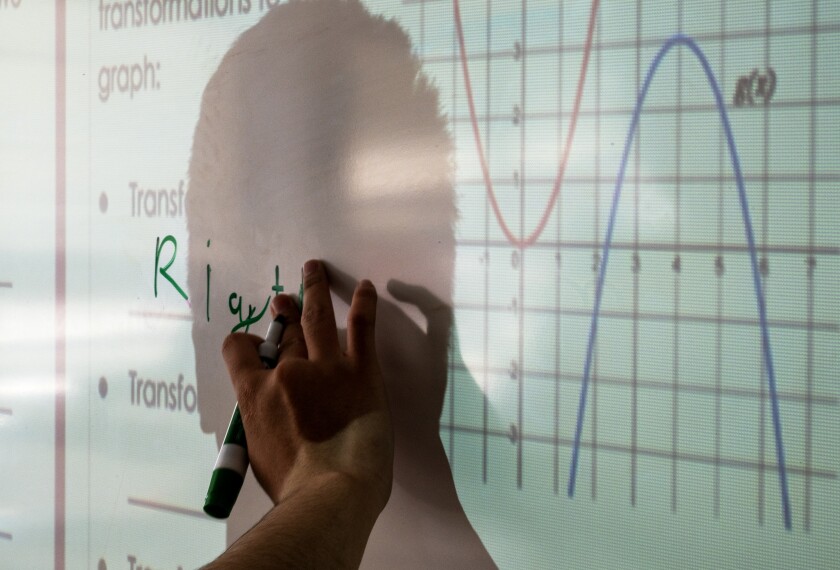
While the academic struggles of young learners in math have been a huge concern, many educators say the challenges facing middle and high school students in that subject are every bit as acute. Recent national test scores in math show a decline in student performance at the high school level that extends back more than a decade. And classroom educators confirm what the test scores show: They describe students arriving in middle and high school lacking foundational skills that make the task of introducing and guiding teens through topics like algebra especially daunting.
In this special report, Education Week looks at where the academic pipeline in math from early grades through high school is failing to deliver, and what can be done about it. One story, by Senior Staff Writer Sarah Schwartz, examines the core academic grounding that many middle and high school students lack, and how schools are attempting to rebuild it. Assistant Editor Alyson Klein breaks down efforts by schools to use technology—specifically AI—to attempt to engage older students in math by “personalizing” lessons to their interests. Senior Staff Writer Evie Blad guides readers through the results of a new, original EdWeek Research Center survey of district and school leaders and teachers on where they see the biggest challenges in secondary math. And Digital News Reporter Jennifer Vilcarino explores strategies to support English learners—a major population in many schools—by focusing not only on their mastery of math concepts but also their math vocabulary. The report not only offers a nuanced picture of the challenges facing schools in math, but also the strategies districts are trying to help students turn the corner.
In this special report, Education Week looks at where the academic pipeline in math from early grades through high school is failing to deliver, and what can be done about it. One story, by Senior Staff Writer Sarah Schwartz, examines the core academic grounding that many middle and high school students lack, and how schools are attempting to rebuild it. Assistant Editor Alyson Klein breaks down efforts by schools to use technology—specifically AI—to attempt to engage older students in math by “personalizing” lessons to their interests. Senior Staff Writer Evie Blad guides readers through the results of a new, original EdWeek Research Center survey of district and school leaders and teachers on where they see the biggest challenges in secondary math. And Digital News Reporter Jennifer Vilcarino explores strategies to support English learners—a major population in many schools—by focusing not only on their mastery of math concepts but also their math vocabulary. The report not only offers a nuanced picture of the challenges facing schools in math, but also the strategies districts are trying to help students turn the corner.
 Mathematics What Schools Should Do to Pump Up the Deflated Math Skills of Older StudentsResearch offers guidance on supporting teenagers who struggle with foundational skills.
Artificial Intelligence 'Personalized' Learning in Math Has Proved Elusive and Overhyped. Can AI Offer a Breakthrough?Efforts to use the tech to customize lessons to students' individual interest demonstrate its potential—and the shortcomings.
Mathematics From Our Research Center Elementary Math Has Been in Focus. But Middle and High School Students' Struggles Are DauntingAn EdWeek Research Center survey finds that educators see older students' lack of progress in the subject as an acute problem.
Mathematics From Our Research Center Fractions Scuttle Many Students' Math Ambitions. New Models Can Clear the WayPre-algebraic skills and basic operations also are stumbling blocks, the EdWeek Research Center finds.
Mathematics How Two Schools Are Rethinking Math for English LearnersSchools in Oregon and Virginia are trying to build students' vocabulary in the subject—and their confidence.
Mathematics Video The Algebra Hurdle: One School's Strategy to Help Students Clear ItAn EdWeek video describes an Indiana school's use of tutoring and courses with different levels of rigor to help students.Mathematics Reports Student Achievement in Math: 5 Trends in K-12 EducationBased on a 2026 survey, this report highlights challenges that students have in math as they move from early grades to secondary schools.
Mathematics What Schools Should Do to Pump Up the Deflated Math Skills of Older StudentsResearch offers guidance on supporting teenagers who struggle with foundational skills.
Artificial Intelligence 'Personalized' Learning in Math Has Proved Elusive and Overhyped. Can AI Offer a Breakthrough?Efforts to use the tech to customize lessons to students' individual interest demonstrate its potential—and the shortcomings.
Mathematics From Our Research Center Elementary Math Has Been in Focus. But Middle and High School Students' Struggles Are DauntingAn EdWeek Research Center survey finds that educators see older students' lack of progress in the subject as an acute problem.
Mathematics From Our Research Center Fractions Scuttle Many Students' Math Ambitions. New Models Can Clear the WayPre-algebraic skills and basic operations also are stumbling blocks, the EdWeek Research Center finds.
Mathematics How Two Schools Are Rethinking Math for English LearnersSchools in Oregon and Virginia are trying to build students' vocabulary in the subject—and their confidence.
Mathematics Video The Algebra Hurdle: One School's Strategy to Help Students Clear ItAn EdWeek video describes an Indiana school's use of tutoring and courses with different levels of rigor to help students.Mathematics Reports Student Achievement in Math: 5 Trends in K-12 EducationBased on a 2026 survey, this report highlights challenges that students have in math as they move from early grades to secondary schools.



Support for coverage of mathematics, post-high school pathways, AI and emerging technology, the teaching profession, and influential state markets is provided by the Gates Foundation. Guided by the belief that every life has equal value, the Gates Foundation works to help all people lead healthy, productive lives. Its commitment to education centers on working to ensure all students graduate high school prepared to succeed in college and careers.