Reading & Literacy

All Write Now

By Ashtar Analeed Marcus — February 17, 2006 1 min read
  • Save to favorites
  • Print

Texas law requires all elementary school students to learn about their community, but when 2nd grade teacher Marilyn Phillips looked for a book to anchor her lessons on Fort Worth, there was none. So she wrote her own.
BRIC ARCHIVE

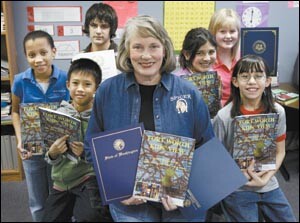
The John D. Spicer ElementarySchool teacher recruited six former students and spent a recent summer touring more than 25 sites that reflect Fort Worth’s character, taking notes and photos at places such as the stockyards, the National Cowgirl and Cattle Raisers museums, a vintage railroad, and local theaters and art museums. The resulting book, published last year, is an illustrated, 63-page guide to the city titled Fort Worth Kids’ View. The descriptions and explanations of the sites are supplemented by asides from the 3rd and 5th graders themselves.

The volume, which resulted in local television appearances for the young authors, letters of praise from several elected officials, and a request from first lady Laura Bush for a copy, has also raised more than $300 for the school’s library through book sales. And it’s apparently filled a yawning curriculum gap: At least six of Phillips’ colleagues have begun using the book to help children learn about local history, art, and social studies.

“The purpose of this book was to help me, as an educator, teach about my community,” Phillips says. “I couldn’t find a book about Fort Worth that was appealing to elementary students.” She adds that the project has also boosted the student scribes’ composition skills. “Children are writers, and it’s just opened the door for them to do that. We hope that this book will encourage students across the nation to write books together.”

The experience has already whetted the publishing appetite of one collaborator. Phillips “put the writing bug in me,” reports 9-year-old Natalie Flores, a book coauthor and now an aspiring autobiographer. “She said we had to write every day, and that just made us better at it. That made me feel really confident.”

“It’s just been an incredible opportunity for all of them,” adds principal Mike Dukes. “They’ve gotten a taste of what it’s like to write, to edit, to publish. [Phillips] has got an incredible ability to find something they enjoy working with.”

Related Tags:

Events

Webinar Supporting Older Struggling Readers: Tips From Research and Practice
Reading problems are widespread among adolescent learners. Find out how to help students with gaps in foundational reading skills.
This content is provided by our sponsor. It is not written by and does not necessarily reflect the views of Education Week's editorial staff.
Sponsor
Reading & Literacy Webinar
Improve Reading Comprehension: Three Tools for Working Memory Challenges
Discover three working memory workarounds to help your students improve reading comprehension and empower them on their reading journey.
Content provided by Solution Tree
Recruitment & Retention Webinar EdRecruiter 2026 Survey Results: How School Districts are Finding and Keeping Talent
Discover the latest K-12 hiring trends from EdWeek’s nationwide survey of job seekers and district HR professionals.

EdWeek Top School Jobs

Teacher Jobs
Search over ten thousand teaching jobs nationwide — elementary, middle, high school and more.
View Jobs
Principal Jobs
Find hundreds of jobs for principals, assistant principals, and other school leadership roles.
View Jobs
Administrator Jobs
Over a thousand district-level jobs: superintendents, directors, more.
View Jobs
Support Staff Jobs
Search thousands of jobs, from paraprofessionals to counselors and more.
View Jobs

Read Next

Reading & Literacy Letter to the Editor Experts Diss Small-Group Instruction. Why?
Experts shouldn't label the practice as ineffective, argues this letter to the editor.
1 min read
Education Week opinion letters submissions
Gwen Keraval for Education Week
Reading & Literacy Video What Happens When Middle and High Schoolers Still Struggle to Read?
When it comes to reading, teachers and experts alike say that many older students still struggle with the basics.
1 min read
Students attend Bow Memorial School in Bow, N.H. on Oct. 29, 2025. Bow Memorial School is a middle school that has developed a systematic approach to addressing foundational reading gaps in middle school students.
Sophie Park for Education Week
Reading & Literacy Opinion Yes, Small-Group Reading Instruction Works. But Use It Wisely
When is the best time to use the approach over whole-class literacy instruction?
Nell K. Duke & Claude Goldenberg
4 min read
Collage of different instruction types including, one-on-one, small group, and whole class instruction.
Getty Images + Education Week
Reading & Literacy How to Build a Reading Block: Two Teachers Share Their Approaches
Studies don't prescribe how best to knit together components of reading—leaving it up to teachers to devise.
7 min read
Students in Anjanette McNeely's class work on their letters during a reading block at Windridge Elementary School in Kaysville, Utah, on Dec. 4, 2025.
What's the best way to attend to all the elements of the 'science of reading' in a literacy block? Research doesn't specify a specific answer, but kindergarten teacher Anjanette McNeely has designed hers to incorporate foundational skills, content, and writing. McNeely's class works on their letters at Windridge Elementary School in Kaysville, Utah, on Dec. 4, 2025.
Niki Chan Wylie for Education Week