Federal

Spellings Hits Road, Stresses Charter Plan

By Alyson Klein — January 30, 2007 3 min read
  • Save to favorites
  • Print

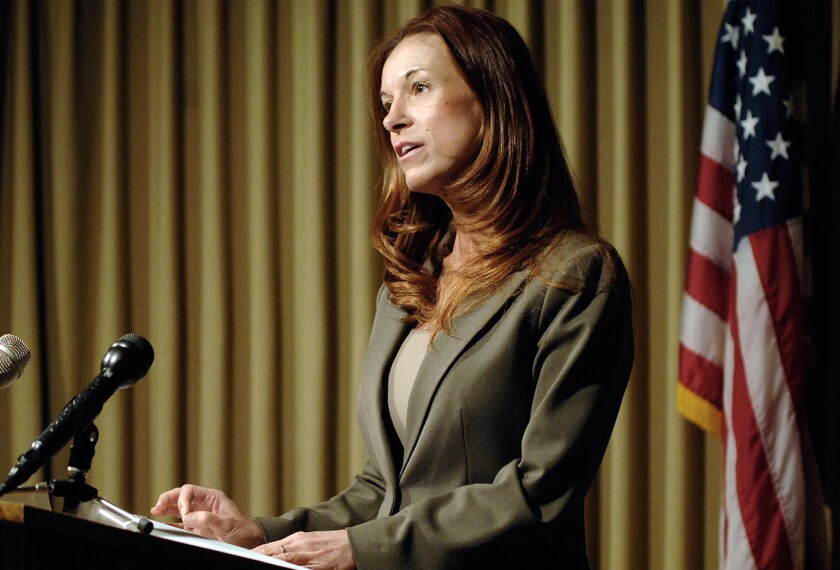
The day after the Bush administration unveiled its most detailed plans yet for renewing the No Child Left Behind Act, Secretary of Education Margaret Spellings selected a charter high school here as the first stop in a campaign to sell a plan that includes expanding the role of charter schools and revamping high school instruction.

“People ask me, ‘Is No Child Left Behind possible?’ And I say yes, it’s absolutely possible. And people say where is that happening, and I say right here at Noble Street,” Secretary Spellings said on Jan. 25 at a student assembly at Noble Street Charter High School, which was founded under a charter from the Chicago school board. It was her first school visit after Mr. Bush’s Jan. 23 State of the Union address. “I am very encouraged by the innovation that’s going on here. … We need to open up more charter schools where they are needed.”

See Also

The administration’s plan would make it easier for districts to turn faltering regular public schools into charters. The administration said it would support local decisions to reopen schools identified as needing improvement under the No Child Left Behind law as charters, even if state law limits the number of those independent public schools.

But that idea is likely to face opposition in the Democratic-controlled Congress. Sen. Edward M. Kennedy, D-Mass., the chairman of the Senate Health, Education, Labor, and Pensions Committee, said in a statement last week that he was “disappointed that the administration has proposed circumventing state law with respect to worker protections [in teacher contracts] and other issues,” including charter school laws.

Secretary Spellings told reporters here that the proposal had been carefully vetted by federal lawyers and would not violate state laws. She also hinted that there would be increased federal spending on education in President Bush’s budget proposal next week, something Democratic leaders say is necessary to gain their support for renewing the NCLB law this year.

“I’m confident we’ll be putting our money where our mouth is,” said Ms. Spellings, although she declined to provide specifics. The last two White House budget proposals sought to level-fund K-12 education spending, including Title I grants to states.

The Bush administration has also been urging states and districts to offer extra pay to effective teachers who are willing to go to low-performing schools. Last year, the 426,000-student Chicago school district received a $30 million grant from the Department of Education’s Teacher Incentive Fund for that purpose.

Arne Duncan, the chief executive officer of the Chicago system, highlighted that proposal in his remarks at Noble Street. “For the first time ever, we are going to put great teachers in the schools that need the most help,” he said.

Emphasis on College Prep

The 450-plus-student Noble Street Charter High School appeared to embody curricular and governance principles that the administration would like to implement nationally.

The administration’s NCLB plan calls for schools to offer rigorous courses, particularly at the high school level. At Noble Street, students receive about 25 percent more mathematics and reading instruction than their peers in other public high schools in Chicago, according to Michael Milkie, the superintendent of the three-campus Noble Network of Charter Schools.

The administration’s proposal calls for states to report how many students complete Advanced Placement courses, including data for subgroups such as racial minorities.

Noble Street’s curriculum emphasizes college preparation and includes a course called College Writing, in which students work on their applications for admission and research financial-aid options.

A version of this article appeared in the January 31, 2007 edition of Education Week as Spellings Hits Road, Stresses Charter Plan

Events

School & District Management Webinar Squeeze More Learning Time Out of the School Day
Learn how to increase learning time for your students by identifying and minimizing classroom disruptions.
This content is provided by our sponsor. It is not written by and does not necessarily reflect the views of Education Week's editorial staff.
Sponsor
Reading & Literacy Webinar
Improve Reading Comprehension: Three Tools for Working Memory Challenges
Discover three working memory workarounds to help your students improve reading comprehension and empower them on their reading journey.
Content provided by Solution Tree
Recruitment & Retention Webinar EdRecruiter 2026 Survey Results: How School Districts are Finding and Keeping Talent
Discover the latest K-12 hiring trends from EdWeek’s nationwide survey of job seekers and district HR professionals.

EdWeek Top School Jobs

Teacher Jobs
Search over ten thousand teaching jobs nationwide — elementary, middle, high school and more.
View Jobs
Principal Jobs
Find hundreds of jobs for principals, assistant principals, and other school leadership roles.
View Jobs
Administrator Jobs
Over a thousand district-level jobs: superintendents, directors, more.
View Jobs
Support Staff Jobs
Search thousands of jobs, from paraprofessionals to counselors and more.
View Jobs

Read Next

Federal Ed. Dept. Offices Will Be Virtually Wiped Out in Latest Layoffs
The U.S. Department of Education is losing about a fifth of its already diminished workforce.
9 min read
Itinerant teacher April Wilson works with Zion Stewart at Bond County Early Childhood Center in Greenville, Ill., on Sept. 29, 2025.
Teacher April Wilson, who works with visually impaired students, works with a student at Bond County Early Childhood Center in Greenville, Ill., on Sept. 29, 2025. The latest round of layoffs at the U.S. Department of Education will leave the federal office of special education programs with few staffers.
Michael B. Thomas for Education Week
Federal A New Wave of Federal Layoffs Will Hit the Education Department
Multiple divisions will lose staff members, according to the union representing agency staffers.
3 min read
Office of Management and Budget Director Russell Vought speaks to reporters after Democratic and Republican Congressional leaders met with President Donald Trump at the White House on Sept. 29, 2025, in Washington, D.C.
Office of Management and Budget Director Russell Vought speaks to reporters after Democratic and Republican congressional leaders met with President Donald Trump at the White House on Sept. 29, 2025. Vought announced Friday that federal layoffs during the shutdown have begun, and those layoffs will hit the U.S. Department of Education.
Allison Bailey/NurPhoto via AP
Federal Senate Confirms Longtime North Dakota Schools Chief for Top Ed. Dept. Role
Senators approved a batch of Trump nominees that also included others to top Education Department posts.
3 min read
North Dakota Superintendent of Public Instruction Kirsten Baesler announces the gathering of a task force to look into future options the state has for the assessment of students during a press conference May 8, 2015, at the state Capitol in Bismarck, N.D.
North Dakota Superintendent of Public Instruction Kirsten Baesler speaks at a press conference on May 8, 2015, at the state capitol in Bismarck, N.D. Baesler will serve as assistant secretary of elementary and secondary education after her Tuesday confirmation by the U.S. Senate.
Mike McCleary/The Bismarck Tribune via AP
Federal How the Federal Government Shutdown Is Affecting Schools: A Tracker
Education Week monitored how the federal government's shutdown affected schools and other education functions.
1 min read
School entrance with a flag in background.
iStock/Getty