
Federal

Senate Confirms Longtime North Dakota Schools Chief for Top Ed. Dept. Role

The Senate also confirmed a new leader of the department’s office for civil rights
By Brooke Schultz — October 07, 2025 3 min read
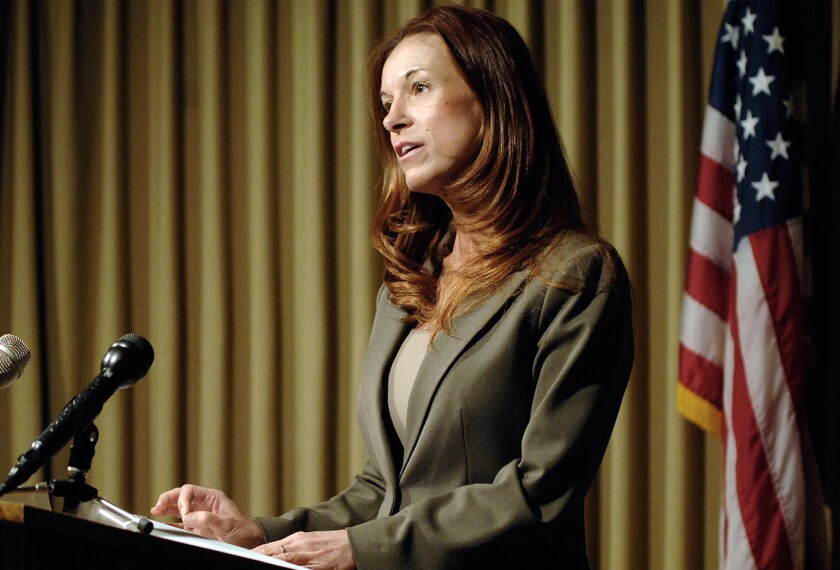
North Dakota Superintendent of Public Instruction Kirsten Baesler announces the gathering of a task force to look into future options the state has for the assessment of students during a press conference May 8, 2015, at the state Capitol in Bismarck, N.D.
  • Save to favorites
  • Print

Kirsten Baesler, the longtime North Dakota state education chief, cleared a U.S. Senate vote Tuesday to serve in a top leadership role at the U.S. Department of Education.

Baesler will join the department as assistant secretary of elementary and secondary education under Education Secretary Linda McMahon, amid turbulent changes to the federal agency that has seen rapid downsizing during the Trump administration. President Donald Trump tapped Baesler for the post in February.

The division Baesler will lead, the office of elementary and secondary education, oversees some of the federal government’s core K-12 functions, including distribution of Title I funds to states and enforcement of the Every Student Succeeds Act, the primary federal school accountability law.

See Also

North Dakota Superintendent of Public Instruction Kirsten Baesler announces the gathering of a task force to look into future options the state has for the assessment of students during a press conference May 8, 2015, at the state Capitol in Bismarck, N.D.
North Dakota Superintendent of Public Instruction Kirsten Baesler announces the gathering of a task force to look into future options the state has for the assessment of students during a press conference May 8, 2015, at the state Capitol in Bismarck, N.D. President Donald Trump has tapped Baesler to serve as assistant secretary of elementary and secondary education.
Mike McCleary/The Bismarck Tribune via AP

With a history of working across the political aisle, Baesler is the longest-serving current state education chief. She was first elected to her nonpartisan post in 2012, where she helped her state achieve national status in competency-based instruction and computer science, and she was last reelected in 2024. She also has served as president of the bipartisan Council of Chief State School Officers during her time as North Dakota’s state chief.

Her nomination had cruised through the Senate Health, Education, Labor and Pensions committee without a hearing, and was sent on to the full Senate in May. Since then, it had been among the executive branch nominations that the Senate didn’t approve until it changed its rules to allow the confirmation of several nominees at once with a simple majority vote.

Baesler was one of more than 100 nominees approved Tuesday in a 51-47, party-line vote.

“I am honored, humbled, and incredibly excited to have received this final vote of confidence from the U.S. Senate,” she said in a statement after the vote.

Baesler’s confirmation coincides with the first government shutdown in seven years, during which most of the Education Department’s workforce is furloughed and newly confirmed nominees can’t be sworn in. That workforce has also shrunk considerably since President Donald Trump took office in January, as he has aggressively worked toward his campaign promise to abolish the 45-year-old federal agency and disseminate its vast portfolio to other agencies.

It’s a vision Baesler herself has carried out at the state level. Last year, Beasler authored an opinion piece about cutting staff at North Dakota’s department of public instruction, and moving mental health services to another agency, outlining how it could serve as a model for the federal government.

She also suggested moving some of the federal Education Department’s functions, like civil rights enforcement and student loans, to other Cabinet-level agencies, mirroring suggestions made in the conservative policy agenda Project 2025. The Trump administration has already begun implementing several Project 2025 proposals, particularly in K-12 education.

Baesler’s appointment comes after the department’s presumptive No. 2, former state education chief and educator Penny Schwinn, dropped her bid to serve in the agency after some conservative lawmakers chafed at her past comments on gender and race in classrooms. The administration hasn’t yet announced a new appointee. Schwinn is serving as a senior adviser and chief strategist in the department—a post that doesn’t require Senate confirmation.

Alongside Baesler, Kimberly Richey, who will oversee the agency’s office for civil rights, was also confirmed Tuesday. The office has, in recent months, become a strict enforcer of the president’s public policy agenda in K-12 schools and colleges and universities.

See Also

President Donald Trump speaks before signing an executive order barring transgender female athletes from competing in women's or girls' sporting events, in the East Room of the White House, Wednesday, Feb. 5, 2025, in Washington.
President Donald Trump speaks at the White House on Feb. 5, 2025, before signing an executive order barring transgender females from competing in women's or girls' sports. Transgender athlete policies have been a common subject of investigations into schools, colleges, state education departments, and athletic associations by the U.S. Department of Education since Trump took office.
Alex Brandon/AP

Craig Trainor—who has been leading the office for civil rights since the start of the Trump administration in an interim capacity and has been a main actor in enforcing the administration’s efforts to eradicate diversity, equity, and inclusion programs—was confirmed to be an assistant secretary at the U.S. Department of Housing and Urban Development in Tuesday’s vote.

Events

Reading & Literacy K-12 Essentials Forum Supporting Struggling Readers in Middle and High School
Join this free virtual event to learn more about policy, data, research, and experiences around supporting older students who struggle to read.
School & District Management Webinar Squeeze More Learning Time Out of the School Day
Learn how to increase learning time for your students by identifying and minimizing classroom disruptions.
Recruitment & Retention Webinar EdRecruiter 2026 Survey Results: How School Districts are Finding and Keeping Talent
Discover the latest K-12 hiring trends from EdWeek’s nationwide survey of job seekers and district HR professionals.

EdWeek Top School Jobs

Teacher Jobs
Search over ten thousand teaching jobs nationwide — elementary, middle, high school and more.
View Jobs
Principal Jobs
Find hundreds of jobs for principals, assistant principals, and other school leadership roles.
View Jobs
Administrator Jobs
Over a thousand district-level jobs: superintendents, directors, more.
View Jobs
Support Staff Jobs
Search thousands of jobs, from paraprofessionals to counselors and more.
View Jobs

Read Next

Federal Video Here’s What the Ed. Dept. Upheaval Will Mean for Schools
The Trump administration took significant steps this week toward eliminating the U.S. Department of Education.
1 min read
The U.S. Department of Education building is pictured in a double exposure on Oct. 24, 2025, in Washington, D.C.
Maansi Srivastava for Education Week
Federal What State Education Chiefs Think as Trump Moves Programs Out of the Ed. Dept.
The department's announcement this week represents a consequential structural change for states.
6 min read
The U.S. Department of Education building is seen behind the Dwight D. Eisenhower Memorial on Oct. 24, 2025 in Washington, D.C.
The U.S. Department of Education building is seen behind the Dwight D. Eisenhower Memorial on Oct. 24, 2025 in Washington, D.C. The department is shifting many of its functions to four other federal agencies as the Trump administration tries to downsize it. State education chiefs stand to be most directly affected.
Maansi Srivastava for Education Week
Federal See Where the Ed. Dept.'s Programs Will Move as the Trump Admin. Downsizes
Programs overseen by the Ed. Dept. will move to agencies including the Department of Labor.
President Donald Trump signs an executive order regarding education in the Oval Office of the White House, Wednesday, April 23, 2025, in Washington, as Commerce Secretary Howard Lutnick, Labor Secretary Lori Chavez-DeRemer, and Education Secretary Linda McMahon watch.
President Donald Trump signs an executive order regarding education in the Oval Office of the White House on April 23, 2025, as Commerce Secretary Howard Lutnick, Labor Secretary Lori Chavez-DeRemer, and Education Secretary Linda McMahon watch. The Trump administration on Tuesday announced that it's sending many of the Department of Education's K-12 and higher education programs to other federal agencies.
Alex Brandon/AP
Federal Most K-12 Programs Will Leave Education Department in Latest Downsizing
The Trump administration announced six agreements to transfer Ed. Dept. programs elsewhere.
U.S. Secretary of Education Linda McMahon is interviewed by Indiana’s Secretary of Education Katie Jenner during the 2025 Reagan Institute Summit on Education in Washington, D.C., on Sept. 18, 2025.
U.S. Secretary of Education Linda McMahon is interviewed by Indiana Secretary of Education Katie Jenner during the 2025 Reagan Institute Summit on Education in Washington, D.C., on Sept. 18, 2025. The U.S. Department of Education on Tuesday unveiled six agreements moving administration of many of its key functions to other federal agencies.
Leah Millis for Education Week
