Federal

Judge Reverses Ed. Dept.'s Abrupt End to States’ Time to Spend COVID Relief

The judge’s order provides relief in the 16 states that sued along with the District of Columbia
By Mark Lieberman & Brooke Schultz — May 06, 2025 | Updated: May 06, 2025 4 min read
Conceptual illustration of a coin in the top section of an hour glass
  • Save to favorites
  • Print

Updated: This story has been updated to add additional comments.

A federal judge on Tuesday halted the Trump administration’s decision to effectively cancel more than $1 billion in K-12 education funding for more than a dozen states—but left the door open for the U.S. Department of Education to again terminate the funding after giving states advance notice.

Judge Edgardo Ramos said in the May 6 order that the 16 Democratic state officials who sued along with the District of Columbia had shown sufficient reason to halt a March 28 letter from Education Secretary Linda McMahon abruptly announcing that the administration had moved up the due date for spending remaining pandemic relief funds.

Ramos’ order prohibits the Education Department from enforcing or implementing the letter’s cancellation of those spending extensions for the 16 states and the District of Columbia through the course of litigation or until a subsequent court order. The department also cannot modify those extensions for the states that sued to spend their pandemic dollars without providing at least 14 days’ notice announcing a new deadline. His order doesn’t apply to states that didn’t participate in the lawsuit.

See Also

Education Secretary Linda McMahon arrives before President Donald Trump attends a reception for Women's History Month in the East Room of the White House, Wednesday, March 26, 2025, in Washington.
Education Secretary Linda McMahon arrives before President Donald Trump attends a reception for Women's History Month in the East Room of the White House, Wednesday, March 26, 2025, in Washington. In a letter Friday, McMahon told state leaders on March 28 that their time to spend remaining COVID relief funds would end that same day.
Jacquelyn Martin/AP

The Education Department did not immediately respond to a message seeking comment.

In the lawsuit, the states argued that the abrupt termination of the extensions was causing budget shortfalls.

New York Attorney General Letitia James, who led the coalition of states filing the lawsuit, said in a statement the injunction was a “major win” for students and teachers. New York lost access to $134 million in funds from the Education Department’s rescission, according to a news release from James’ office.

“The Trump administration’s illegal decision to cut off essential education funding put some of our most vulnerable students at risk of falling behind in school,” James said.

Ramos’ order endorsed at least one piece of the states’ argument—that the federal agency circumvented procedural steps it needed to take to change the spending deadline. The department could correct that procedural error by issuing a letter that provides states with sufficient notice of a changed deadline.

“It’s a pretty early step in the case, and it isn’t determinative of the outcome,” said Katie Roy, partner and general counsel with Education Resource Strategies, which consults with school districts.

States had raised concerns about harm to programs and students if funding were to stop

In her March 28 letter, McMahon told states that, by failing to meet earlier deadlines for spending COVID relief funding, states “ran the risk that the Department would deny your extension request.” McMahon said in the letter, sent after 5 p.m. on a Friday, that the deadline for spending the funds had passed that same day at 5 p.m.

“Extending deadlines for COVID-related grants, which are in fact taxpayer funds, years after the COVID pandemic ended is not consistent with the Department’s priorities and thus not a worthwhile exercise of its discretion,” she wrote, adding the department would consider extensions on “an individual project-specific basis.”

At a Tuesday hearing in the case, Ramos said the reasoning in McMahon’s letter was “not a reasonable explanation” and that Congress didn’t intend for the funding to end when the federal government declared the COVID-19 emergency to be over, Courthouse News Service reported.

More than 40 states had secured approval from the department—including some while McMahon was in charge—for up to 14 additional months to spend those dollars, largely for contracted expenses like construction and tutoring, when the education secretary ended those extensions. States had already faced a Sept. 30, 2024, deadline to commit to spending those funds for specific services and programs.

See Also

Republican presidential nominee former President Donald Trump speaks during a news conference held at Trump Tower, Friday, Sept., 6, 2024 in New York.
Donald Trump speaks during a news conference held at Trump Tower on Sept. 6, 2024 in New York. His education actions since returning to the White House in January 2025 have drawn numerous lawsuits alleging he's overstepping his authority.
Stefan Jeremiah/AP

In her letter, McMahon said that, instead of blanket approvals to extend the spending timeframe, the Education Department would consider project-by-project extension requests.

Along with the District of Columbia, the states that sued were Arizona, California, Delaware, Hawaii, Illinois, Maine, Maryland, Massachusetts, Michigan, Minnesota, Nevada, New Jersey, New Mexico, New York, Oregon, and Pennsylvania.

Court documents in the case show that the Education Department has started granting some extensions to spend money after McMahon’s March letter, and denying other requests.

Hayley Sanon, the principal deputy assistant secretary and acting assistant secretary for the office of elementary and secondary education, sent a letter May 2 approving continuing funds for four projects in Arizona, while denying four other requests from the state. In the denials, she explained that the projects did not directly support students or their academic recovery.

“I found the projects to be inconsistent with the Department’s priorities and thus not a worthwhile exercise of its discretion,” she wrote in her letter.

See Also

Person thinking to enter money maze puzzle.
iStock/Getty

Several state chiefs, including in Republican-led states such as Mississippi, pushed back on McMahon’s abrupt rule change, arguing that schools would be forced to default on contracts and cut vital services for students if she didn’t reverse course. But only Democratic state officials sued, which means that for now, only their states are getting relief from the court ruling.

Ramos, an appointee of former President Barack Obama, also directed the department to provide written notice to all agency staff and submit evidence to the court of that notice within three days.


Events

This content is provided by our sponsor. It is not written by and does not necessarily reflect the views of Education Week's editorial staff.
Sponsor
School Climate & Safety Webinar
Belonging as a Leadership Strategy for Today’s Schools
Belonging isn’t a slogan—it’s a leadership strategy. Learn what research shows actually works to improve attendance, culture, and learning.
Content provided by Harmony Academy
This content is provided by our sponsor. It is not written by and does not necessarily reflect the views of Education Week's editorial staff.
Sponsor
School & District Management Webinar
Too Many Initiatives, Not Enough Alignment: A Change Management Playbook for Leaders
Learn how leadership teams can increase alignment and evaluate every program, practice, and purchase against a clear strategic plan.
Content provided by Otus
This content is provided by our sponsor. It is not written by and does not necessarily reflect the views of Education Week's editorial staff.
Sponsor
Artificial Intelligence Webinar
Beyond Teacher Tools: Exploring AI for Student Success
Teacher AI tools only show assigned work. See how TrekAi's student-facing approach reveals authentic learning needs and drives real success.
Content provided by TrekAi

EdWeek Top School Jobs

Teacher Jobs
Search over ten thousand teaching jobs nationwide — elementary, middle, high school and more.
View Jobs
Principal Jobs
Find hundreds of jobs for principals, assistant principals, and other school leadership roles.
View Jobs
Administrator Jobs
Over a thousand district-level jobs: superintendents, directors, more.
View Jobs
Support Staff Jobs
Search thousands of jobs, from paraprofessionals to counselors and more.
View Jobs

Read Next

Federal Ed. Dept. Wants to Revamp Assistance Program It Calls 'Duplicative,' 'Confusing'
The department's Comprehensive Centers have already been through a year of shakeups.
3 min read
A first grade classroom at a school in Colorado Springs, on Feb. 12, 2026.
A 1st grade classroom at a school in Colorado Springs, Colo., on Feb. 12, 2026. The U.S. Department of Education released a proposal to rework a decades-old program charged with helping states and school districts problem-solve and deploy new initiatives, calling the current structure “duplicative” and “confusing.”
Kevin Mohatt for Education Week
Federal Will the Ed. Dept. Act on Recommendations to Overhaul Its Research Arm?
An adviser's report called for more coherence and sped-up research awards at the Institute of Education Sciences.
6 min read
The U.S. Department of Education building is pictured on Oct. 24, 2025, in Washington, D.C.
The U.S. Department of Education building in Washington is pictured on Oct. 24, 2025. A new report from a department adviser calls for major overhauls to the agency's research arm to facilitate timely research and easier-to-use guides for educators and state leaders.
Maansi Srivastava for Education Week
Federal Trump Talks Up AI in State of the Union, But Not Much Else About Education
The president didn't mention two of his cornerstone education policies from the past year.
4 min read
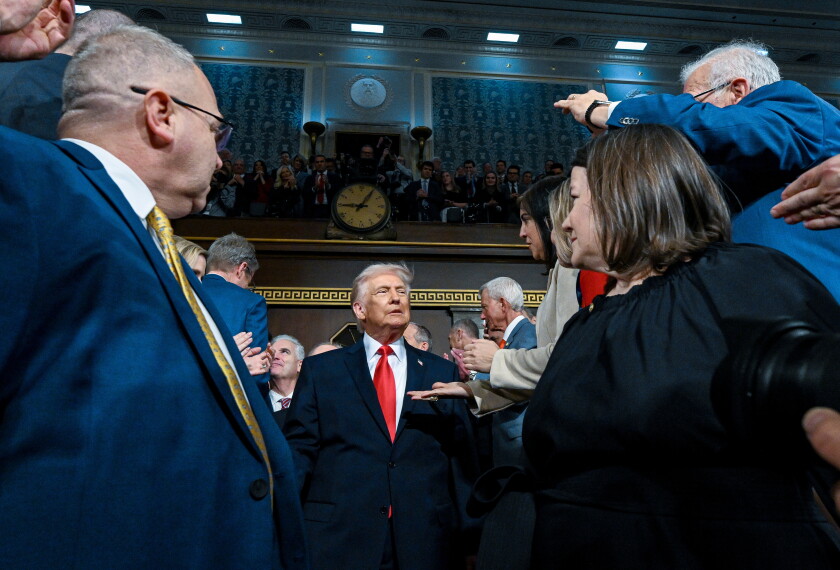
President Donald Trump enters to deliver the State of the Union address to a joint session of Congress in the House chamber at the U.S. Capitol in Washington, Tuesday, Feb. 24, 2026.
President Donald Trump enters to deliver the State of the Union address to a joint session of Congress in the House chamber at the U.S. Capitol in Washington, Tuesday, Feb. 24, 2026. The president devoted little time in the speech to discussing his education policies.
Kenny Holston/The New York Times via AP, Pool
Federal Education Department Will Send More of Its Programs to Other Agencies
Education grants for school safety, community schools, and family engagement will shift to Health and Human Services.
4 min read
Various school representatives and parent liaisons attend a family and community engagement think tank discussion at Lowery Conference Center on March 13, 2024 in Denver. One of the goals of the meeting was to discuss how schools can better integrate new students and families into the district. Denver Public Schools has six community hubs across the district that have serviced 3,000 new students since October 2023. Each community hub has different resources for families and students catering to what the community needs.
A program that helps state education departments and schools improve family engagement policies is among those the Trump administration will transfer from the U.S. Department of Education to the U.S. Department of Health and Human Services. In this photo, school representatives and parent liaisons attend a family and community engagement discussion on March 13, 2024, in Denver to discuss how schools can better integrate new students and families into the district.
Rebecca Slezak For Education Week