
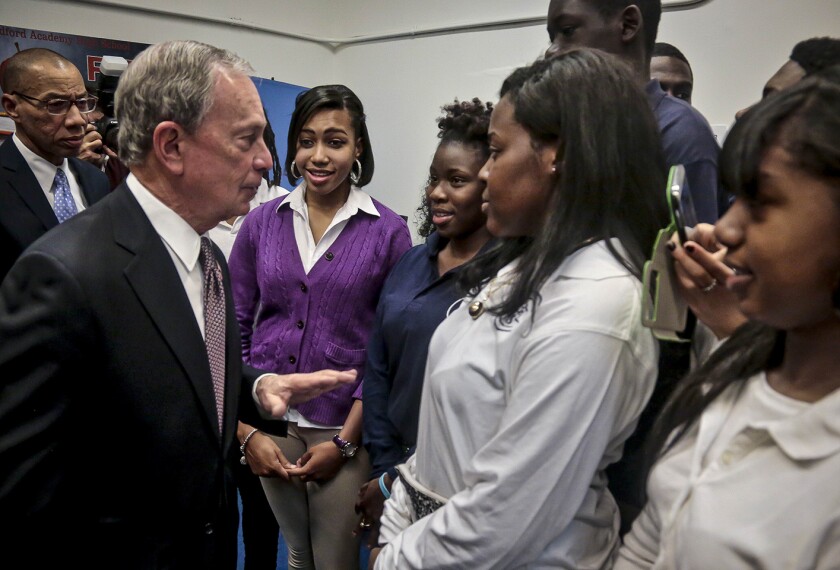
Former New York City mayor and one-time presidential candidate Michael R. Bloomberg has announced a $750 million effort to expand student enrollment in charter schools, pay for new charter facilities, and train teachers and principals who work in charters.
The five-year plan, announced by Bloomberg on Wednesday, aims to increase charter enrollment by 150,000 students, and will focus on 20 metro areas, including New York City. The initiative will also support research into charter schools, and prioritize help for educators of color “so charter school leadership can accurately reflect the diversity of their students.”
In a Wall Street Journal op-ed describing his strategy, which will be overseen by Bloomberg Philanthropies, Bloomberg said he wants his initiative to counter COVID-19’s effects on students and fill the gap left by what he describes as traditional public schools’ failures since the pandemic began.
Bloomberg was blunt about where he thinks things stand. His op-ed begins with the sentence: “American public education is broken.”
A long-time supporter of charters who backed charter school supporters in school board races in places like Louisiana, Bloomberg is also a controversial figure in K-12 circles for his approach to issues like accountability as well as charters. At the start of his tenure as mayor in 2002, Bloomberg sought and successfully gained control of the city’s public schools and fought for increased access to building facilities for charters.
Bloomberg’s position on charters as New York City’s mayor, along with other issues, led him into frequent disagreements with the United Federation of Teachers, the city’s teachers’ union, and American Federation of Teachers President Randi Weingarten.
It’s unclear where exactly Bloomberg’s effort will have an impact. In response to a request for comment from Education Week, a spokeswoman for Bloomberg Philanthropies said Wednesday that the organization is in the process of determining which metro areas, aside from New York, will receive funding through the initiative.
Bloomberg Philanthropies said in a statement that it will partner with local and national organizations, but did not name them.
In some ways, Bloomberg’s new initiative parallels the federal Charter Schools Program, which provides grants intended to support successful charters and help them expand. That program also funds research into charters and helps share best practices between them.
The federal charter program is getting $440 million this year; on an annualized basis, Bloomberg’s initiative amounts to $150 million a year over five years. Congressional Democrats’ unsuccessful efforts to reduce funding for the charter program in recent years has mirrored increasing unease about—and in some cases opposition to—charter schools in the Democratic Party. House Democrats are once again proposing cuts to the program for the upcoming fiscal year.
Bloomberg’s new initiative shows he has not gone along with that political shift.
Bloomberg initiative comes as charters grow during the pandemic
The ex-mayor, who was a Democratic candidate for president in 2020, is launching his initiative at a time when enrollment in charters appears to have grown since early 2020. In September, the National Alliance for Public Charter Schools reported that 240,000 new students enrolled in charters during the 2020-21 school year, based on data from a majority of states. That represents a 7 percent year-over-year increase, according to the alliance. Roughly 3.3 million students were enrolled in charters in the 2018-19 school year, the group reported.
Meanwhile, the overall enrollment of U.S. public schools, including charters, dropped by 1.4 million students during the 2020-21 school year, according to an Education Week analysis from last summer, as the pandemic continued to affect daily operations.
Supporters say the growth in charter school enrollment during COVID reflects many parents’ desire for more education options during the pandemic and dissatisfaction with how many traditional public schools responded to the virus.
But the charter alliance cautioned in September that it was “premature” to draw conclusions about why exactly charter enrollment rose while overall public school enrollment dipped, although the group also characterized the shift as parents and students “voting with their feet.”
Charter supporters, critics react
Nina Rees, the president and CEO of the alliance, said Bloomberg’s initiative “is significant, not only because it will create more dedicated schools and leaders, but also because it signals that government, politics, philanthropy, and the nation are taking notice of how charter schools can be a lifeline for so many students.”
The alliance said that the growth in charters in Oklahoma, Pennsylvania, and Utah during the pandemic was primarily due to growth in cyber charters, but that these schools did not explain charter growth nationwide. An Education Week investigation of cyber charters found a host of problems with many of the schools involving low academic performance and mismanagement.
Bloomberg, who said that funding under the new initiative would not go to fully virtual charters or those run by for-profit organizations, cited the alliance’s figure of 240,000 new charter students. In his op-ed, he said that charters’ flexibility over issues like staffing and compensation make them especially well-suited to respond to the pandemic.
“This allows them to create a culture of accountability for student progress week to week that many traditional public schools are missing. ... As school failures worsen, children are paying a terrible price for this lack of accountability,” he wrote.
But Carol Burris, the executive director of the Network for Public Education, a prominent critic of charter schools, dismissed the idea that charter schools have served students better during the pandemic than other schools and said that the boom in charter enrollment could fade significantly in the next couple of years. She also questioned why Bloomberg wouldn’t give money to support traditional public schools if he believes they’re fundamentally broken.
“Michael Bloomberg has always liked charter schools. That is who he is,” Burris said.
Bloomberg Philanthropies said in its announcement about the $750 million strategy that while some school systems have moved to implement policies focused on educator accountability, student growth, and charters, “in too many places, leaders lack the political will and support to implement these necessary changes.”
Burris speculated that part of the motivation for Bloomberg’s initiative could be to take advantage of the election of Eric Adams to be New York City’s next mayor. Adams received prominent backing from charter supporters during the 2021 mayor election and sided with charters on issues like school security funding during his time as Brooklyn borough president.
While he has indicated that he supports keeping a cap on charters in the city in place, Adams has also previously said that he believes successful charters should get the chance to expand.


