
Roxane M. Dyk’s office is located in the town of Platte, in South Dakota, though in reality, her office is her car. Ms. Dyk estimates she’s spent three out of every four days this fall on the road, putting 1,200 miles on her 2001 Dodge Stratus over a recent 10-day period.
Ms. Dyk is not making sales calls—she’s visiting schools. She’s one of several roving mathematics specialists who work with the state to provide training to elementary teachers, a group of educators who often need considerable help in that subject.
State and local school leaders, as well as professional organizations, have paid increasing attention to improving the math skills of early-grades teachers in recent years. That renewed emphasis has emerged in response to federal testing mandates in elementary school math and also to the recognition that students stand little chance of succeeding in secondary math topics if they flounder in the subject’s more basic content.
Most elementary teachers are generalists who are asked to cover all subjects—math, science, reading, social studies—at their grade level. Many have completed only one or two college-level courses in math, coursework they might barely remember.
Three years ago, South Dakota officials set out to overcome those hurdles through the creation of a professional-development and mentoring program called South Dakota Counts. The program tries to build teachers’ confidence and content knowledge in math. It also encourages them to teach math in a different way, prodding students to explain their answers orally and in writing as ways to increase their depth of knowledge of basic arithmetic and other topics.
The South Dakota program begins in the summer, when Ms. Dyk and math specialists from around the state meet with select elementary teachers at a weeklong seminar. Throughout the school year, the specialists meet with smaller groups of teachers from their assigned regions.
Ms. Dyk said she speaks to the teachers in her group about how students benefit from talking about solutions to math problems rather than just churning out answers. She then asks the teachers to try that verbal approach themselves.
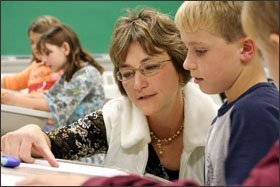
“Once you ask them, ‘Can you explain how you did that?,’ you see there are a lot of misconceptions out there,” Ms. Dyk recalled. “They had never had to visualize what they knew. It was just memorization.”
South Dakota officials refer to that process of written and oral explanation as “cognitively guided instruction,” or CGI. After meeting with groups of teachers in her region, Ms. Dyk begins the work that really racks up the miles on her car. She travels to schools to observe individual teachers in class and offer them suggestions. The idea is that those educators, once they’ve received that help, will become “teacher leaders,” who can work with elementary colleagues in their buildings.
Talking Through Lessons
One teacher-leader Ms. Dyk has worked closely with is Sheryl Muckey, a 4th grade teacher in the 165-student Corsica School District 21-2. Ms. Muckey’s math background is typical of many elementary teachers’. She took a few courses in college, but that was about 25 years ago. She says she did not need help with math content so much as she wanted ideas on how to present lessons in new ways and deepen students’ understanding.
Some of Ms. Dyk’s advice focused on individual problems. After observing one class, Ms. Dyk suggested that the teacher use certain numbers, like 22, when discussing place value, so that it would be easier for students to “hear” the 10s and ones being said.
Other suggestions were aimed at having Ms. Muckey ask more probing questions of students and prove their math knowledge. Ms. Dyk recommended that her students explain in writing why answers to various math problems were true or false. Ms. Dyk also encouraged the Corsica teacher to have the students keep math journals, with words and drawings describing solutions to math problems.
“It’s things I don’t always think of,” Ms. Muckey said. “You teach kids for 20 years, you do certain things automatically.”
South Dakota Counts has helped teachers in 100 districts; 180 teacher-leaders are participating. The program is financed with a $900,000-per-year grant from the U.S. Department of Education’s Title II program, which supports state and local professional-development ventures.
Improving elementary math education, and the skills of teachers who deliver math content, has received increased attention from policymakers and advocacy organizations in recent years.
Two years ago, a major professional organization, the National Council of Teachers of Mathematics, published “Curriculum Focal Points for Prekindergarten Through Grade 8 Mathematics,” a document that seeks to provide educators with clearer direction on the most essential math topics they need to cover.
And earlier this year, the National Mathematics Advisory Panel, a group commissioned by President Bush to report on effective strategies for preparing students for algebra and advanced math, recommended a more focused curriculum in prekindergarten through 8th grade. Students in those grades need strong grounding in fractions, whole numbers, and elements of geometry and measurement, the panel concluded.
Demand for Assistance
Early-grades teachers seek help from many sources. About 40 percent of the NCTM’s conference workshops, publications, and online materials are devoted to pre-K-5 teachers, said James Rubillo, the executive director of the 100,000-member organization, based in Reston, Va. The NCTM targets math specialists, teacher-leaders, and curriculum supervisors in particular, reasoning that they are most effective in helping their colleagues, he added.
Demand for help from elementary teachers, especially at the pre-K-2 level, has risen in recent years, Mr. Rubillo said. Those early-grades teachers often say, “Help us understand the reasons behind the procedures,” the NCTM official said in an e-mail. “Help us make sure that we teach mathematics with more understanding than we experienced ourselves.”
Pinpointing the math content that is most crucial to elementary math teaching has also been a focus of the National Science Foundation, a federal agency that subsidizes research projects across the country on a wide variety of math and science education topics.
Much of the research on elementary-level math educators focuses on cultivating a “deep understanding tied to the math they’re actually teaching,” said Joan Ferrini-Mundy, the director of the NSF’s division of research on learning in formal and informal settings.
South Dakota officials have sought to build that understanding on several fronts, said Stephanie Weideman, the director of the office of curriculum, technology, and assessment for the state education department. In addition to the teacher-to-teacher training provided by South Dakota Counts, the state has worked with Black Hills State University to establish a “math specialist” endorsement for educators who want to be recognized for their skills and their ability to mentor others.
Many students “didn’t have the skills necessary when they left elementary school to continue to improve at the middle and high school level,” Ms. Weideman said. “We worked to make sure we gave them the strong foundation, so they could perform at a high level cognitively when they got to the high school level.”


