Special Report
Classroom Technology

What Educators Really Think About the Overuse of Tech in Schools

By Kevin Bushweller — April 20, 2026 1 min read
EdWeek What Educators Say - Drawbacks
  • Save to favorites
  • Print
The Opposing View
Other educators see it differently. Read the counterpoint: What Educators Really Think About the Benefits of Tech Use in Schools

Most school districts now feature 1-to-1 computing environments for all students. Learning-management systems are used extensively to make classroom assignments, test students, and plan lessons. And teachers and students’ use of artificial intelligence in K-12 classrooms is increasing at a rapid pace.

Advocates of these developments make the case that 1-to-1 computing gives students access to the most current information on a topic, rather than material from outdated textbooks; they point to how learning-management systems allow teachers to use data in more sophisticated ways to improve instruction; and they argue that students need to learn how to use AI to prepare for jobs in a tech-driven economy.

But what about the downsides of using technology for teaching and learning?

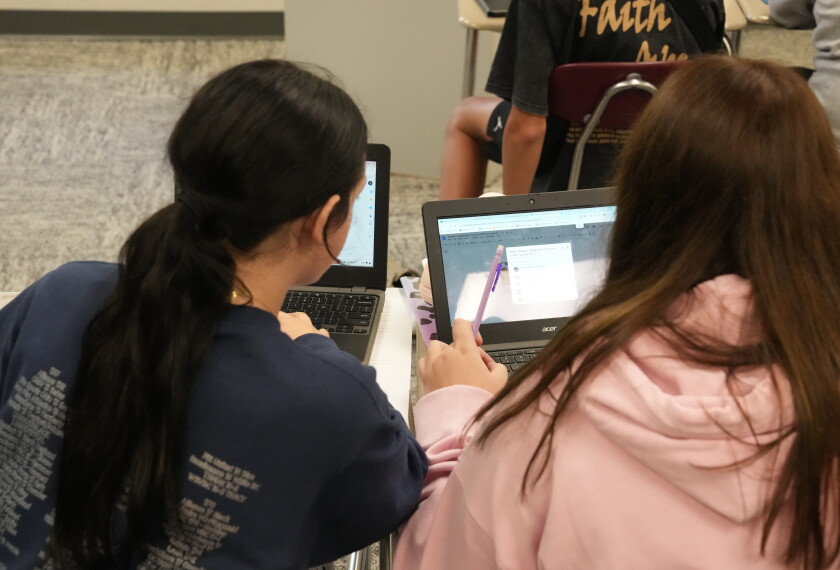
Critics of the overuse of technology in schools argue that it has led to students losing the ability to concentrate and engage in deep learning, stifled creativity and original thinking, created classroom distractions that have hurt instruction in big ways, and harmed students’ mental health. They argue that it is time to dial back the use of it and get back to lower tech, developmentally appropriate learning.

The EdWeek Research Center posed a question in a recent survey asking educators whether they believed ed tech improves or hurts learning. Based on their responses, they were then asked why they felt that way.

Thirty-six percent said technology does more to decrease learning, and their “why” responses are featured in this article. (Twenty-nine percent said tech increases learning. See related article on those responses here.)

Below are 25 responses that we felt best represented a wide range of views from more than 200 answers. They have been edited for length and clarity and are presented in the alphabetic order of the states the respondents are from.


Mourning the loss of deep-thinking skills

   Students have become accustomed to quick answers. They Google what they want to know and take everything as fact without confirming what AI states. I have to constantly remind them that they can't trust immediately—they have to fact-check. Students also have become accustomed to copy/paste without any thought to what they are doing. A lot of technology has stopped all deep-thinking processes.

—Elementary school teacher | Arizona

   PLEASE HELP US. My district has no plans to curb tech use. There's really no hope that we can walk things back. Students are distracted, disengaged, and read MULTIPLE GRADES below reading level. It's atrocious. Learning is not happening, despite my best efforts. Students cheat on EVERY assignment, using ChatGPT for even the most elementary assignments.

—High school teacher—English/language arts/literacy/reading | California

   Computers and digital tools can support instruction, but they are not a replacement for teachers' explicit instruction and guidance. Effective learning requires skilled educators who intentionally model thinking, clearly explain concepts, and scaffold instruction so students can gradually take ownership of their learning. Through explicit instruction, teachers check for understanding, respond to student misconceptions in real time, and create opportunities for meaningful discussion and practice—elements that technology alone cannot replicate.

—Elementary school assistant principal/other school leader | California

   Recently, I have found students request paper assignments. Most students who request online assignments are those who are consistently absent. In my class, students use their computers to play games during my lectures or message other students. They are constantly distracted.

—High school teacher—English/language arts/literacy/reading | Maryland

   Students are losing the ability to write, socialize, and perhaps even think for themselves with the emerging use of AI.

—Elementary school teacher—special education | Colorado

   From what I have seen since our school has implemented laptops in the classroom is a lack of engagement in discussions, not being on the appropriate tab during class time, and increased use of AI to complete work.

—High school teacher—social studies/humanities/civics/history | Colorado

   Distraction! Fosters the mindset, "I'll just Google it." A few years ago, I asked students to choose an issue that was important to them personally and write a speech about it. Some students actually had to search Google for "good topic for a speech."

—High school teacher—English/language arts/literacy/reading | Connecticut

   There are fundamental skills of attention, discipline, and focus that they have not developed. They cannot focus for more than a few minutes; they cannot even read a question that has multiple sentences. They cannot determine relevant info from irrelevant information. Now if they had those skills, and a few students do, then technology is a great way to increase their understanding of course content and apply their knowledge to novel cases, but as it stands, they are just using technology to play games and get answers online, even if the answers they obtained are incorrect.

—High school teacher—science | Florida

1 / 8
Auto-rotating · click to pause

Development of curiosity and creativity are at risk

   Technology hijacks creativity and curiosity. Technology inhibits peer-to-peer interactions, social and emotional learning, and behavior. Students are habituated toward immediate feedback and answers and thus do not have stamina or tolerance for waiting or wondering.

—Elementary school teacher | Illinois

   Students have no idea how to use technology as a tool, only as a toy. They are given no classes or instruction on proper usage and do not know how to use it for work. It also divides focus and encourages multitasking, which is not a skill that they possess. The way technology is used keeps most students firmly in the concrete thinking phase rather than encouraging them to move to the abstract phase of thinking.

—Middle school teacher—social studies/humanities/civics/history | Kansas

   Students cut school if they can just log in and complete work from home, lack of academic dialogue, lack of critical thinking, lack of meaningful classroom discussion, increased anti-social behaviors.

—High school teacher—math/computer science/data science | Kentucky

   Students have become too reliant on technology. They display diminished critical-thinking skills and diminished stamina for working through struggle. They want the answers instantly and are used to them being readily available through technology.

—Middle school teacher—English/language arts/literacy/reading | Massachusetts

   The students are asked to do so much testing and are expected to be on the computer to practice skills. We have seen the impact it is having. Kids need to write and be able to express themselves without all this testing. Even our 4- to 6-year olds all test on the computer. This is not allowing the brain to develop.

—Elementary school reading intervention teacher—special education | Michigan

   There is no thinking involved. They use AI, don't bother to actually read the answer it spits out, and either cut and paste or copy in by hand the answer AI gives them. Most don't even try to think it through. It also causes a LOT of drama, interpersonal conflicts, damages mental health, etc. Many are so addicted they can't go more than 15 or 20 minutes without checking their phone and they demonstrate an inability to focus. They all also claim that they can multitask. Research has consistently shown that idea is a myth, you just do both tasks poorly.

—High school teacher—English/language arts/literacy/reading | Michigan

   Students have little ability to take their time reading or looking at work. They scroll through rather than read an article. They glance at art rather than closely examine it.

—High school teacher—fine arts-related subjects (e.g., art, dance, music, theater) | New Jersey

   I think it is different at different age levels. But we are seeing a negative impact on student language (which leads to literacy) skills from lack of conversation. I also don't think that the amount of tech in classrooms in general was ever right-sided after COVID.

—District-level administrator—curriculum and/or instruction | New Hampshire

1 / 8
Auto-rotating · click to pause

Educators see too many distractions, not enough active learning

   1. Distractions and multitasking. 2. Surface-level engagement. 3. Overreliance on digital tools. 4. Reduced interaction and discussion. 5. Cognitive overload.

—Elementary school assistant principal/other school leader | New York

   Students’ use of technology for school-related purposes can sometimes decrease learning when it leads to distraction, shallow engagement, or overreliance on digital tools rather than active thinking. While devices provide quick access to information, students may be tempted to multitask or quickly search for answers instead of fully processing and analyzing the material. This can reduce opportunities for deeper comprehension, problem-solving, and meaningful discussion with peers and teachers.

—Elementary school teacher | New York

   Standard-level students do not have the maturity and self-control to limit their use to academic purposes. They're playing games or watching sports instead of paying attention to my lesson or engaging in meaningful online content.

—High school teacher—English/language arts/literacy/reading | North Carolina

   Our students' attention spans are so low. They don't have a drive to do well or to explore more in learning. Students don't have much of a work ethic anymore. It's become more of an "entertain me, or I won't do it" type of attitude. I know this is not a problem that only our school has. I also know that it's not just due to their school-related work or school-issued devices. When they go home, they are on video games and/or devices much of the time. Parents are on their devices much of the time.

—Elementary school assistant principal/other school leader | Ohio

   The studies prove that overuse of technology and screen time have net negative effects on student achievement and lead to heightened anxiety, low-cognitive engagement, and lower attention spans.

—District-level administrator-technology | Pennsylvania

   Decades of research demonstrates that children learn best with traditional tools. As a school-based [speech and language pathologist] for over 25 years, I witness the harms daily from the excessive use of technology on learning and on social-skills development. The tech industry has profited while students suffer. We need to remove 1:1 device [programs] for ALL students.

—Middle school speech and language pathologist | Rhode Island

   Research has shown that students retain (so actually learn) more content and show mastery in more skills using pen-and-paper activities. Research also shows that all of us spend too much of our day on screens, and it has a negative impact on our mood. Finally, with the advent of AI, more and more students use it to cheat than to enhance their learning. Yes, they used to just Google an answer before, but it at least required them to organize, synthesize, and analyze the information. And, yes, students used to just copy information from textbooks, but most assessment tasks required more than a surface level of information, so even if a student copied one or more assignments in a unit, their mastery could be more accurately measured by the quality of projects, quizzes, essays, and subject-area tests.

—High school assistant principal/other school leader | Tennessee

   They want to listen to music, change backgrounds, search for their interests more than actually use it for educational purposes. I started the year using more technology than I do now because students are trying to use the computer for their own interests, have little self-regulating of the educational time. There is a lot of wasted time where there is no educational value.

—Elementary school teacher | West Virginia

   Elementary students learn better through hands-on learning. They need to be physically moving their bodies and manipulating tools, even something as simple as flashcards are a tool of manipulation. Sitting and looking at a screen and only using a keypad and keyboard is not enough stimulation. Also, many activities are game-based. There are many students who just fly through the material, guessing, or hitting random buttons just to get to the game. Even if they score low points, they will eventually earn enough points to play something, and that is what they are looking for.

—Elementary school teacher—Bilingual education/English as a second language | Wisconsin

1 / 9
Auto-rotating · click to pause

Related Tags:

Events

This content is provided by our sponsor. It is not written by and does not necessarily reflect the views of Education Week's editorial staff.
Sponsor
Reading & Literacy Webinar
Unlocking Success for Struggling Adolescent Readers
The Science of Reading transformed K-3 literacy. Now it's time to extend that focus to students in grades 6 through 12.
Content provided by STARI
Jobs Virtual Career Fair for Teachers and K-12 Staff
Find teaching jobs and K-12 education jubs at the EdWeek Top School Jobs virtual career fair.
This content is provided by our sponsor. It is not written by and does not necessarily reflect the views of Education Week's editorial staff.
Sponsor
College & Workforce Readiness Webinar
Portrait of a Learner: From Vision to Districtwide Practice
Learn how one district turned Portrait of a Learner into an aligned, systemwide practice that sticks.
Content provided by Otus

EdWeek Top School Jobs

Teacher Jobs
Search over ten thousand teaching jobs nationwide — elementary, middle, high school and more.
View Jobs
Principal Jobs
Find hundreds of jobs for principals, assistant principals, and other school leadership roles.
View Jobs
Administrator Jobs
Over a thousand district-level jobs: superintendents, directors, more.
View Jobs
Support Staff Jobs
Search thousands of jobs, from paraprofessionals to counselors and more.
View Jobs

Read Next

Classroom Technology What's Worse for Students: A Boring Worksheet or Ineffective Ed Tech?
Some parents and policymakers are growing skeptical of the value of education technology.
5 min read
Amelia Vance, the founder & president of the Public Interest Privacy Center, leads a discussion on Feb. 10, 2026, at George Washington University law school in Washington, D.C. about problems in providing clear information about digital learning tools to educators and families. Panelists included Meg Jones, a professor at Georgetown, and Sara Collins, the director of government affairs at Public Knowledge, a nonprofit organization.
Amelia Vance, at left, the founder and president of the Public Interest Privacy Center, leads a discussion on Feb. 10, 2026, at George Washington University law school in Washington. The panel discussed problems schools are having providing clear information to parents and educators about the digital learning tools students are using. <br/>
Alyson Klein/Education Week
Classroom Technology How These Elementary Schools Are Teaching Students Good Digital Habits
Two schools are trying to instill smart tech practices in even the youngest learners.
4 min read
A vector silhouette illustration of a young boy using electronic devices in various poses including laying down and using a tablet, crouched and using a smart phone, and standing taking a selfie. A multi-coloured wave pattern is the background.
DigitalVision Vectors
Classroom Technology More States Are Pairing Cellphone Bans With Media Literacy Instruction
Students need to develop the skills to critically analyze the content they view on their phones.
2 min read
Hand holding sieve to filter truth from lies, facts from fakes. Concept of media literacy, fake news detection, and critical thinking in digital age.
iStock/Getty
Classroom Technology How Do Teens Feel About Cellphone Bans? You Might Be Surprised
A survey by the Pew Research Center provides a window into what students think of cellphone bans.
4 min read
Group of students holding cell phones in their hands.
iStock/Getty