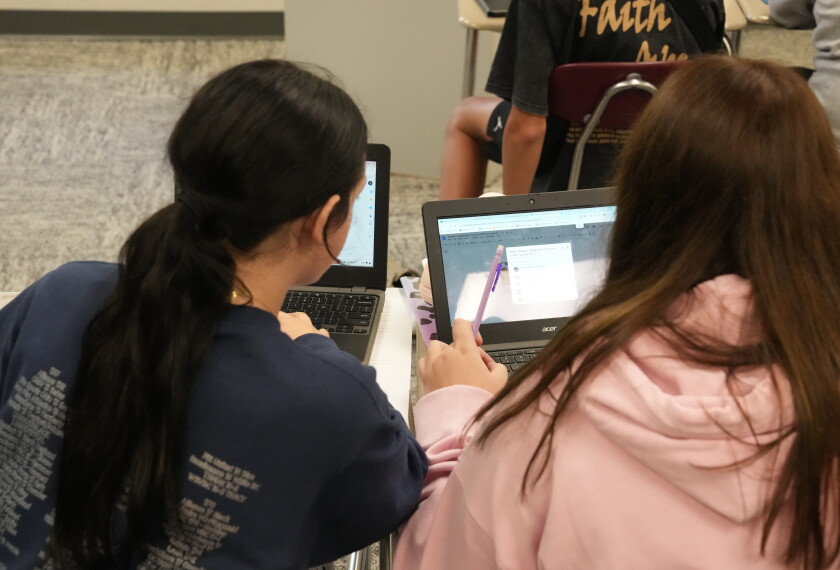
Schools have been confronting a rising tide of concern over—and outright hostility toward—screen time in the classroom, and education leaders don’t expect that sentiment to ebb this coming school year.
If anything, they predict pushback to education technology will grow. That’s why district leaders across the country are thinking seriously about getting to the right amount of classroom tech use and communicating more deliberately with parents about how educators are using technology—even those who haven’t yet seen local backlash against devices in their classrooms.
To map out how significant an issue education “techlash” will be for school leaders and how they should respond, Education Week spoke with several district leaders, a school communications expert, and a parent advocate to hear their predictions for the next school year and their strategies for getting ahead of the pushback.

Their answers coalesced around a few major themes: Many school systems are likely overdue for a tech reset and a deep look at how much tech they’re using; district leaders are worried the pendulum might swing too far in the other direction, leading schools to ditch technology that’s actually useful for student learning; and communication with parents will be key to striking a balance.
The superintendent of the Minnetonka, Minn., public schools, David Law, says parents have been expressing concerns about the amount of tech use in their kids’ schools. In response, his district is reevaluating its classroom technology use and scaling some of it back.
“We have to do a reset, and we have to retrain our kids because some kids have developed some bad habits, and some staff members maybe have developed bad habits,” he said.
But there’s no simple solution, said Law, who is also the immediate past president of AASA, the School Superintendents Association. “If we stop sending technology home, there are households that will still have technology and then there are kids that won’t,” he said.
In Michigan, Tom Livezey, the superintendent of Oakridge public schools, said he has not experienced a big tech backlash in his district, but he’s still preparing for it.
“The conversation needs to be deeper than just screen time,” he said. “The two things that I intend to focus on are: Is the technology safe, and is it helping students learn?”
Is it time for a tech reset? Here’s how to find out
To navigate parental concerns over tech, Law knew he needed to start with data—on how parents feel but also on what’s actually happening in classrooms. His district recently surveyed its teachers about how much class time students are spending on screens.
“In our teacher survey, we have some teachers who reported much more use than we would’ve ever approved,” he said.
Furthermore, Law said, products his district purchased years ago have added a host of new features the district doesn’t need and may not fit its educational goals.
“Now our kids, and even teachers, might say, ‘Hey, this is pretty cool, practice on this.’ But it was beyond what we intended for the amount of time and use,” Law said.
Moving forward, teachers are to only use technology when it’s appropriate, make students put devices away as soon as they complete an activity, and never start class on screens, Law said. School-issued devices should never be used just to kill time. At the elementary level, devices won’t be sent home with students unless it’s deemed necessary, such as for the district’s Chinese and Spanish immersion programs, for which many resources and practice tools are online, Law said.
We have to do a reset, and we have to retrain our kids because some kids have developed some bad habits, and some staff members maybe have developed bad habits.
In Belvidere, Ill., Superintendent Cassandra Schug first heard concerns from parents about tech use in classrooms in the course of surveying staff, students, and families about the district’s cellphone policies.
The concerns were especially pronounced among elementary families, she said. So, Schug is using the playbook her district developed to address students’ cellphone access at school to also tackle classroom tech concerns. (The district ultimately landed on a three-tier cellphone policy, with student phones banned in elementary schools, allowed during lunch in middle schools, and permitted during lunch and passing periods at the high schools.)
In addition to surveys and focus groups, a research study team comprising students, educators, school board members, and others will examine research and best practices on classroom tech use.

“As long as you are making changes that are for the betterment of your students, at the end of the day, I think mostly people are going to get behind that,” she said.
Communication with families can uncover more nuanced perspectives
If education leaders seek feedback from parents and guardians, they may find attitudes that differ from the dominant national narrative of strong tech backlash, said Keri Rodrigues, the president of the National Parents Union.
Parents’ opinions about tech in schools are nuanced, she said.
In recent NPU polling, only 1% of parents said they wanted zero screen time in schools. Three quarters said they wanted daily screen time limits (with most saying 1-3 hours is appropriate), and three quarters of parents also said their schools’ device use is already at about the right level.
“They want guardrails, not handcuffs,” said Rodrigues. “This is technology that kids will need to be prepared for the economy and the jobs of the future.”
Parents are also far more concerned about the potential harmful effects of social media on their kids than the internet and AI more broadly, Rodrigues said.
“If you want to know how parents feel about something, you’ve got to open yourself up and talk to them, and you’ve got to do it before the cake is already baked,” she said. If districts skip those steps, they’ll develop policies that are less effective and result in parent pushback.
Good communication is as much about listening as it is about talking, said Mellissa Braham, the associate director of the National School Public Relations Association. That can happen through advisory committees, surveys, parent teacher organizations, and school board meetings, she said.
They want guardrails, not handcuffs. This is technology that kids will need to be prepared for the economy and the jobs of the future.
Getting input from families is an important first step. But to assuage parents’ concerns about technology use in the classroom, school and district leaders need to tell parents what is going on inside classrooms.
“It’s really important for school systems to approach communications about educational technology first from listening to parents’ concerns. Then they’re going to be better able to explain how the educational technology use is different from the screen time that is triggering those concerns,” Braham said, referring to technology designed for learning versus gaming and social media apps.
School leaders and teachers can share details about the kinds of tech they use and why in newsletters, Braham said. She recommends placing that information at the top so there’s a better chance parents will see it.
Not all screen time is equal—and schools must communicate that
For the technology that schools intend to keep, testimonials from parents discussing how it has helped their kids can be an effective messaging tool, said Braham.
And that’s another key point in the communication strategy: after the surveys and the soul searching and the reset, school and district leaders must explain to families the benefits of the technology they’re sticking with.
Technology allows educators to personalize learning for large and diverse classrooms of kids, something that would be extremely difficult—if not impossible—to do otherwise, said Schug, the Belvidere, Ill., superintendent.
“There’s a lot of ways we use those Chromebooks that really foster effective, differentiated instruction,” she said. “Whatever we do here with those Chromebooks, we have to make sure we’re not throwing the baby out with the bath water.”

Adaptive assessments on computers can quickly provide detailed data on students’ academic progress—and who needs extra help—that teachers can put to use right away.
It’s a difficult balancing act, acknowledges Krestin Bahr, the superintendent of the Peninsula school district in the Seattle area. But at the same time, she’s found that parents often aren’t completely anti-technology.
“What we heard from parents,” she said, is that “they want us to prepare [their kids] for an AI world. At the same time, they are anxious and worried about their kids being addicted to screens.”
Bahr is trying to assuage parents’ concerns by making sure the district’s youngest students have analog learning tools and supplies, such as manipulatives, pencils, and paper.
Law is making some changes in his Minnesota district to “intentionally communicate on this topic more, because parents are telling us we don’t know enough.”
The district plans to share a list of the technology its schools use, and it’s creating a new online system that will make it easier for parents to comment on the district’s tech use and flag concerns.
But it’s not just about parents, Law said. Educator input and buy-in are also important.
“The parents giving feedback are not practitioners, and I’m not a 2nd grade teacher,” he said. “Developing a plan without the people who have to implement it is destined to fail.”