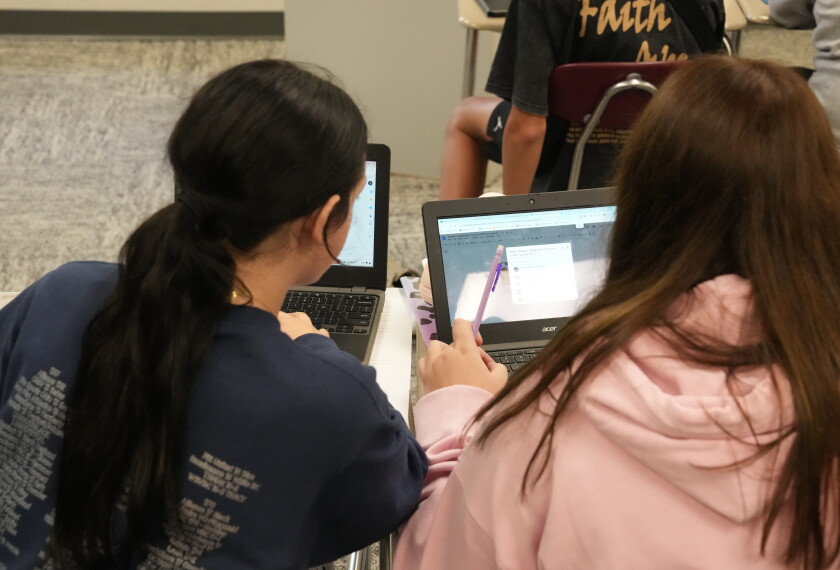
Parents are pushing back against the amount of time students spend on screens in schools amid broader concerns over the effects of excessive technology on children’s well-being, creativity, critical thinking, and social skills.
While some educators acknowledge that a tech reset in schools may be needed, there’s also a general concern that potentially beneficial tech tools will get scrapped in the rush to purge screens from classrooms.
So, how do school and district leaders explain to parents that some technology is beneficial to learning? In many ways, addressing education “techlash"—the shorthand for growing objections to schools’ ed-tech use—is as much a communications issue as it is an issue of how much time students are spending on screens.

It’s vital that schools explain the difference between unhealthy and healthy technology use to parents, said Mellissa Braham, the associate director of the National School Public Relations Association, which provides communications services and training to school leaders. She doesn’t predict parents’ concerns over technology in schools will suddenly dissipate this year.
Braham spoke with Education Week about how schools can communicate with parents about tech use at a time when many K-12 leaders are bracing for the pushback to grow. This conversation has been edited for length and clarity.
Are we seeing this tech backlash because parents don’t know what’s going on in classrooms?

Many school systems try to help parents understand what is going on in their classrooms. But parents are busy, they have a lot on their plate these days, and it is hard to pay attention to all the school newsletters and emails and their district emails. Districts need to be very strategic and intentional about focusing on the specific topic of educational technology use to help assuage some of these parent concerns that are coming up.
It’s really important for school systems to approach communications about educational technology first from the sense of listening to parents’ concerns. And they might do that through advisory committees, through surveys, hearing comments during PTA meetings or board meetings. And once they understand what the parents’ concerns are, then they’re going to be better able to explain how the educational technology use is different from the screen time that is triggering those concerns.
For the education technology that school leaders feel is beneficial, what are some best practices for this communication?
We’ve seen some great examples in the last couple of years of how to go about talking about technology related to personal devices. But I think these examples can carry over into how we talk about educational technology.
Testimonials and firsthand experiences build trust in the information we’re sharing. It’s easier to trust an individual person than it is an organizational entity.
Simple videos, less than a minute, that touch on key points about the use of educational technology, maybe graphically with animation, can be helpful to just make the concepts simple. That’s a different way to communicate that information other than an email or a newsletter that has tons of pages to scroll through with lots of technical information about policies.

You could put up posters—whether that’s in your hallways for students, whether that’s in the room where your PTA comes into, whether it’s something you send home at the elementary level in backpacks—to very simply explain the difference between screen time usage for different purposes and how it is used by the school system.
Another thing that I have seen is providing talking points for building principals because they’re on the front lines of having these conversations with families. We need to empower all of our frontline communicators with talking points so they know how to have this conversation with accuracy and to build that trust.
You said parents get bombarded with information and may not be receiving the message school leaders are sending. How do you cut through the noise?
The best way to get someone to see your communication is to make it personal. The way that we can do that at a school is by saying, “in your child’s classroom, here’s how we use educational technology,” rather than as a district.
It really shouldn’t be just another article tucked in at the bottom of someone’s newsletter. It’s going to be most effective when the person who’s receiving your email feels like the content is specifically meant for them. That means the subject line either mentions their student’s classroom or their student’s school building or their student’s teacher. And that is what cuts through the noise.

We do a lot of research at NSPRA about what parents are looking for in terms of communications. And nationally, most parents say that their school district is communicating about the right amount that they would want.
But at the same time, we hear constantly in parent focus groups that they’re overwhelmed by the volume of communications and that they want things that they feel are specifically for them and it makes it easier to follow the information.
So, targeted newsletters from either the teacher or the principal are best?
The district can make it easier for the school. Your communications person at the district level could meet up with the information technology department and say, “talk to me about how they use educational technology in this building.” And the district communications person could craft a template message and then have one customized by building. Or the communications person could craft a template and say, “principals, ask yourself these three questions so you can customize this newsletter article.”
There is definitely a way for the district to support buildings because our principals, our teachers already have a lot on their plates.
Looking into your crystal ball, will tech backlash continue to be an issue for schools?
I do think so.
The jobs of the future are not going to require less technology. We want to promote students’ well-being and reduce screen time. But at the same time, we have to prepare them for the world ahead. So, the issue of screen time is going to continue to be at the forefront of families’ minds.