

Corrected: A previous version of this story misstated the number of alternate-preparation programs that received an F or a D rating. It was 12.
The number of teacher-preparation programs that teach reading instruction that’s aligned with the greater body of cognitive research has increased significantly over the past seven years, according to a new review.
The National Council on Teacher Quality, a Washington-based group that advocates for more rigorous teacher preparation, has released the latest edition of its Teacher Prep Review, which started in 2013 and assigns letter grades to preparation programs across the country. This time, NCTQ evaluated 1,047 traditional elementary teacher-preparation programs (both graduate and undergraduate), along with 58 alternative-certification programs.
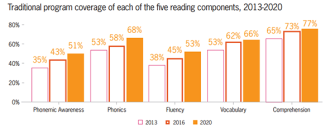
The group found that 51 percent of the traditional programs received an A or B grade for their coverage of the five essential components of reading—phonemic awareness, phonics, fluency, vocabulary, and comprehension. In 2013, just 35 percent received those grades.

“We have been beating this drum since 2006, and our theory was that if you held programs accountable for teaching this stuff, then eventually they would start to teach it,” said Kate Walsh, the president of NCTQ. “We’re very excited that [this progress] substantiates our theory of change.”
However, she said, there is still a long way to go. A third of 4th graders can’t read at a basic level, according to the assessment known as the “nation’s report card.” And most of those students are black and Hispanic children.
“Are we going to write off another generation of kids while we wait for the other 40 to 50 percent [of teacher-preparation programs] to get on board?” Walsh said.
NCTQ has structured its review around the research from the 2000 National Reading Panel, a congressionally mandated review board that named the five essential components of reading and found evidence that explicit, systematic phonics lessons help kids become better readers. Despite these findings, which have been confirmed by further research reviews, many teacher-preparation programs have been slow to embrace what’s become known as the science of reading.
For this review, a team of reading experts evaluated the syllabi for required reading courses to see if the textbooks, planned lecture topics, and assigned readings support the five components of reading. Passing mentions of the components were not enough—NCTQ says its experts looked for “clear evidence of dedicated course time as well as measures to hold teacher candidates accountable for learning each component.” (The methodology of reviewing syllabi has been criticized in the past. Each program is now shown its rating before publication and given a chance to provide input and additional evidence; 15 percent of programs took NCTQ up on that offer for this review.)
In a statement, U.S. Secretary of Education Betsy DeVos slammed colleges whose curriculum did not adequately support the five components of reading.
“When nearly half of our nation’s teaching colleges are teaching future teachers what amounts to junk science, it’s no wonder nearly half of our nation’s low-income 8th graders are functionally illiterate,” she said. “How can anyone sit by and let this continue? How can even one college continue with a discredited curriculum? We know how to teach kids how to read. We just need to equip teachers with the fact-based, proven science to do it.”
Gaps in Coverage
The NCTQ experts found that comprehension was the component most covered by traditional teacher-preparation programs, and phonemic awareness was the least—just over half of traditional programs cover this skill, which is the ability to identify individual sounds in spoken words. And only 53 percent of those programs spend enough time preparing prospective teachers to teach fluency, or the ability to read accurately and smoothly.
Even so, phonemic awareness was the area in which traditional programs saw the most growth—in 2013, only 35 percent of programs covered that particular component.
—Chart via NCTQ
Walsh noted that research about phonemic awareness and fluency is newer than research about the other three components, which might explain their significant improvement over time as professors become more familiar with the body of reading research.
“If you were trained even in the ‘90s, you may not have learned anything about phonemic awareness,” she said. “The fundamental reason why teacher education has not been teaching the science of reading is that the teacher-educators are not themselves trained in it.”
For instance, an Education Week survey asked professors who teach early literacy how many phonemes are in the word “shape.” (There are three: “sh,” “ay,” and “p.”) While nearly all professors answered correctly, there was variation based on experience: 95 percent of those with less than five years in the field responded correctly as compared to 79 percent with more than 20 years of experience.
In the NCTQ review, preparation programs received an A if they adequately covered all five components—26 percent met this benchmark. A quarter received a B, meaning they covered four elements of reading. Eighteen percent of programs received a F, meaning they covered one or zero of the components with enough dedicated course time.
NCTQ also reviewed every required textbook—725 in all, which is seven times higher than the number of textbooks used in elementary mathematics programs—and found that 40 percent are “inadequate” for teaching the science of reading. Many of the textbooks promote unproven strategies like cueing systems, which encourage students to use semantic, visual, and syntactic clues to read an unfamiliar word, and running records, which is a tool for teachers to track student reading errors based on cues.
An Education Week analysis found that professors who teach early-reading courses are introducing the work of researchers and authors whose findings and theories often conflict with one another, including some that may not be aligned with the greater body of scientific research.
The Type of Program Matters
Traditional undergraduate programs have improved the most, according to NCTQ’s analysis. Fifty-seven percent now earn an A or a B, which is a 10-point improvement from 2016 and an 18-point improvement from 2013.
Traditional graduate programs, however, have stagnated. Thirty-three percent earn an A or a B, which is 9-point improvement from 2013, but is the same percentage as in 2016. That is partially due to the fact that more graduate programs are included in this year’s review than in years past, NCTQ notes.
Even so, coverage of the reading components varies significantly by program type—on average, there’s a 20-point difference for each component. For example, just 36 percent of graduate programs cover phonemic awareness, compared to 55 percent of undergraduate programs.

—Chart via NCTQ
Graduate programs do only offer two courses on average in reading instruction, compared to three in undergraduate programs—but even when NCTQ compared two-course graduate programs to two-course undergraduate programs, there was still a meaningful difference in their scores.
Walsh said she’s not sure why this difference exists. One theory, she said, is that the more senior faculty members are more likely to teach at the graduate level, and they might be the least likely to be trained in the cognitive science. That theory is unproven.
However, Education Week’s survey did find that less-experienced instructors were more likely to teach research-backed principles of reading than senior professors. For example, 69 percent of instructors with five years or less experience in higher ed said a student who comes across an unfamiliar word should first sound it out (as opposed to look at the pictures or use context clues to make a guess). Just 38 percent of professors with more than 20 years experience said the same. Senior professors were also much more likely to teach cueing systems.
Also, NCTQ’s review of the 58 alternate-preparation programs yielded poor results—all but 12 of the programs received an F or a D. Only one alternate program, the California Teacher Residency Program at the Alder Graduate School of Education, earned an A.
The NCTQ analysis only considered coursework that’s required before candidates step into the classroom as teachers of record, which is probably why so many programs failed. Many alternate-preparation programs allow candidates to take coursework while teaching.
“It’s a fundamental flaw of their design,” Walsh said. “Most kids only get one chance at 1st and 2nd grade.”
Mississippi a Bright Spot
Just like in 2016, Misissippi teacher-preparation programs earned the highest aggregate grade of the nation, with eight of its 12 traditional programs earning an A and the other four getting a B.
There has been a renewed commitment to early reading in the Magnolia State in recent years. Every undergraduate elementary education program in Mississippi has to require that prospective teachers take two courses in early literacy that cover the five components of reading. And the nonprofit Barksdale Reading Institute has worked to deliver research-based training for professors of early literacy across the state.
Mississippi was also the only state in the nation to make improvements in 4th grade reading over the last two years on the National Assessment of Educational Progress, although those gains cannot be explicitly linked to these reforms.


