Evidence-Based Practice

Read more about educational practices backed by research
Reading & Literacy K-12 Essentials Forum Strategies to Create a Culture of Reading in Schools
Join this free virtual event to learn how teachers and school district leaders ensure students are reading enough.
November 4, 2026
English Learners K-12 Essentials Forum Rethinking Instruction for English Learners
Join this free event to explore teacher preparedness, family communication, and strategies to ensure equity and opportunity for students.
October 1, 2026
This content is provided by our sponsor. It is not written by and does not necessarily reflect the views of Education Week's editorial staff.
Sponsor
Reading & Literacy Whitepaper
Making It Stick: Western U.S. Leaders on Literacy
Explore how Western U.S leaders are building the support, focus, and follow-through needed to turn literacy research into daily practice.
Content provided by Lexia Learning
This content is provided by our sponsor. It is not written by and does not necessarily reflect the views of Education Week's editorial staff.
Sponsor
Reading & Literacy Whitepaper
Built to Last: Central U.S. Leaders on Literacy
See how Central U.S. leaders are creating the focus, structures, and support needed to help effective practices endure.
Content provided by Lexia Learning
Collage-style illustration of the top of the U.S. Capitol building rotunda, with the upper portion hinging open and an arm wearing a suit reaches out holding a pen. The hand is writing a red X through a clipping of a printed letter B, and cut out letters A and C are on the page as well.
Illustration by Emily Wright for Education Week + Getty
Reading & Literacy Opinion Why Congress’s Latest Foray Into the Reading Wars Is Too Sloppy to Work
In trying to promote the science of reading, are politicians doing the opposite?
Timothy Shanahan, September 23, 2026
•
5 min read
WASHINGTON, DC - SEPTEMBER 16: Members of the U.S. House of Representatives leave the Capitol Building after a session on September 16, 2026 in Washington, DC. House Speaker Mike Johnson (R-LA) cancelled votes for Thursday, sending lawmakers home a day early ahead of the midterm-election recess.
Members of the U.S. House of Representatives leave the Capitol after a session on Sept. 16, 2026 in Washington, D.C. The House passed legislation that would make the "science of reading" a priority in some federal literacy grants.
Roberto Schmidt/Getty Images
Reading & Literacy Federal 'Science of Reading' Legislation Passes the House
A bipartisan bill would make the evidence-based instruction a priority in some federal literacy grants.
Sarah Schwartz, September 17, 2026
•
3 min read
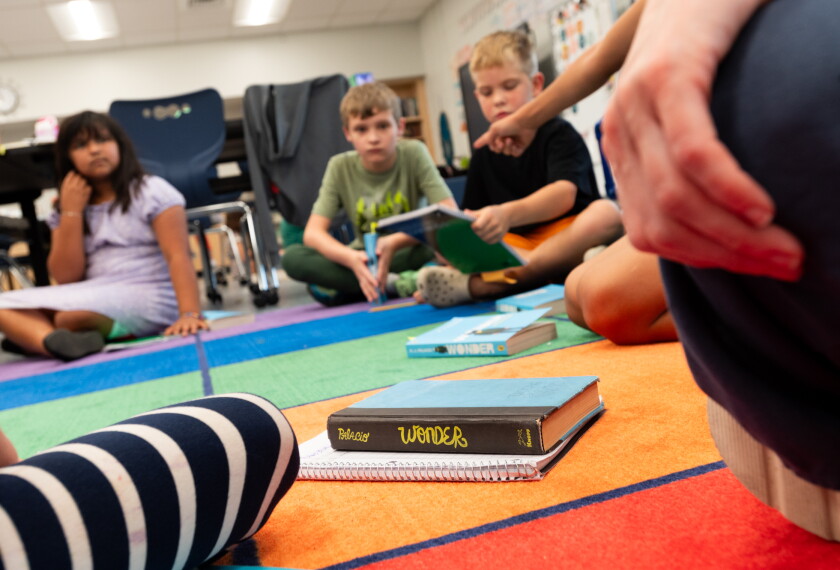
Natalia Gutierrez, age 10 (5th grade), Garrett Christian, age 10 (5th grade), William Robinson, age 8 (3rd grade), wait to begin reading time in the afternoon at Creative Minds School in Wichita, Kansas on September 15, 2026.
Fifth graders Natalia Gutierrez, 10, and Garrett Christian, 10, and 3rd grader William Robinson, 8, wait to begin reading time in the afternoon at Creative Minds School in Wichita, Kan., on Sept. 15, 2026. Applying reading research to the classroom can be challenging, and engineering principles could help, some researchers say.
Melissa Lukenbaugh for Education Week
Reading & Literacy Q&A The Science of Reading Has an Implementation Problem. Could Engineering Help?
Researchers suggest that an "engineering of reading" could better translate evidence into practice.
Sarah Schwartz, September 16, 2026
•
11 min read
This content is provided by our sponsor. It is not written by and does not necessarily reflect the views of Education Week's editorial staff.
Sponsor
Reading & Literacy Whitepaper
Fluency for All: Moving Students Beyond Decoding
The Fluency for All Kit is a free collection of evidence-based resources designed to support educators in identifying fluency gaps and st...
Content provided by WordFlight
Conceptual illustration of classroom conversations and fragmented education elements coming together to form a cohesive picture of a book of classroom knowledge.
Sonia Pulido for Education Week
Mathematics Opinion The Five Questions You Should Ask Before Believing the ‘Science of Math’
Here’s why we should be wary of people claiming to have found the next "science of reading."
Larry Ferlazzo, September 1, 2026
•
5 min read
Education Week opinion letters submissions
Gwen Keraval for Education Week
Mathematics Letter to the Editor We Can't Fall Into 'Math Wars'
The real opportunity for the field is not to choose sides but to build stronger bridges.
August 28, 2026
•
1 min read
This content is provided by our sponsor. It is not written by and does not necessarily reflect the views of Education Week's editorial staff.
Sponsor
Reading & Literacy Whitepaper
The Missing Link Between Decoding and Reading Fluency
Learn how six research-backed principles from cognitive science can make practice more effective and help students develop lasting fluency
Content provided by WordFlight
Teacher Donnie Piercey goes over the results of a writing assignment called "Find the Bot" during his class at Stonewall Elementary in Lexington, Ky., Feb. 6, 2023.
Teacher Donnie Piercey reviews the products of a writing assignment during his class at Stonewall Elementary in Lexington, Ky., on Feb. 6, 2023.
Timothy D. Easley/AP Photo
Reading & Literacy First Reading. Then Math. Is the 'Science of Writing' Next?
Integrating reading and writing can lead to better student outcomes in both areas, studies show.
Sarah Schwartz, August 19, 2026
•
4 min read
Students at R. Brown McAllister Elementary School use exercises in phonemic awareness during literary instruction on March 19, 2025, in Concorn, N.C.
Students at R. Brown McAllister Elementary School practice exercises in phonemic awareness during literary instruction on March 19, 2025, in Concorn, N.C. Consensus exists that teaching students alphabetics, including phonics and phonemic awareness, is critical for reading—but which methods are the most efficient?
Cornell Watson for Education Week
Reading & Literacy A New Phonics Debate Shows How the 'Science of Reading' Movement Is Evolving
Growing momentum behind 'linguistic' phonics has raised questions about how best to use classroom time.
Sarah Schwartz, August 13, 2026
•
6 min read
Julie Celestial, center, teaches her kindergarten class a literacy lesson at Mark Twain Elementary School in Long Beach, California on Tuesday, May 6, 2025 . A new bill could change how literacy is taught in elementary schools by providing transitional kindergarten through fifth-grade teachers with training and textbooks that stress what's known as science of reading, an approach to literacy that focuses heavily on phonics and foundational reading skills to combat California's literacy crisis. Though other states have shifted to this evidence-based reading, California's reading instruction has largely been left to the control of school districts, many of which have not made the switch. The school has begun their shift to a science of reading approach and are seen as an example for other California districts.
Julie Celestial, center, teaches her kindergarten class a literacy lesson at Mark Twain Elementary School in Long Beach, Calif. on Tuesday, May 6, 2025. Proponents of a "speech-to-print" phonics approach say it works more efficiently than other methods. But research evidence is inconclusive.
Allen J. Schaben/Los Angeles Times via TNS
Reading & Literacy What is 'Linguistic' Phonics and Why Are Some Schools Adopting It?
A new question is emerging in the "science of reading": Is one type of phonics instruction better than another?
Sarah Schwartz, August 7, 2026
•
8 min read