

The worst of the pandemic might be over, but how do its effects linger in the classroom?
Handwriting
After over 30 years in education at the school, district, and state department levels, Cindi Rigsbee returned to the middle school classroom this past year to teach 7th grade English/language arts. A national board certified teacher, she was the North Carolina Teacher of the Year in 2009 and a finalist for National Teacher of the Year that same year:
This past school year had challenges, as they all do. But after 34 years in education, I usually see the same obstacles year after year, each with a little twist or a different name. However, this past year, I faced a new one: At least once a day, our teacher discussions would include the comment, “It’s because of COVID.”
I had been away from the classroom for 10 years while working as a teacher trainer, and then as a literacy coach, prior to returning to a 7th grade English/language arts classroom this past year. I have been shocked, saddened, frustrated, and perplexed at the impact that two years away from face-to-face learning had on middle school students. And while students were impacted in numerous ways, one was the most obvious in my ELA classroom: writing.
When it comes to writing, 7th graders have never been fans. And to be honest, the group of students I taught this year had a pretty good command of content from the beginning. Their struggle was with mechanics. They couldn’t grasp spelling (I even had one who misspelled her own name on a paper) and they had only minimal understanding of conventions like punctuation and capitalization. Very few capitalized the pronoun “I” or the first word in a sentence, and as for punctuation, I fielded numerous questions like, “What’s that thing that has a dot on top and a comma under it?” I was speechless.
My 7th graders were in 4th and 5th grades when they endured COVID quarantine, and as wonderful as their online teachers were, I realize it was all but impossible to transfer understanding of writing conventions via videoconferencing during that time. I felt like I was starting from the beginning with them.
But start I did.
I created rubrics for every assignment that detailed the conventions students should address in their writing. I checked boxes intentionally and left room at the bottom to point out problem areas. For example, a student may have a note that said, “Don’t forget to use end marks” or “Capitalize the pronoun I.” After returning the graded rubrics to the students, I then made copies of my own that I kept throughout the year and matched them against subsequent writing activities to ensure they understood the concept and weren’t holding on to bad habits. As the year progressed, students did gradually make changes to their own writing since the comments I made were specific and personal.
In addition to the problems I encountered with the mechanics of writing, there was a much bigger problem that I had not anticipated. Student handwriting during this past school year, more than in any other year I have taught, was many times illegible. This group of 7th graders missed handwriting, specifically cursive, instruction during COVID. In addition to the spelling problems, my students presented a strange mix of uppercase and lowercase letters in their words.
Many students would submit essays with words written like this: cApitALizAtion. Since I learned to read in the ‘60s and use text messages for communication less than my 12- and 13-year-old students, I struggled to be able to read what I needed to grade. The textspeak utilized in my 7th grade classroom made assessing student understanding very difficult because, well, teacher understanding of the writing itself was difficult.
I did some research and found that the best way to help middle school students who are struggling with printing is to teach them cursive. I then consulted with K-5 teachers and received strategies for teaching cursive to my students. With practice sheets in hand, I met with students after school, and we wrote our letters on the dotted lines (just like I remember from learning cursive in elementary school). By the end of the year, some of those who struggled the most presented me with legible writing.
But it is important to note: Habits are hard to break so the more practice, the more improved the students’ writing became. One student in particular (who started the year with inverted letters that were large like you would expect a kindergartner to write) ended the year with, “I can write now! Look at my handwriting!” It was a magical moment after some frustrating times, thanks to COVID.

‘A Strong Desire to Work by Themselves’
Renee Jones was the 2023 Nebraska Teacher of the Year. She teaches AVID and 9th grade English at Lincoln High School. Follow her on Twitter @ReneeJonesTeach:
A large challenge our students are facing due to COVID is the increase in the desire to work independently. In my experience, in the classroom, this often looks like students on their phones in class, partnered with a strong desire to work by themselves, rather than to engage interactively with their peers.
Prior to the pandemic, students were looking at their phones in class. After the pandemic, students are not only glancing at their phones, but they are checking every notification, watching videos, and struggling not to pick up their phones at any perceived moment of downtime. This includes but is not limited to instruction, independent work time, the transition between activities, etc. Students are engaging less with each other face to face and more through sending messages—even students who are in the same room.
The number of interactions and time discussing cellphone expectations, asking students to put their devices away, and filling out the appropriate paperwork necessary to track cellphone usage is often frequently overwhelming.
For a student, their cellphone is often a comfort zone. An easy distraction that feels familiar and at times, useful. Oftentimes, what I, as their classroom teacher, am asking them to do may be uncomfortable or less familiar. Tasks like completing academic research, preparing to present an informative speech in front of their peers, being vulnerable, and talking with peers you don’t know. A cellphone is an entertaining retreat, one that is often providing a barrier to academic success and hinders the ability of our youth to interact face to face.
As an advocate for restorative practices, I advocate and work in my classroom to work with the student to eliminate the distraction of cellphones, while working to build skills needed for collaboration. In my experience, a daily Whack-A-Mole dialogue asking the students to be off of their phones was ineffective and frustrating for both the student and the adult. Going through the administrative documentation process, was, at times temporarily helpful, however, oftentimes daunting. These procedures are time-consuming when in moments, this documentation includes 5-8 students per class, for all five classes, every single day. This, of course, doesn’t include the time it takes to track the documentation, make phone calls home, etc.
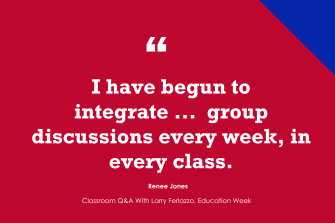
Instead, what I have begun to integrate and open discussion about, including talking with students, is building the technology into the lessons, when applicable, as well as including collaborative partner or group discussions every week, in every class.
Cellphones are not going anywhere. While I believe we should work with our students to integrate the technology they desire, I do not believe that cellphones in the classroom support academic learning.
It is important we engage in a dialogue and academic rigor about the influence of this technology, and appropriate ways to use it, and then model this for our students. Can we encourage students to be out of their seats, move throughout the classroom, talk with students, or only use technology in an appropriate way—something like PearDeck, Kahoot!, research vocabulary, etc. If we can keep the student engaged in our discussion, talking with peers, and using the technology effectively and appropriately, then we can decrease the time spent leisurely on their phone.
All in all, I work to combat cellphones by establishing strong relationships with my students, building an intentional restorative community, and following through on our building cellphone expectations and working intentionally to have students engage with each other. It is a challenging and necessary battle.
Thanks to Cindi and Renee for contributing their thoughts!
Today’s guests answered this question:
What challenges are your students continuing to face because of COVID, and how are you responding to them?
Consider contributing a question to be answered in a future post. You can send one to me at lferlazzo@epe.org. When you send it in, let me know if I can use your real name if it’s selected or if you’d prefer remaining anonymous and have a pseudonym in mind.
You can also contact me on X formerly known as Twitter at @Larryferlazzo.
Just a reminder; you can subscribe and receive updates from this blog via email. And if you missed any of the highlights from the first 12 years of this blog, you can see a categorized list here.


