

Student agency is about creating the conditions where students feel a sense of ownership over their learning.
In today’s post, educators offer suggestions on how teachers can help make it happen.
You might also be interested in The Best Resources On Student Agency & How To Encourage It.
‘Agency Doesn’t Happen by Accident’
Craig Aarons-Martin is CEO of CCM Education Group:
Agency doesn’t happen by accident—it’s cultivated, affirmed, and protected. In every school I’ve led, I’ve told my team: “If students don’t feel ownership, we’re not building a school—we’re managing a building.”
When I taught 5th grade in New Orleans, I let my students redesign our classroom layout, create their own leadership jobs, and co-develop rubrics for group work. That was the beginning of my understanding that agency isn’t just about voice—it’s about power.
Here’s what I’ve consistently done to develop student agency:
- Co-create classroom norms. Students help define what respect looks like, how we handle conflict, and how we celebrate one another. When they build the culture, they’re more likely to protect it.
- Use data as a shared tool, not a secret. I’ve invited students to data conferences to track their progress and set goals. Agency grows when they know how they’re doing and what they can do next.
- Embed student leadership in school governance. I formed student-leadership teams and let youth sit on hiring committees and planning task forces that center issues of equity, belonging, leadership, and advocacy. Their feedback shaped everything from the advisory curriculum to hiring the next head of school.
- Redefine success beyond test scores. We celebrated risk-taking, reflection, and collaboration as much as academic mastery. When students saw growth and courage valued as much as grades, they leaned into their learning journey.
- Affirm identity as a leadership tool. Whether it was through heritage projects, morning meetings, or the school pledge that has us declare “I am strong, bold, and built to master challenges,” I helped students see who they are as an asset to our learning community—not a barrier.
Agency is not about letting go of structure. It’s about building the kind of structure where students feel safe enough to take risks, speak truth, and lead boldly.

‘Co-Creating Community Agreements’
Kwame Sarfo-Mensah is a 15-year veteran educator and the founder and CEO of Identity Talk Consulting, LLC, an independent educational consulting firm that provides professional development and consulting services:
To create a classroom culture that prioritizes student agency and the social-emotional welfare of students, I had to shift my mindset from dictating rules to my students to co-creating a living list of community agreements that promote mutual respect and accountability with my students.
Community agreements served as the foundation that my students and I collectively wanted to establish and maintain within the classroom and beyond. The following table reveals the differences between rules and agreements in terms of how they impact the culture of our classrooms.
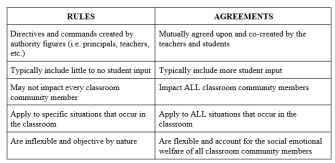
Agreements are not the same as rules. Agreements serve as reminders for all members of the classroom community (including teachers and students) of the type of behaviors they expect themselves and others to exhibit. Every member of the classroom community was responsible for ensuring that the agreements were honored, at all times. First, however, I needed to establish with our students what those agreements would be. To help me with this task, I created a Community Agreements worksheet to help my students write down their visions for how they wanted our classroom community to function.
Co-creating community agreements with students at the start of the school year helped my students and I build a collaborative culture, but to sustain it, I needed to revisit and refine these agreements throughout the year. By regularly revisiting community agreements and updating them with additions, deletions, and revisions, I was able to proactively mitigate harm from conflicts that occurred among members of my classroom community. When those conflicts do happen, the community agreements can help you navigate them.
Overall, community agreements provided clarity to the collective mission of the classroom community and ensured that each member played their role in prioritizing the social, emotional, and physical safety of each person within the classroom. When that happened, order within the classroom was maintained, and my students were in a stronger position to thrive.

‘Write Essential Questions’
Gina Elia is a Chinese and English as a second language teacher based at an independent high school in south Florida:
To encourage more student agency in my classroom, I have recently started inviting my students to write the essential questions for each of our units in my high school Chinese classes.
I first read about this idea in an online article in which an educator teaching the middle school equivalent of the International Baccalaureate program explained that he did this to encourage inquiry in his classroom. His idea appealed to me, and a new practice was born in my classroom.
I still come up with the overall topic of each unit I design for my class—the environment, holidays, or technology, for example—and the first text to which I expose students, so they can learn a bit about the topic in the context of Chinese culture. Sometimes the text is an article, blog, or other written artifact, but I also like to incorporate other multimedia artifacts like films, videos, websites, and TV shows. After we have absorbed and discussed the text, I ask students to each write down some questions they have on the topic that they would like to further explore.
For most subjects, of course, these questions would be in the language of instruction of the class, probably English for most people reading this article. For world-language classes like mine, I ask students to write the questions mostly in the target language, but tell them they can throw in some English words here and there to express their meaning at this stage, since I don’t want their curiosity to be limited by their language ability.
I collect all of the questions anonymously onto one Google Doc and have students vote for their top three choices. The top-voted questions become our essential questions for the rest of the unit. I work with the students to understand how to express those questions accurately in the target language, and then for the rest of the unit, I tailor the activities and learning experiences I design to address the questions students have come up with.
Through this method, students have come up with much more specific questions than I would have thought of on my own or gotten from the textbook I use. More importantly, these questions reflect their real-world concerns and preoccupations.
For example, in a recent IB-level unit on migration, we first read a blog about some students’ experiences of how they have changed since studying abroad and returning home. I had two students in that class who were themselves from abroad who were attending high school in the United States, and unsurprisingly, their questions were ultimately voted in as the essential questions of the unit. They asked about whether one’s relationship with one’s parents changes after studying abroad and whether the experience of studying abroad is influenced by one’s character traits.
These are questions that the other students and I never would have thought to ask because we haven’t studied abroad long term. Their specificity reflects a deep understanding of the study-abroad experience as well as the dynamics it creates and the ways in which it impacts a student’s life. We all came to understand much more about studying abroad than we had before because the voices of my students who had personal stakes in the matter directed the class’s learning.

Options
Tammy Mulligan currently teaches 4th graders on Hanscom Air Force Base in Massachusetts. She is the author of the new book, The Power of Quick and Frequent Practice: Joyful Small Moves with Big Impacts on Elementary Literacy:
One way I help students develop agency in the classroom is by giving them options to reflect and highlight their learning each week. At the beginning of the school year, students learn about two ways to showcase their learning: (1) displaying work in their identity frames, and/or (2) using Seesaw to create videos to share with classmates and/or caregivers.
At the beginning of the year, students decorate an 11x14 cardboard matte frame about themselves. Using photographs, drawings, and words, students express their interests, hopes, and passions on the frame. Then, during the school year, each week, students have the opportunity to take a photograph (either a selfie or have someone else take a photo of them). They print out an 8x10 photo to hang in the frame or add the actual work sample. When new work is added to the frame, students share the hard work they did to accomplish this goal.
Students also have the option to go onto Seesaw and create a video explaining their learning. Once the video is approved by a teacher, caregivers can access these videos at home and even send messages back to their child. To ensure self-reflection occurs regularly in the classroom, I set aside a 10-minute block once a week for students to reflect on and celebrate their accomplishments. However, once students are familiar with this self-reflection, the process occurs more organically throughout the school day, but beginning with a set time, jump-starts the reflection process.

Thanks to Craig, Kwame, Gina, and Tammy for contributing their thoughts!
Today’s post answered this question:
How have you created the conditions for student agency to develop in your classroom?
Consider contributing a question to be answered in a future post. You can send one to me at lferlazzo@epe.org. When you send it in, let me know if I can use your real name if it’s selected or if you’d prefer remaining anonymous and have a pseudonym in mind.
You can also contact me on Twitter at @Larryferlazzo or on Bluesky at @larryferlazzo.bsky.social.
Just a reminder; you can subscribe and receive updates from this blog via email. And if you missed any of the highlights from the first 13 years of this blog, you can see a categorized list here.


