Michigan’s 7th graders are poised to face a tough new set of course requirements by the time they graduate in 2011.
To earn a diploma under a bill passed by the legislature late last month, high school students will need to earn four credits of mathematics and English, three credits of science and social studies, two credits of foreign language, one credit of physical education and health, and one credit in visual, performing, or applied arts.

Students would also have to complete an online learning assignment, such as an online course for high school credit, or a noncredit test-preparation class.
That requirement is thought to be the first of its kind in the nation. (“Mich. Pupils Could Face Online Rule,” Feb. 8, 2006)
“When we hold our kids to high standards, they will do great things,” Gov. Jennifer M. Granholm, who plans to sign the bill into law, said in a press release. “This new curriculum will help give Michigan the best-educated workforce in the nation and bring new jobs and investment to our state.”
The measure—based on a plan adopted by the state board of education in December—also represents a huge shift in the state. Michigan will go from having barely any statewide requirements for graduation to having some of the most demanding standards in the country, observers say. Currently, the state requires only that students pass one semester of civics education. Instead, most graduation requirements are left up to local school districts.
Michael Cohen, the president of Achieve Inc., a Washington-based nonprofit organization that focuses on raising academic standards and student achievement, said that Michigan would join Kentucky and Arkansas in requiring all students to complete four years of mathematics, including Algebra 2.
“There’s growing research that says taking and passing Algebra 2 is necessary to having even decent odds at succeeding in college,” Mr. Cohen said last week.
Fueling the Economy
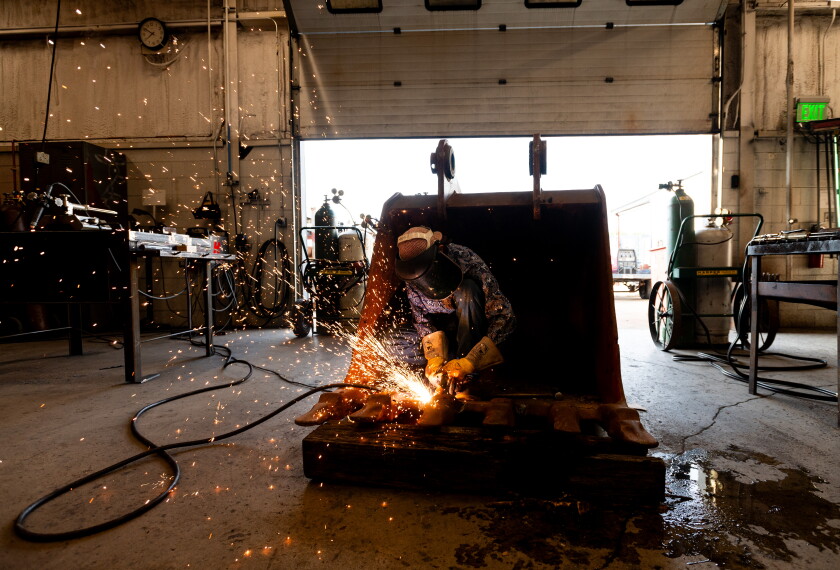
The requirements are also intended to prepare students for advanced manufacturing careers—the kind of jobs that Michigan, hard hit by the woes of the U.S. auto industry, has been trying to attract to bolster its economy. Members of the business community were heavily involved in the effort to craft the legislation.
Work on the bill began two years ago, when Gov. Granholm, a Democrat, convened the Cherry Commission on Higher Education and Economic Growth, named for Lt. Gov. John Cherry, who led the panel. While the group mostly focused on improving access to higher education, it also recommended a more rigorous curriculum in high school and better training for teachers and administrators.
Michigan has also participated in Achieve’s American Diploma Project, which is a network of 22 states working to raise standards in high school and improve graduates’ chances of succeeding in college or work.
The goals of the diploma project include aligning high school standards with expectations of postsecondary education institutions and employers’ needs, and streamlining high school assessments to serve as “readiness tests” for college or employment.
The initiative is among the efforts under way that reflect policy leaders’ anxieties about U.S. students’ preparedness for success in the 21st-century economy. (“Economic Trends Fuel Push to Retool Schooling,” March 22, 2006)
As part of the diploma project, Michigan developed an action plan that closely matches the legislation.
The state’s new requirements would move beyond the current courses required by most districts, according to a recent survey by the state education department. The survey found that fewer than one-third of the state’s 770 districts require Algebra 1, and a little more than a third require students to pass a biology course, to earn a diploma.
Before the final bill was sent to the governor, legislators debated whether the Algebra 2 requirement was too stringent for all students. But in the end, the course was included after a few compromises were reached. For example, students will be able to fulfill the requirement over two years. A student can also seek modifications to the Algebra II requirements after earning half a credit in the course.
“The legislature was insistent that [students] at least try it,” said Martin Ackley, a spokesman for the Michigan Department of Education.
Under the plan, children entering 3rd grade this coming fall will also be able to begin earning their foreign-language credits before they enter high school.
Well-Trained Teachers
Reaction from Michigan education groups has been largely positive.
“Superintendents in Michigan are universally committed to making the high school experience more meaningful,” said William H. Mayes, the executive director of the Michigan Association of School Administrators. “They know the world has changed.”
He added that education leaders are concerned that there won’t be enough highly qualified teachers to help students meet the requirements in mathematics and science. “The other thing universities need to do is to make sure teachers know how to teach it,” he said of those subjects. “Not every child learns exactly the same way.”
Lu Battaglieri, the president of the Michigan Education Association, an affiliate of the National Education Association, said that the union welcomed “the spotlight on high school curriculum,” but asked that local districts and schools have some flexibility in implementing the requirements.
While the first students who would have to comply with the new rules are not in high school yet, Mr. Cohen of Achieve said that the work of preparing students for those courses begins now.
“This will force the education system to pay more attention to students, from the earlier grades on,” he said.
Gov. Granholm’s budget proposal for fiscal 2007 also includes recommendations designed to help strengthen students’ skills, including a new after-school math and science program for middle school students and an expansion of early-childhood education.