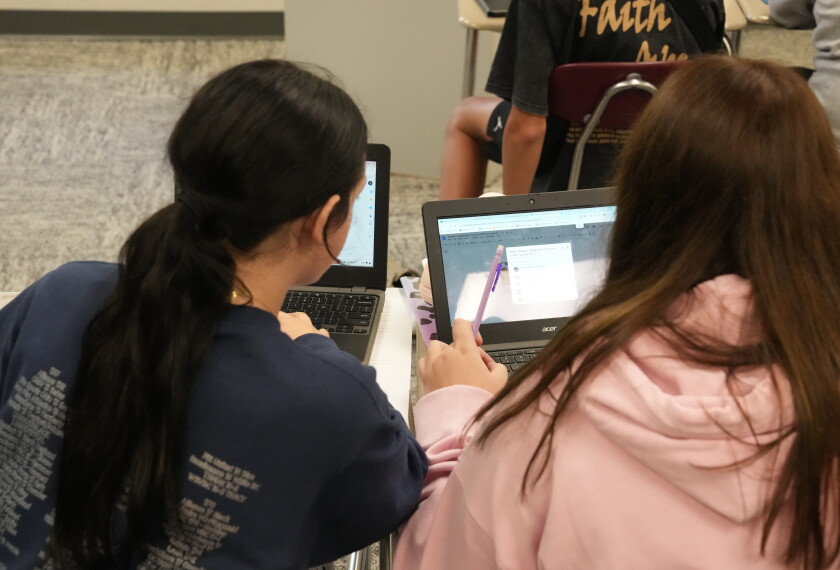
Michigan education officials are pushing legislation that includes online lessons as part of a package of new requirements for high school graduation. If state lawmakers approve the bill, which was introduced late last month, the mandate would be the first of its kind in the nation, state officials there believe.
While the details are still in the works, officials envision a substantial “online experience” that could range from a course for high school credit that is supervised by a classroom teacher, to a noncredit test-prep tutorial pursued at home, or a course unit that is conducted with online tools.
“We thought of this as a skill that people would need to have to continue to be lifelong learners,” said Jeremy M. Hughes, the chief academic officer for the Michigan education department.
Read the related story,
The proposal is part of a campaign to boost the state’s graduation requirements from one course in civics to 18 courses spread among seven subjects. Last month, the state board of education approved a package that would be among the most demanding in the nation: The plan includes two years of foreign language, four of math, and three years of science.
But it may well be the technology requirement that has drawn the most attention nationally. That’s fine by state officials, who are trying to help Michigan shed its Rust Belt image and become a front-rank competitor in the sweepstakes for high-tech business.
“Michigan is providing leadership,” declared Jamey Fitzpatrick, the president of the Michigan Virtual University, a nonprofit corporation that provides online courses. “It is recognizing that the world of work is fundamentally different than it was.”
Local educators, meanwhile, are concerned about the possible costs to their districts from the online plan. Questions have also been raised about tracking students’ completion of the requirement and exactly how “online-learning experience” would be defined.
For instance, Roland Moore, the Detroit public schools’ technology chief, told the Detroit Free Press recently that access to the Internet was limited in three-quarters of the district’s high schools, a problem that would cost millions to solve.
Flexible But Substantial
State officials say the requirement would be flexible enough to minimize the burden on schools and districts, which, they point out, have made major investments in computers and Internet connections over the past decade. E-learning could also take place at home or in a public library, they said.
Finally, an important resource for districts would be the Michigan Virtual High School, part of the Michigan Virtual University. Despite its name, MVU now focuses exclusively on secondary education and has been building a catalog of online offerings for more than five years. Fewer than half the states have such a statewide online- learning program, according to a recent report by a coalition of education groups that drew on findings from the Editorial Projects in Education Research Center.
The proposed requirement—to take effect with next year’s 9th graders—would not force students to complete an online course for high school credit nor would it require them to use the Michigan Virtual University’s offerings. MVU’s courses, including its highly popular ACT college-admissions test preparation, are available only to districts that pay per-student fees.
Rather, districts could put their own courses online, or teachers could devise a substantial online-learning experience that uses, for example, e-mail, an electronic bulletin board, and threaded e-discussions, according to officials.
“We don’t want to see it evolve into a trip to the computer lab with everybody using a search engine to find something,” Mr. Fitzpatrick of MVU said.
But even if the practical issues are resolved, policy questions remain. For example: Is mandating a similar experience for every high school student going to foster the skills they need in the workplace?
Computer skills are among the easiest for young people to acquire, according to Saul Rockman, a San Francisco-based expert on the educational use of computers. More fundamental and harder to impart, in his view, are the abilities to solve problems and communicate effectively—which can be taught with or without computers.
“The notion of having an independent experience with something of value on the computer associated with school is not a bad idea,” he allowed, “but insisting that everyone have it may not be the best strategy.”
What Students Want?
Susette Jaquette, who coordinates online learning for the 17,000-student Ann Arbor, Mich., schools, took a different tack, saying the policy was needed to force districts to keep up with students.
“A lot of districts, they’ll take too long to get there without a policy,” she maintained as she registered students at Huron High School for an online version of the lone course—in civics—that Michigan currently requires for graduation. District enrollment in the course, which is taught by a Huron teacher, has more than doubled to 60 since it was offered last summer, she said. Students with busy schedules like the flexibility that the online course gives them.
“The kids are going to force us to do it so we might as well do it now,” Ms. Jaquette said. “It’s what they want.” She added, though, that most students would do better with a combination of regular classes and online work than a pure online course.
Daniel Saltzman, an 11th grader at Ann Arbor’s Pioneer High School, has taken a number of courses online. He agrees that some students and subjects are better suited to pure online learning than others. Mr Saltzman also believes that some experience with online learning is good for students. “If they find they work well with it, they can do more,” he wrote in an e-mail to Education Week. “If they hate it, they can stop.”