Special Education

Diplomas and Disabilities

December 06, 2000 1 min read
  • Save to favorites
  • Print
Diplomas and Disabilities

Graduation Rates Vary
The following shows the number and proportion of disabled students age 17 or older who earned standard high school diplomas in 1997-98, as a percentage of all such students in that age bracket and disability category.
Disability Number Percentage
Specific learning disabilities 99,640 30.5
Speech or language impairments 4,099 35.0
Mental retardation 15,268 13.8
Emotional disturbance 13,861 22.3
Multiple disabilities 2,061 10.3
Hearing impairments 2,761 29.0
Orthopedic impairments 2,037 25.8
Other health impairments 5,052 29.6
Visual impairments 1,157 30.6
Autism 384 8.4
Deaf- blindness 132 39.2
Traumatic brain injury 671 27.7
All disabilities 147,123 25.5

Standard Diplomas Inching Up

There has been a gradual rise in recent years in the proportion of students with disabilities earning standard high school diplomas, as a percentage of all such students ages 17 to 21 who exit their states’ education systems.
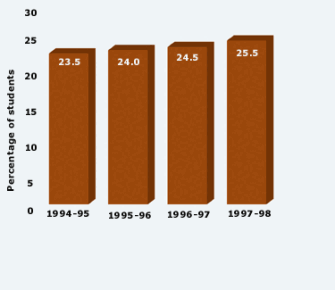
SOURCE: U.S. Department of Education, Office of Special Education Programs, Data Analysis System.

A version of this article appeared in the December 06, 2000 edition of Education Week as Diplomas and Disabilities

Events

This content is provided by our sponsor. It is not written by and does not necessarily reflect the views of Education Week's editorial staff.
Sponsor
Special Education Webinar
Bridging the Math Gap: What’s New in Dyscalculia Identification, Instruction & State Action
Discover the latest dyscalculia research insights, state-level policy trends, and classroom strategies to make math more accessible for all.
Content provided by TouchMath
This content is provided by our sponsor. It is not written by and does not necessarily reflect the views of Education Week's editorial staff.
Sponsor
School Climate & Safety Webinar
Belonging as a Leadership Strategy for Today’s Schools
Belonging isn’t a slogan—it’s a leadership strategy. Learn what research shows actually works to improve attendance, culture, and learning.
Content provided by Harmony Academy
This content is provided by our sponsor. It is not written by and does not necessarily reflect the views of Education Week's editorial staff.
Sponsor
School & District Management Webinar
Too Many Initiatives, Not Enough Alignment: A Change Management Playbook for Leaders
Learn how leadership teams can increase alignment and evaluate every program, practice, and purchase against a clear strategic plan.
Content provided by Otus

EdWeek Top School Jobs

Teacher Jobs
Search over ten thousand teaching jobs nationwide — elementary, middle, high school and more.
View Jobs
Principal Jobs
Find hundreds of jobs for principals, assistant principals, and other school leadership roles.
View Jobs
Administrator Jobs
Over a thousand district-level jobs: superintendents, directors, more.
View Jobs
Support Staff Jobs
Search thousands of jobs, from paraprofessionals to counselors and more.
View Jobs

Read Next

Special Education 50 Years of IDEA: 4 Things to Know About the Landmark Special Education Law
The nation's primary special education law details schools' obligations to students with disabilities.
5 min read
President Ford at work in the Oval Office on Jan. 27, 1976.
President Gerald Ford, pictured in the Oval Office on Jan. 27, 1976, signed into law the predecessor to the Individuals with Disabilities Education Act in 1975.
Courtesy of the Gerald R. Ford Presidential Library & Museum
Special Education Letter to the Editor Aligning General and Special Education for Student Success
Involving all educators can make a big difference.
1 min read
Education Week opinion letters submissions
Gwen Keraval for Education Week
Special Education What a New Dyslexia Definition Could Mean for Schools
An updated definition put forth by an international group of researchers could identify more students.
5 min read
Students in the online blended learning class at the ALLIES School in Colorado Springs, Colo., work with programs like ST Math and Lexia, both created for students with dyslexia, on April 7, 2023.
Under a new definition, students wouldn't need to have "unexpected" learning gaps to be identified for dyslexia services. Students in the online blended learning class at the ALLIES School in Colorado Springs, Colo., work with literacy programs created for students with dyslexia, on April 7, 2023.
Jaclyn Borowski/Education Week
Special Education Parents Should Continue to File Disability Rights Complaints, Say Special Ed. Advocates
Continuing to file them puts pressure on the Ed. Dept. to enforce special ed. laws.
4 min read
Image of a hand raising a red flag.
DigitalVision Vectors
