
Federal

Trump Threatens Funds to Schools That Let Trans Athletes Compete on Girls’ Teams

By Brooke Schultz — February 05, 2025 4 min read
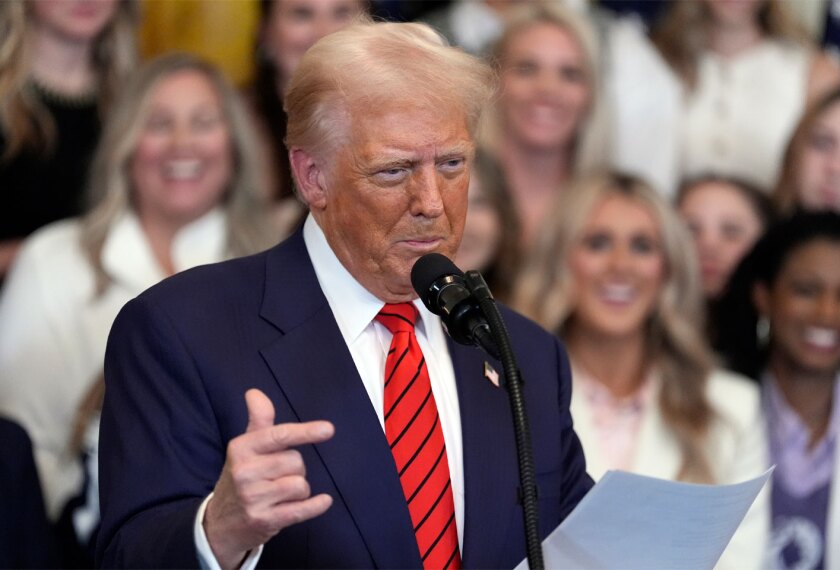
President Donald Trump speaks before signing an executive order barring transgender female athletes from competing in women's or girls' sporting events, in the East Room of the White House, Wednesday, Feb. 5, 2025, in Washington.
  • Save to favorites
  • Print

President Donald Trump signed an executive order Wednesday that threatens to withhold federal subsidies from K-12 schools that allow transgender girls to compete on women’s teams and launch investigations into those that don’t comply.

Trump signed the order at the White House surrounded by student-athletes, timing it to coincide with National Girls and Women in Sports Day.

“You’ve been waiting a long time for this. So have I,” he told the crowd.

The order is another effort from the president to roll back protections for transgender youth and adults, who in the past few years have been the targets of a growing number of restrictive state laws and school board policies.

About half the states have passed legislation barring transgender women from playing on school athletic teams that don’t align with their sex at birth. Other state laws govern which bathrooms and locker rooms transgender students can use at school and limit teachers’ ability to discuss gender identity in class. Many school boards have policies requiring that parents be notified when their children request changes to the name or pronouns they use.

On his first day in office, Trump signed executive orders declaring that the federal government would recognize only two sexes and making clear his Education Department would not extend protections under Title IX to prohibit discrimination based on sexual orientation and gender identity at schools.

It is a marked reversal from the Biden administration, which sought to expand protections for LGBTQ+ students but faced legal headwinds brought on by Republicans. Opponents to former President Joe Biden’s attempts to issue more expansive regulations for Title IX contended that he was acting outside of his executive power.

Roughly 3 percent of high school students identify as transgender; 2 percent are questioning their gender identity, according to U.S. Center for Disease Control and Prevention data. Those students face higher rates of bullying and depression than their peers.

Transgender students are less likely than their peers to participate in school sports. Nineteen percent of transgender and gender-expansive youth reported playing sports in the Human Rights Campaign’s 2022 Youth Survey, compared with nearly half of all high school-age youth.

See Also

In this Nov. 21, 1979 file photo, Bella Abzug, left, and Patsy Mink of Women USA sit next to Gloria Steinem as she speaks in Washington where they warned presidential candidates that promises for women's rights will not be enough to get their support in the next election.
In this Nov. 21, 1979, photo, Bella Abzug, left, and Patsy Mink of Women USA sit next to Gloria Steinem as she speaks in Washington at an event where they warned presidential candidates that promises for women's rights will not be enough to win their support in the next election.
Harvey Georges/AP
Federal Explainer What Is Title IX? Schools, Sports, and Sex Discrimination
Libby Stanford, May 31, 2024
•
2 min read

Under Trump’s new order, the secretary of education must prioritize civil rights cases against schools and athletic associations governed by educational institutions that allow transgender girls to play on girls’ teams. He directed the secretary to revoke funding to schools that don’t comply.

Beyond K-12 schools, Trump is also seeking to influence major athletic organizations and governing bodies—even the Olympics, which are slated to convene in Los Angeles in 2028. In the order, he directs his assistant for domestic policy to convene representatives from those organizations, alongside female athletes, “to promote policies that are fair and safe, in the best interests of female athletes,” and consistent with Title IX, the federal law prohibiting sex discrimination at schools that receive federal funds. He directs Secretary of State Marco Rubio to engage with the International Olympic Committee to ensure that “eligibility for participation in women’s sporting events is determined according to sex and not gender identity or testosterone reduction.”

During the White House signing event on Wednesday, Trump partially credited his return to the White House to his campaign promise to roll back transgender protections. Trump-aligned groups spent tens of millions of dollars on anti-trans advertisements during the 2024 campaign, according to the New York Times.

He said Democrats “look like fools” supporting transgender athletes, saying Republicans would keep winning elections campaigning against transgender rights.

“This will effectively end the attack on female athletes in K-12 schools, and virtually all U.S. colleges and universities. I don’t think we missed anything, but if we do, we’ll make it up very quickly with an order,” Trump said.

In a statement, the U.S. Department of Education’s deputy general counsel, Candice Jackson, said the department would follow his order and “prioritize Title IX enforcement against educational institutions that refuse to give female athletes the Title IX protections they deserve.”

The president made promises on the campaign trail to address what he on Wednesday called a “militant transgender ideology.”

The executive order order he signed on his first day in office that made it U.S. policy to recognize only two sexes directed the attorney general to instruct government agencies that civil rights laws that prohibit discrimination based on sex—such as Title IX—can’t be expanded to apply to discrimination based on sexual orientation or gender identity.

See Also

President Donald Trump holds up an executive order commuting sentences for people convicted of Jan. 6 offenses in the Oval Office of the White House, Monday, Jan. 20, 2025, in Washington.
President Donald Trump signs a series of executive orders in the Oval Office on Monday, Jan. 20, 2025, the first day of his second term in office. Trump was expected to sign dozens of executive actions, some of them affecting schools, on his first day.
Evan Vucci/AP

Other executive actions from the president have included orders seeking to halt federal support of gender-affirming care, and another kicked off a process to determine how to pull federal dollars from schools that “directly or indirectly” support students’ gender transitions—including referring to students by names or pronouns that may differ from their sex assigned at birth and not informing their parents.

The Biden administration last year issued regulations under Title IX to expand protections for LGBTQ+ students.

But in the concluding weeks of the administration, the U.S. Department of Education pulled back its proposed regulations on transgender athletes—which would have prohibited categorical bans on trans athletes’ membership on athletic teams that aligned with their gender identity—so that the Trump administration couldn’t steamroll the process for his own aims.

A Kentucky judge recently struck down the Title IX regulations that Biden did issue. The Education Department, under Trump, said it would resume use of the set of rules Trump issued in his first term.

See Also

President Donald Trump signs a document in the Oval Office at the White House, Thursday, Jan. 30, 2025, in Washington.
Evan Vucci/AP/AP

Events

This content is provided by our sponsor. It is not written by and does not necessarily reflect the views of Education Week's editorial staff.
Sponsor
Student Achievement Webinar
The Relationship Advantage for Attendance, Engagement, and Achievement
Relationship-building goes beyond back-to-school. Get practical ideas from district leaders and educators to strengthen student connections.
School & District Management Webinar EdMarketer Quick Hit: Build Campaigns That Engage K-12 Leaders
We’ll share what’s resonating with Education Week’s K-12 audience based on user behavior across platforms and other proprietary data.
This content is provided by our sponsor. It is not written by and does not necessarily reflect the views of Education Week's editorial staff.
Sponsor
Assessment Webinar
Measuring What Matters: How District Leaders Are Redefining Student Assessment
In this panel discussion, district leaders and systems experts will examine the gap between the outcomes we want and the systems in place.
Content provided by Otus

EdWeek Top School Jobs

Teacher Jobs
Search over ten thousand teaching jobs nationwide — elementary, middle, high school and more.
View Jobs
Principal Jobs
Find hundreds of jobs for principals, assistant principals, and other school leadership roles.
View Jobs
Administrator Jobs
Over a thousand district-level jobs: superintendents, directors, more.
View Jobs
Support Staff Jobs
Search thousands of jobs, from paraprofessionals to counselors and more.
View Jobs

Read Next

Federal Q&A A Top Democrat Breaks Down His Party's Plans for K-12 in a House Majority
If Democrats retake the House, Rep. Bobby Scott may be in a position to set his chamber’s K-12 agenda.
5 min read
Rep. Bobby Scott, D-Va., speaks during a prayer vigil held by the Chesapeake Coalition of Black Pastors at The Mount (Mount Lebanon Baptist Church) in Chesapeake, Va., Sunday, Nov. 27, 2022, for the six people killed at a Walmart in Chesapeake, Va., when a manager opened fire with a handgun before an employee meeting Tuesday night.
Rep. Bobby Scott, D-Va., speaks during a prayer vigil in Chesapeake, Va., on Nov. 27, 2022. Scott is the ranking Democrat on the U.S. House of Representatives' education committee and will seek the panel's chairmanship if Democrats win a House majority in next month's elections.
Carolyn Kaster/AP
Federal What a Democratic Congress Could Mean for Trump's K-12 Agenda
They may try to reverse—or at least investigate—the Trump admin.'s efforts to dismantle the Ed. Dept.
9 min read
House Minority Leader Hakeem Jeffries, D-N.Y., the top Democrat in the Republican-majority House, is joined by Rep. Pete Aguilar, D-Calif., chair of the House Democratic Caucus, as they criticize President Donald Trump and his policies while talking to reporters about the approaching midterm election, at the Capitol in Washington, Thursday, Sept. 17, 2026.
House Democratic Leader Hakeem Jeffries speaks at the U.S. Capitol on Sept. 17, 2026. He's joined by Rep. Pete Aguilar, D-Calif., who chairs the House Democratic Caucus. If Democrats gain a majority of either chamber of Congress after next month's elections, they'll be able to hold oversight hearings on and launch investigations into the dismantling of the U.S. Department of Education.
J. Scott Applewhite/AP
Federal The Future of Education Research: More Partisan and Largely Left to States?
As Trump administration works to change federal grants, outside researchers try to regroup.
6 min read
Image of file folders with tabs called "funding" "grants" "projects" and a blank note paper paperclipped to the outside.
Collage by Laura Baker/Education Week + Getty
Federal Bipartisan Bill in Congress Would Help Schools Put Cellphone Bans or Restrictions in Place
The bill would establish a federal grant program to support state efforts to restrict cellphones.
5 min read
Sen. Tom Cotton, R-Ark., the chairman of the Senate Intelligence Committee, center, is joined from left by Sen. John Barrasso, R-Wyo., the GOP whip, and Senate Majority Leader John Thune, R-S.D., as he speaks to reporters ahead of a Wednesday meeting with President Donald Trump, at the Capitol in Washington, Tuesday, June 23, 2026. (AP Photo/J. Scott Applewhite) Senate Minority Leader Chuck Schumer, D-N.Y., speaks to reporters at the Capitol in Washington, Tuesday, June 23, 2026.
Sen. Tom Cotton, R-Ark., speaks to reporters ahead of a meeting with President Donald Trump at the Capitol in Washington on June 23, 2026. Cotton is one of the sponsors of a bipartisan bill that would create a grant program for states to implement school cellphone bans or restrictions.
J. Scott Applewhite/AP
