

The nominee for the U.S. Department of Education’s No. 2 spot stopped short of a full-throated endorsement of closing the federal agency during her confirmation hearing Thursday—but, leaning on her time as a state education chief, stressed that states should be further empowered to spend federal funds largely as they see fit.
“A department or an agency in the federal government is not going to change the outcomes of students,” Penny Schwinn told U.S. senators on the Health, Education, Labor, and Pensions committee. “What we need to do is ensure that we have created a system that is going to drive outcomes. That is not going to happen from the federal government, whether there’s a Department of Education or not.”
Schwinn and Kimberly Richey, whom President Donald Trump has tapped to lead the department’s office for civil rights, tried to strike a delicate balance during their joint hearing Thursday—vowing to Republicans that they were dedicated to Trump’s social policy agenda while telling Democrats they would follow the law and seek better education outcomes.
If confirmed, the pair will be significant players in how the department executes Trump’s aggressive vision for downsizing the federal role in education while simultaneously ramping up enforcement of his policies on diversity, equity, and inclusion; antisemitism; and transgender student rights at the nation’s schools and universities.
Neither are strangers to education policy, with Schwinn having worked as a teacher, school leader, and state education chief in Tennessee. Richey, currently a top official in Florida’s department of education, served in the office for civil rights under President George W. Bush and during Trump’s first term. They would join a department helmed by McMahon, a former business executive who led the U.S. Small Business Administration during Trump’s first term.

The women testified in a panel that included two U.S. Department of Labor nominees, but education issues received significant attention during the roughly two-hour hearing, as the department they seek to join has already changed radically in the president’s first five months, shedding nearly half its staff under the shadow of an executive order calling for its eventual closure (both maneuvers have recently seen pushback in federal court).
The department has also canceled scores of contracts and grants—particularly for teacher-training programs and mental health services—and is seeking to shed billions from its bottom line in proposed budget cuts. It has gutted internal offices and closed more than half the regional sites for investigators of cases of alleged discrimination.
At the same time, the agency has come out as a strong enforcer of the president’s agenda, threatening to pull federal dollars from schools, universities, and states for noncompliance with presidential directives on DEI and transgender students.
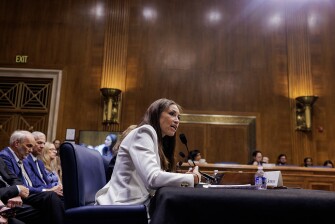
On Thursday, Republicans sought reassurance that the nominees would align themselves with those priorities. Schwinn, who previously dismissed culture war battles over gender and race instruction as “extraneous politics” during her time as education commissioner in Tennessee, was promptly asked to commit herself to the president’s vision.
“My responsibility was to implement the laws as passed, something that I’m very, very committed to, and those laws were in alignment with President Trump’s agenda and the executive orders that have been put out,” she told lawmakers Thursday.
Meanwhile, when pressed by a Democratic senator on protections for LGBTQ+ students, Richey told senators that complaints submitted to OCR alleging discrimination on the basis of sexual orientation and gender identity “would be investigated” consistent with Title IX, the federal law barring sex discrimination, and case law.
Sen. Josh Hawley, R-Mo., chafed at that, asking Richey if she would follow in the footsteps of the Biden administration—which sought to expand Title IX to protect transgender students, an effort the Trump administration swiftly rolled back.

“That is not what we did under President Trump’s first term, and that is not what we will do under President Trump’s second term,” Richey said, adding later, “The current leadership within OCR and Secretary McMahon, as you know, is prioritizing these cases, and that will not stop in my leadership.”
Schwinn and Richey also fielded concerns from Democrats that the diminished Education Department could no longer carry out congressionally mandated responsibilities.
When prompted by Sen. Andy Kim, D-N.J., Richey said she thought cases of antisemitism—a stated Trump administration priority—were getting worse.
But she declined to say if she’d have enough staff to handle the thousands of complaints filed annually by students and families alleging discrimination in schools. The office for civil rights saw some of the largest cuts in a massive Education Department reduction in force in March, shrinking from 560 to about 300.
“If it’s getting worse, doesn’t it make sense then that we would invest more in countering antisemitism and invest more in the office for civil rights?” Kim asked.
“I’m always going to advocate that OCR have the staff and resources it needs to do its job,” Richey told him.

At the same time, she told lawmakers she supported the president’s plans to redistribute the Education Department’s vast portfolio—including OCR—to other federal agencies.
“The current structure is not serving students. The current structure is not meeting the needs of students,” Richey said, citing declining national test scores. “We would see better outcomes if what we were doing right now is working.”
With the proposed closure of the department looming large, Sen. Bill Cassidy, a Louisiana Republican who chairs the committee, said Schwinn’s record and experience would be “vital” in “reforming a department that has lost its purpose.”
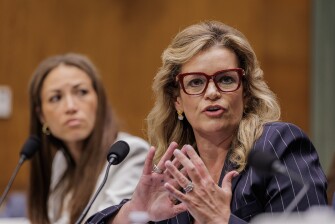
Schwinn, for her part, said that in her time leading Tennessee schools, federal Education Department funding was most helpful when it was flexible.
“We need to make sure that ... our states understand exactly how much money they’re getting and what the laws say their responsibilities are, and then allow states to figure out the best way to implement that to achieve outcomes for their kids,” she said.
She separately laid out a plan to bolster school choice from the federal level—another top priority for the Trump administration, with charter school funding the only K-12 program to see an increase in the president’s proposed budget.
Schwinn said she would be able to give states better guidance about what they can and can’t do with federal funds under current policy, provide examples of states with successful practices, and provide more information to families about school choice options.
Schwinn initially sidestepped a question from Sen. Maggie Hassan, D-N.H., who asked if she supported the president’s goal of shuttering the Education Department.
After Hassan pressed, Schwinn said she “supported the president’s EO,” referring to Trump’s March executive order that directed McMahon to “take all necessary steps to facilitate” the agency’s closure. But Schwinn mischaracterized it as “explor[ing] all the opportunities and options around what is in the best interest of students, including shuttering the Department of Education.”
Richey claimed that Trump was “the first president to turn the focus on students—to stop and say, what is best for students? What is best for families?”
But Democrats pushed back.
“As I have said before,” Hassan said, “unlike a good carpenter who measures twice before cutting, this administration just cuts, and it is doing real, real harm.”
After Thursday’s hearing, the committee will vote on Schwinn’s and Richey’s nominations, sending them to the full Senate.


