
New York City schools Chancellor David Banks is no stranger to conflict.
As the leader of the nation’s largest school system serving nearly a million students, Banks is used to answering to school staff, politicians, parents, and even students—and in very public fashion. But in early May, Banks had to face his toughest potential critics yet—Republican lawmakers in the U.S. House of Representatives.
Banks was one of three district leaders called to answer questions about a rise in antisemitism in K-12 schools at a May 8 subcommittee hearing. A few months prior, three college presidents who testified failed to forcefully condemn antisemitism on their campuses, and two were out of their jobs within weeks.
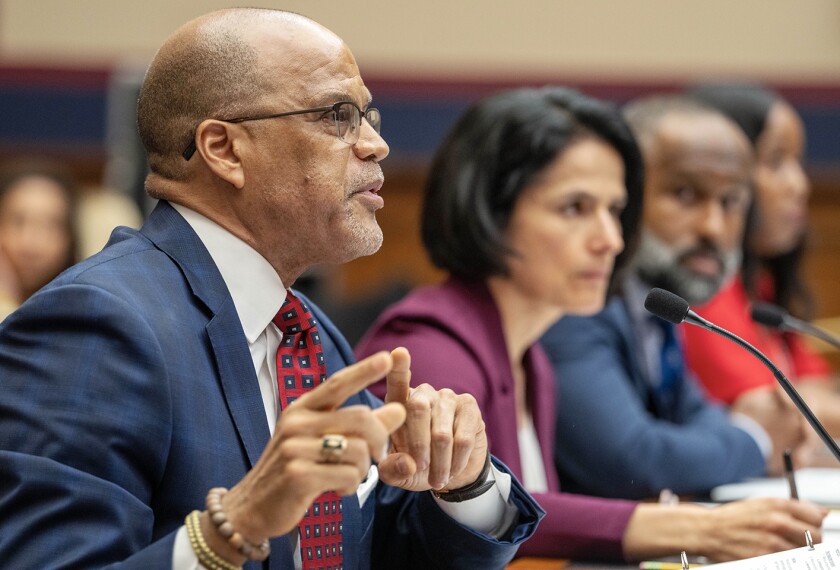
House Republicans chose Banks after pro-Palestinian students at Hillcrest High School in Queens, Banks’ alma mater, rampaged through the halls in November 2023 after learning a teacher had attended a pro-Israel rally. Banks subsequently moved Hillcrest’s principal to another district role, a decision that was the subject of a few heated exchanges at the hearing. The New York City schools are also under investigation by the U.S. Department of Education’s office for civil rights for potential violations since the Israel-Hamas war.
Banks verbally parried with Republican lawmakers trying to discredit his leadership, but did not back down nor apologize for how he’s handled acts of antisemitism or Islamaphobia in the city’s schools.
In a conversation with Education Week, Banks recounted his experience testifying before Congress and the work underway in the district to combat antisemitism, Islamophobia, and other forms of hate.
The following interview has been edited for length and clarity.

How would you say the Israel-Hamas war has affected the culture and climate at New York City schools?
Any act of hate is a big deal, no matter where it is and no matter how it shows itself, whether that’s racism, xenophobia, Islamophobia, antisemitism. It is all bad.
We have a responsibility as the leaders of the system to ensure that we can keep all of our kids and our staff physically safe and emotionally safe. We have had, to date, at least 35 to 40 incidents of either antisemitism or Islamophobia that we have a record of. And it’s a wide range—from kids who are drawing a swastika on a bathroom wall to teachers who have made Islamophobic statements to their own students.
It’s a wide range of ways in which it has shown up, and we are very concerned anytime we see it.
What has been your response to these incidents?
We see our response as something that we call safety, engagement, and education. Each one of those is critically important.
You’ve got to keep kids safe, and there has to be consequences when anybody moves and behaves in a way that is outside of what our values are and what our stated disciplinary procedures are.
So, we made sure that all of our teachers know that when you see acts of antisemitism, those are hate crimes. They have to be reported to the police. We’ve got to make sure that is done. But sometimes we’ll see things that are not hate crimes but they are still bad behavior and they’ll affect the overall culture of the school and we’ve got to make sure we address those properly.
We’ve been engaging the Jewish and Muslim communities around the city. I’ve created an interfaith advisory council made up of some of the top faith-based leaders in the city, and that’s not just Muslim and not just Jewish. It runs a wide range of other religions as well.
We made sure that all of our teachers know that when you see acts of antisemitism, those are hate crimes.
I think that it is important to engage the faith-based community and not simply just say, ‘well, we believe in separation of church and state so we don’t even talk to them.’ During times like this it is critically important for us to engage everybody.
The ultimate antidote to hate and to antisemitism and to Islamophobia is to educate. We’ve got to help raise the consciousness of kids. They’ve got to have a greater level of exposure.
So while the teaching of the Holocaust is mandated in some of our older grades, teaching about Jewish history, the fullness of Jewish history, the fullness of Muslim history, is not actually mandated. We’re getting ready to release a pretty comprehensive curricula related to those histories. The more that our kids get exposed to that history, the more that they’re able to get out and visit places like the Jewish Heritage Museum, the better off we will be.
No teacher and no child should go to a school and fear for their lives and think they’re somehow going to come under attack simply for their faith. We want everybody to see the common humanity in us all and not see anybody else as the other.
What was your reaction to being asked to testify before Congress, and how did you prepare for it?
I was incredulous that I was asked. I couldn’t believe it.
I knew that they had brought several of the university presidents, and I said, ‘Why in the world would they want K-12 leaders to show up?’
I certainly did not want to do it. I saw the way in which those hearings [with university presidents] were conducted, and I considered them not helpful and very much playing to ‘gotcha’ moments, trying to embarrass people. That to me is not how you solve for antisemitism or Islamophobia.
I began to study and make sure, together with my team, that if I were asked about any incident in any school or classroom that I would be ready to respond. I had a couple of people on my staff here that I worked very, very closely with, galvanizing the information. It kind of reminded me of when I was in law school and preparing for exams. It had to be with that level of intensity.
I was incredulous that I was asked. I couldn’t believe it.
I was fully prepared to answer any questions but to also push back if members were, in my opinion, being disrespectful or otherwise just trying to play ‘gotcha.’
I very much believe in civic engagement. Whatever your politics happen to be, it doesn’t matter. If you get called, you go, you answer the questions, you do your best and then you move on. That’s what we did and I’m proud of the way we showed up.
During the hearing, committee members pushed you on your decision to reassign, rather than fire, the principal at Hillcrest. Why might immediate firing not be the answer in situations like that?
All of our folks who work for us have due process rights. You can’t just willy nilly fire people because you disagree with what they said. You have to do the proper investigation and after that investigation you have to make a determination around what you think any particular consequence should be for that behavior if you think there’s any consequence that’s needed at all.
In this particular case, after going to the school and speaking to hundreds of educators there and parents and students, I saw some real gaps in leadership. I ultimately made the decision that the principal should be removed from the school. I didn’t think he was the right person to lead the resurgence of the school, but I was fully committed to a resurgence of the school.
Now, I also did not feel that he deserved to lose his employment altogether as well. I didn’t think he was prepared to meet the moment at Hillcrest—that’s the reason we moved him out of that particular spot. But I also thought he had a lot to offer to the school system, so we reassigned him to another role.
How might your experience as a K-12 administrator have prepared you to be in the congressional hot seat more than the higher education leaders?
I testify before the city council on a regular basis. I testify before the state assembly. I’m engaging students on a regular basis. I do community forums on my own. I do community forums with the mayor. We’re always out there in the community in a way that is very different from the normal day of a university or college president.
Some of them don’t engage with the students much at all, and some of them do, but they don’t engage in the way that we do at public schools. Here, our kids are still forming and still developing. I’m used to engaging, I’m used to testifying. I’m used to being in front of some tough examiners, if you will.
What advice do you have for other district leaders navigating politically divisive moments like this?
Do everything you can to stay on the side of right, meaning lead with your values and hold fast to those values.
As a leader of any institution, I think that they should recognize that they have a responsibility to do the right thing for their kids, their parents, their families, and those that work for them. It keeps it simpler when you do that.
If you’re just working off of somebody else’s talking points, that’s not the best way for you to be grounded in your actions. Your actions should truly emanate from that which you believe deeply. If you do believe that, then you should move accordingly and that’s what we did.


