
Student Achievement What the Research Says

The State of After-School and Summer Programs, in Charts

By Sarah D. Sparks — November 08, 2023 1 min read
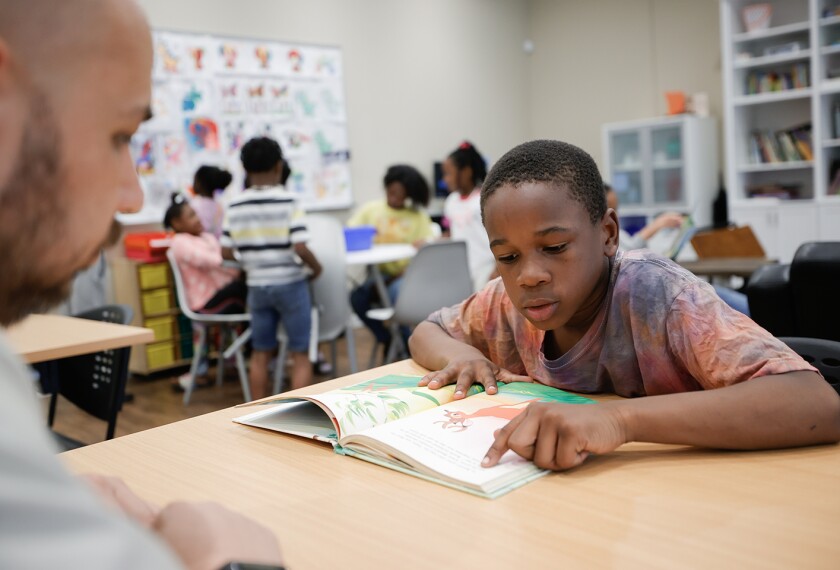
Michael Crowder, 11, right, reads to Tim McNeeley, left, during an after-school literacy program in Atlanta on April 6, 2023. McNeeley, director of the Atlanta based Pure Hope Project, hosts the daily program for children in kindergarten through 5th grade.
  • Save to favorites
  • Print

While many public school students remain months or years behind academically, significantly fewer are participating in supplemental academic programs over the summer and this school year.

Fewer than 1 in 5 K-12 students participated in academic programs in public schools this summer, and about 1 in 8 are taking part in remedial or enrichment activities after school in 2023-24—both down from the last school year, according to the latest results from the federal School Pulse Panel, which came out this week.

The National Center for Education Statistics uses the panel data collection to take the monthly “pulse” of more than 1,400 K-12 schools in areas such as academic recovery, staffing, and educational activities to gauge their progress in recovering from pandemic learning disruptions.

Part of the problem is uneven and changing access. Large schools and those serving the highest concentrations of low-income students or students of color have increased their after-school offerings, with roughly 3 in 4 now providing academic enrichment or assistance outside the school day. Eighteen percent of students in high-poverty schools and 19 percent of students serving high concentrations of students of color participated in academic programs after school.

But fewer small and rural schools are offering such after-school programs in 2023-24 compared to 2022-23 school years.

“Sadly, the decline in access to after-school and summer programming is consistent with what we have been seeing—and we fear it will get worse” when federal pandemic recovery aid ends next school year, said Jodi Grant, the executive director of the Afterschool Alliance, a nonprofit advocacy group. “The parents of 25 million students want after-school programs for their children but don’t have access. We need to find ways to include more students, instead of reducing opportunities.”

While the Biden administration urged schools to use federal pandemic relief money to create summer and after-school programs to help students advance academically, only about 1 in 4 schools reported using pandemic recovery aid to support after-school academic assistance.

In a separate survey by AASA,the School Superintendents Association, more than half of district leaders said they would cut back or end enrichment and summer-learning programs in the 2024-25 school year, when relief funding ends.

Events

This content is provided by our sponsor. It is not written by and does not necessarily reflect the views of Education Week's editorial staff.
Sponsor
Special Education Webinar
Hidden Costs of Special Ed Vacancies: Solutions for Your District
When provider vacancies hit, students feel it first. Hear what district leaders are doing to keep IEP-related services on track.
Content provided by Huddle Up
This content is provided by our sponsor. It is not written by and does not necessarily reflect the views of Education Week's editorial staff.
Sponsor
Privacy & Security Webinar
How Technology Is Reshaping Childhood
How do we protect kids online while embracing innovation? Learn about navigating safety, privacy, and opportunity in the Digital Age.
Content provided by Connect x Protect
Budget & Finance Webinar Creative Approaches to K-12 Budget Realities
What are districts prioritizing in 2026? New survey data reveals emerging K-12 budgeting trends.

EdWeek Top School Jobs

Teacher Jobs
Search over ten thousand teaching jobs nationwide — elementary, middle, high school and more.
View Jobs
Principal Jobs
Find hundreds of jobs for principals, assistant principals, and other school leadership roles.
View Jobs
Administrator Jobs
Over a thousand district-level jobs: superintendents, directors, more.
View Jobs
Support Staff Jobs
Search thousands of jobs, from paraprofessionals to counselors and more.
View Jobs

Read Next

Student Achievement Opinion Schools Are Investing in the Wrong Sorts of Assessment. How to Get It Right
Testing rarely changes what happens next. It’s like driving forward while looking in the rearview mirror.
Terry Grier
4 min read
students are measured by a large yellow ruler. There are test papers and answer sheets in the background. Student testing. Measuring learning.
Vanessa Solis/Education Week + Getty + Canva
Student Achievement Opinion Should Teachers Offer Extra Credit? Yea or Nay?
Educators discuss whether extra credit warps grading or reinforces skills students will use later.
8 min read
Conceptual illustration of classroom conversations and fragmented education elements coming together to form a cohesive picture of a book of classroom knowledge.
Sonia Pulido for Education Week
Student Achievement Spotlight Tutoring Works…When It’s Done Right
Well-designed high-dosage tutoring boosts reading, math, and STEM interest, proving that targeted support drives real recovery gains.
Student Achievement The ‘Pandemic Babies’ Are Now in 1st and 2nd Grade. How Are They Doing?
Achievement is still lower for kids who were toddlers during the pandemic—even though they didn't experience school closures.
3 min read
A second grader works on math problems at Place Bridge Academy, May 20, 2025, in Denver.
A second grader works on math problems at a school on May 20, 2025, in Denver. New research shows that children born during the pandemic who are now in 1st and 2nd grades, are showing slightly lower growth than other cohorts.
Rebecca Slezak/AP
