

Today’s post is the latest in a series sharing ideas on how school districts—and schools—can better retain teachers.
‘Building Community’
Jen Mott, Ed.D., is a school administrator at one of the largest middle schools in Ohio and is the author of two books on education:
Teacher retention has been a hot topic in the world of education for decades. As the industry has shifted, expectations have been added for preservice and current teachers, and political landscapes have changed to impact the polarization in schools across the country, researchers have been looking for ways to help school administrators keep the teachers they were putting time, money, and energy into.
This was all before 2020.
Since COVID hit, there has been an unbelievable shift in workplace and employee expectations in all industries. As the world returned to “normal,” there were many jobs that, well, didn’t. Teachers used to have a somewhat revered job regarding the level of flexibility that others didn’t have, like planned vacations or breaks (regardless of how much they were used for professional development, grading, etc.) throughout the year. Quickly, though, teachers turned to revering other jobs—many held by spouses and/or close friends—who could now work from home, practice hybrid work weeks, or come and go more easily.
Coupled with the increased demands and decrease in respect, this shift created a sense of opportunity for teachers to utilize their transferable skills and start seeking out alternative careers. There are entire businesses now running with the sole purpose of recruiting teachers and helping them realize what they are capable of outside of teaching, including offering resume help and tailored transition plans and/or communities that allow them to support one another toward leaving.
So, what are districts left to do to not only attract but now retain their teachers when many are feeling the pull to leave?
Help Create Purpose
The language around emotional workplace safety has increased. Help teachers understand their purpose, return to their why, and go beyond traditional professional development. Instead of just focusing on new theory that is just a replica of a cycle they have seen come and go, help them find inspiration and motivation by providing speakers who encourage and motivate, speak to the heart of why they do what they do, and even tap into their family, students, or other people who matter in their life to help ground them to their purpose. Data is not everything.
Build Community
Seek to give teachers the opportunity to build community within their department, team, hallway, or with other teachers in other districts who teach the same content if your school is small. The more teachers feel connected to a strong core of people rooting for them, the more they will want to do well for their team, school, and students. Find opportunities for team building; give teachers time to just be together to collaborate, share, vent, and encourage. Listen to what they need and help them get it without making things complicated.
Help Teachers Flourish
If a teacher is not thriving in a particular position and/or if a teacher shares about the possibility of leaving, talk with them about why that might be. Perhaps it is the wrong context they are in, and something about a grade-level change, leadership-position opportunity (making them a department chair, team leader, or something similar), content they are teaching, and/or a school change within the district might help.
Consider being proactive about this by having listening sessions with your staff and/or offering 1:1 opportunities for teachers to meet with you as a school leader to hear what is on their mind and help them with any context changes that would encourage them to stay.
While teacher retention is not foolproof, being intentional about building community, giving teachers what they need or want regarding removing barriers, and helping them revisit the entire reason they got into teaching in the first place could all be beneficial ways to retain teachers and help improve overall workplace satisfaction.

Listen to Teachers
Renee Jones was the 2023 Nebraska Teacher of the Year. She teaches AVID and 9th grade English at Lincoln High School. Follow her on X @ReneeJonesTeach:
Put and pay teachers to be in the rooms where retention discussions are happening.
Two years ago, as the Nebraska State Teacher of the Year, I attended an educator shortage conference. With roughly 300 people in the room, one of the keynote speakers asked people to raise their hand when their vocation was named. He went through human resources, and those individuals raised their hand. He asked who was here from higher ed., and they raised their hand, and so on. When he got to teacher, I was one of three people, out of those 300 that had their hand up.
How are we having authentic conversations about retaining educators if we do not provide the opportunity for educators to represent their vocation? School districts need to create systems that support paid opportunities for educator representatives to advocate and be part of all discussions relating to our profession.
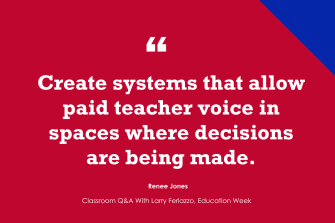
It is not enough to provide noncontract time to voice our opinions. In fact, this only exacerbates the work-life balance struggle that many teachers voice concern over. Create systems that allow paid teacher voice in spaces where decisions are being made.
Boosting ‘Self-Efficacy’
Joseph Jones is the superintendent of schools in the New Castle County Vocational and Technical district in Delaware.
T.J. Vari is the senior director of product strategy at MaiaLearning.
Connie Hamilton, Ed.S., is an educator, speaker, and author with over two decades of experience in teaching, school leadership, and curriculum development:
There is a natural tendency to want to feel good at work. It’s a very human condition to want to be comfortable. Given this reality, many school leaders who want to retain their teachers react by trying to help their employees feel good, creating conditions of comfort in the workplace. Staff shortages exacerbate this reaction. The problem is that this type of response often backfires.
To genuinely feel good at work, we have to be good at it. Enjoying work comes from being successful, and the key to success is continuous improvement.
Therefore, school leaders should focus on building the capacity of their teachers, rather than just providing comfort or short-term fixes. Those who only work toward the former will continue to find themselves with unsatisfied, and sometimes disgruntled, staff. Those who find ways to invest in their teachers, to improve their skills, will be the ones who retain satisfied and dedicated teachers.
Here’s an example: One school leader stocks the staff lounge with free drinks and treats. The hope is that this will comfort staff, making them feel like they’re looked after and cared for. While this is a nice gesture, it’s not a strong long-term retention strategy. Another school leader invests in each individual to build their capacity and strengthen their skills in the classroom. This starts by asking teachers what they want from the professional learning efforts of the school and then delivering the most customized professional learning possible. In the end, the second leader’s approach results in more committed teachers who are dedicated to the school.
Two groups are especially vulnerable to leaving during shortages: new teachers and the best teachers. New teachers, with only a few years of service, need more support to feel connected to the school and profession. The best teachers can go anywhere they want and seek better opportunities. Because they thirst for knowledge, they crave personalized professional learning; one-size-fits-all doesn’t meet their needs.
To retain these groups, focus on effective onboarding, mentoring, and tailored professional learning. Investing in your best teachers elevates the whole staff as a “rising tide lifts all ships.”
In short, if you want to retain teachers, spend less energy on comfort and prioritize improving their practice and boosting their sense of self-efficacy. And, doing so with your newest and best teachers creates a positive ripple effect throughout the school.

‘Teacher Salaries’
Abby Baker is a middle school ELA teacher in North Carolina who also coaches teachers on classroom management. Follow her on Instagram @abakercoach:
Perhaps one of the best indicators of a great school is not what you find through Googling or on popular review sites such as “Greatschools.” While a quick internet search can be helpful when seeking a teaching job, one of the best ways to know if a school is “great” is to look at their teacher-retention rate.
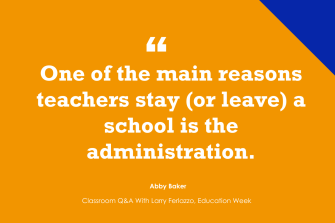
Teachers who stay at a school do so because of a variety of factors, and as a former administrator, I can say with certainty that one of the main reasons teachers stay (or leave) a school is the administration. School leaders have so much impact on their school. How they lead establishes the climate, for better or worse.
Supporting teachers should be at the forefront of school leadership because teachers who feel like administrators “have their backs” tend to be happier, which leads to higher retention rates. Rita Pierson gave an entire TED talk on how every student deserves a champion, and I would argue that every teacher does as well.
Leading like a champion looks like covering a teacher’s class when an emergency comes up; it’s being visible in teachers’ classrooms often, not just to conduct formal observations; it’s upholding disciplinary actions for students when necessary; it’s having high expectations for both students and staff and following through when those expectations aren’t met; it’s leading with grace, not fear. Teachers don’t leave a school when they feel supported in all areas of their job.
Speaking of support, some teachers need more than others. Schools that invest in quality coaching have a higher likelihood of retaining (and growing) novice teachers. Remember when you were a new teacher? If your first year or two was anything like mine, you’ve probably tried hard to sear it from your memory. Novice teachers need more than mentors who check in with them once a week; many need explicit coaching on everything from classroom management to instruction.
One of my favorite parts of being a school leader was coaching teachers to improve their craft. My goal was to see growth in teachers, and to do that, we focused on one area at a time. For example, if students came into the class in disarray, our focus would be entering and exiting routines. Once that was mastered, we would move onto another focus area.
Oftentimes, leaders give new teachers a laundry list of things they are doing wrong but offer little support or guidance for them to improve! Investing in teachers means helping them get better by guiding and working directly with them, just like a sports coach would do for his/her team. Schools “win” when they have effective instructional coaches, and who wants to depart from a “winning” team?!
Although school leadership and quality teacher coaching are important factors in retaining teachers, perhaps an even bigger driver is teacher salaries. As an educator who has taught in two states, it’s disheartening to see the discrepancies in pay as they vary by state and even school district. In some places, teachers do not make a liveable wage, so they are seeking other career options that offer more stability and adequate compensation.
I’m sure you know a teacher or two who has left the profession for a larger salary in another field. Even though many schools and districts offer opportunities for teachers to earn extra cash throughout the year, via coaching, leading a club, etc., many of these duties require time, and the compensation is meager compared to the task. Additionally, some districts continue to pile more and more on teachers’ plates without any additional pay! Teachers are professionals and should be compensated as such before the teacher shortage becomes a teacher desert.
Thanks to Jen, Renee, Joseph, T.J., Connie, and Abby for contributing their thoughts!
Today’s post answered this question:
What are specific actions districts and individual schools should take to retain teachers?
In Part One, Erica Buchanan-Rivera, Diana Laufenberg, and Jehan Hakim shared their suggestions.
In Part Two, Douglas Fisher, Nancy Frey, Andrea Terrero Gabbadon, and Dennisha Murff contributed their ideas.
I shared some ideas in Part Three.
In Part Four, Carissa McCray,, Craig Aarons-Martin, Amanda Muffler, and Lauren Arzaga Daus offered their responses.
Consider contributing a question to be answered in a future post. You can send one to me at lferlazzo@educationweek.org. When you send it in, let me know if I can use your real name if it’s selected or if you’d prefer remaining anonymous and have a pseudonym in mind.
You can also contact me on X at @Larryferlazzo or on Bluesky at @larryferlazzo.bsky.social .
Just a reminder; you can subscribe and receive updates from this blog via email. And if you missed any of the highlights from the first 13 years of this blog, you can see a categorized list here.


