
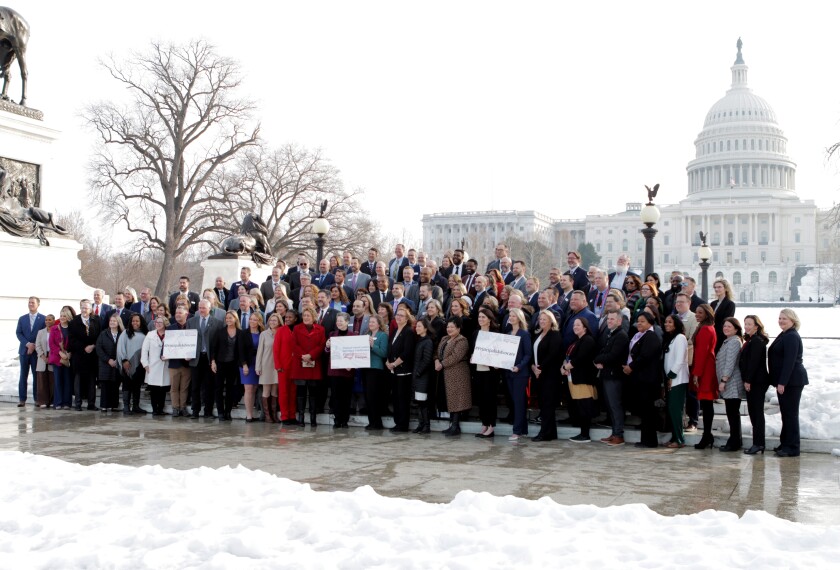
More than 200 elementary school principals gathered on Capitol Hill this week to meet with their states’ congressional delegations. They had three main asks: increase funding for teacher training and retention, address growing student mental health needs in early grades, and protect public school funding from going to private school choice options.
Still, the school leaders, whose meetings with lawmakers were facilitated by the National Association of Elementary School Principals as part of the group’s annual advocacy conference, were palpably relieved as they headed to the Hill. Just a little over a week before their visit, federal lawmakers had approved—and President Donald Trump signed into law—a fiscal 2026 budget that maintained level funding for virtually every K-12 program.
Last year, the principals had made nervous appeals to their representatives to protect the funding that aided their most vulnerable students at a time when the Trump administration had started terminating what turned out to be more than $2 billion in federal education grants.
The principals last year also met weeks before the president introduced a budget proposal to slash billions of dollars from U.S. Department of Education programs—a proposal that Congress ultimately declined to adopt.
David Carpenter, the principal of Jeeter Elementary School in Opelika, Ala., said lawmakers this year have been more open to meeting in person, compared to last year, when the delegation from Alabama mostly met congressional aides.
“There was a lot of turning upside down of ideas and conversation, but I also think that there was a little bit of avoiding talking with us, because there was so much up in the air,” he said. “This year, it’s been a little easier to set up meetings.”
In Carpenter’s meeting with lawmakers, he reiterated the importance of steady funding for students with disabilities.
“Every year I’ve been here, we have pressed for more funding for IDEA,” he said, referring to the Individuals with Disabilities Education Act and the primary federal funding stream that helps public schools provide services for students with disabilities.
Carpenter said he has seen a sharp increase in the number of students who qualify for special education services since the pandemic, and it’s been a tall ask to provide the necessary supports because of the costs.
Rachel Edoho-Eket, the principal of Waterloo Elementary School in Howard County, Md., shared Carpenter’s concerns about hiring enough mental health counselors and special education teachers for a growing population of students who need their services.
“Early intervention is great,” said Edoho-Eket. “You want students to be screened earlier. But our staffing formulas aren’t keeping up with the needs.”
Principals stressed the importance of Title II, the $2.2 billion program for teacher training. They said they want to use those federal dollars on getting more teachers credentialed in early childhood education, special education, and other areas where schools struggle to hire teachers.
Principals also pressed their members of Congress to maintain level funding for other federal programs like Title IV-A, which helps schools provide student support and academic enrichment, and Head Start, which offers free early childhood education for students from low-income families.
The Trump administration had proposed zeroing out dedicated Title II and IV-A dollars, instead moving the programs into a single education fund that would have been $4.5 billion less than current allocations for the programs it would have replaced.
While that didn’t happen for fiscal year 2026, the relief might be temporary, said John Schilling, the superintendent and principal of Southside Elementary school district in California.
Schilling is apprehensive about unwanted surprises in next year’s budget and worried the administration could push for more cuts to public school funding in the future.
“I think we’re all scared for the reality that those cuts may actually come to pass,” he said.
Federal dollars should strengthen educator pipelines, principals say
With the immediate threat to federal funds now tamped down, principals have trained their eyes on staffing their schools with an adequate number of teachers and support staff.
But with student enrollment falling nationwide, crunching school budgets, principals feel pressured to reallocate money that could have gone toward hiring more specialized teachers or interventionists, said Edoho-Eket, the principal from Maryland.
“There’s a lot of burnout happening with our staff, and it’s related to funding issues. As more programs are [proposed to be] cut, more things are being pressed upon teachers,” she said. “Teachers are now interventionists and counselors. … This is a hard time to recruit people who want to become educators.”

Also, teachers need continuous training to meet the needs of a changing classroom, said Carpenter, the principal from Alabama.
Both Edoho-Eket and Carpenter have seen their young students become increasingly unable to regulate their emotions, and they emphasized the need to train teachers in dealing with these behaviors.
Carpenter said principals need federal dollars to solve these staffing challenges. For example, he has used Title I funding to hire a retired teacher who helps identify students with the greatest mental health needs.
The teacher, who works for four hours a day, acts as an informal counselor for the kids and helps teachers manage any disruptive student behavior in their classes.
“Her job is to focus just on the kids with the greatest needs,” Carpenter said. “That’s what Title money is intended to do from the get-go.”
Principals are worried about competing with expanding school choice options
Apart from the big-ticket advocacy items, like maintaining level federal funding, principals also brought a bevy of smaller, but connected, requests to their lawmakers. They requested more funding to hire nurses and to increase reimbursement rates for school lunches by 45 cents per meal and breakfasts by 28 cents.
Annette Sanchez, an elementary principal from Beeville, Texas, leads a school where over 85% of her students are economically disadvantaged and rely on free meals at school.
Sanchez spoke to her representatives about pushing forward the Healthy Meals Help Kids Learn Act, which would increase funding for school meals. The legislation was introduced in the House in October by Rep. James McGovern, D-Mass. There hasn’t been any movement on the bill so far.
“We may need that full reimbursement so that our kids are not hungry. If they’re hungry, they’re not going to learn,” said Sanchez.
With her current budget, Sanchez is also worried that her school may not be able to compete with private and home-school options in Texas for which families will be able to receive state support next school year.
Last year, Texas Gov. Greg Abbott signed into law a billion-dollar private school choice program that provides families up to $10,000 to use toward private schooling options and up to $2,000 for home school. Students with disabilities are eligible for up to $30,000.
Some parents celebrated their newfound ability to choose where to send their kids, while public school advocates said the new program would take essential dollars away from public schools. More than 42,000 families applied on the first day after applications for the funding opened on Feb. 4.

While Sanchez supports parents’ right to choose the type of education that’s right for their children, she’s worried that private schools may cherry-pick the students they choose to enroll—for example, not accepting students with disabilities. This might put vulnerable students at risk of being left behind in public schools that are now under-resourced because of state money going toward funding private school choice, Sanchez added.
Sanchez spoke to lawmakers about “having accountability” for choice programs.
Carpenter, the principal from Alabama, had similar concerns about tax dollars being diverted to more school choice options, over and above the system already in place in his state.
Carpenter pressed his representatives about the new federal tax-credit scholarship program, which was passed as part of Trump’s One Big, Beautiful Bill Act. The program, which takes effect next year in states whose governors opt in, allows individuals to claim federal tax credits of up to $1,700 in exchange for donations to organizations that issue scholarships to cover K-12 school-related expenses. So far, 28 states—including Alabama—plan to opt in.
Carpenter is worried that by opting in, Alabama may send more taxpayer dollars toward private school options.
“This may be a bigger battle next year,” he acknowledged, “but I would argue that right now, if some of the rules that govern these scholarship-giving organizations and how they distribute the funds is not talked about sooner than later, … it might end up being a drain on our [public] school funds.”


