Student Well-Being & Movement

NCAA Agrees to Concessions for Disabled

By Joetta L. Sack — June 03, 1998 2 min read
  • Save to favorites
  • Print

In a settlement reached last week with the U.S. Department of Justice, the National Collegiate Athletic Association agreed to modify its course requirements to better accommodate students with learning disabilities.

The NCAA consented to courses for learning-disabled students that are “substantively comparable” to classes for nondisabled students, and will consider those courses designated as “remedial,” “special education,” or “special needs.”

The organization that governs intercollegiate sports will also consider changing its rules so that students with learning disabilities who do not meet the requirements may apply for waivers to compete in athletics an additional year.

As part of its effort to raise academic standards for college athletes, the NCAA requires high school students to take 13 specified core courses if they want to compete as college freshmen. Learning-disabled students, as well as academically gifted ones, have been shut out for taking classes with unorthodox course descriptions.

No Wrongdoing Admitted

The Justice Department last fall found the NCAA out of compliance with Title III of the Americans with Disabilities Act, which requires private organizations to make “reasonable modifications” to give disabled people access to their services. The 1990 federal law also prohibits imposing eligibility criteria that tend to screen out individuals with disabilities. (“Justice: NCAA Biased Against Learning-Disabled Students,” Nov. 5, 1997.)

The Overland Park, Kan.-based NCAA maintained that it was not required to follow the Title III provisions, and it admitted no wrongdoing in the settlement. It will, however, pay a total of $35,000 to four students with learning disabilities whose complaints to the Justice Department provoked the investigation.

Wallace I. Renfro, a spokesman for the NCAA, said the Title III mandate mainly deals with access to facilities, such as wheelchair ramps, an aspect of athletics that the group does not get involved with. But “we want to be in compliance with the ADA,” he said. “We have voluntarily worked with the Justice Department to do that.”

Justine Maloney, the legislative chairwoman for the Learning Disabilities Association, based in Pittsburgh, said the consent decree should help give students with learning disabilities a fair chance at competing in college sports. “They’ve covered all the bases,” she said of the parties to the settlement.

Traditionally, learning-disabled students have had problems securing NCAA eligibility, she said. “Many just sort of give up and either try another college that will give them a break or just give up on the athletics altogether.”

The decree also requires the NCAA to educate its waivers’ subcommittee on learning disabilities.

Related Tags:

A version of this article appeared in the June 03, 1998 edition of Education Week as NCAA Agrees to Concessions for Disabled

Events

This content is provided by our sponsor. It is not written by and does not necessarily reflect the views of Education Week's editorial staff.
Sponsor
Special Education Webinar
Bridging the Math Gap: What’s New in Dyscalculia Identification, Instruction & State Action
Discover the latest dyscalculia research insights, state-level policy trends, and classroom strategies to make math more accessible for all.
Content provided by TouchMath
This content is provided by our sponsor. It is not written by and does not necessarily reflect the views of Education Week's editorial staff.
Sponsor
School Climate & Safety Webinar
Belonging as a Leadership Strategy for Today’s Schools
Belonging isn’t a slogan—it’s a leadership strategy. Learn what research shows actually works to improve attendance, culture, and learning.
Content provided by Harmony Academy
This content is provided by our sponsor. It is not written by and does not necessarily reflect the views of Education Week's editorial staff.
Sponsor
School & District Management Webinar
Too Many Initiatives, Not Enough Alignment: A Change Management Playbook for Leaders
Learn how leadership teams can increase alignment and evaluate every program, practice, and purchase against a clear strategic plan.
Content provided by Otus

EdWeek Top School Jobs

Teacher Jobs
Search over ten thousand teaching jobs nationwide — elementary, middle, high school and more.
View Jobs
Principal Jobs
Find hundreds of jobs for principals, assistant principals, and other school leadership roles.
View Jobs
Administrator Jobs
Over a thousand district-level jobs: superintendents, directors, more.
View Jobs
Support Staff Jobs
Search thousands of jobs, from paraprofessionals to counselors and more.
View Jobs

Read Next

Student Well-Being & Movement Looking for SEL's Benefits? Good Implementation Is Key, Experts Say
How well an SEL program is implemented is critical for achieving the outcomes that research promises.
6 min read
Students visit the Alaqua Animal Rescue in Freeport, Fla., for an SEL-based curriculum on Aug. 23, 2025.
Students visit the Alaqua Animal Rescue in Freeport, Fla., for an SEL lesson on Aug. 23, 2025. Social-emotional learning can be a powerful tool for boosting student engagement and improving behavior and academic performance, but experts say it has to be implemented well.
Micah Green for Education Week
Student Well-Being & Movement Millions of Students Attend Schools Near Toxic Sites, a New Study Shows
The study explores schools' proximity to hazardous sites and students' exposure to pollutants.
4 min read
The Fifth Ward Elementary School and residential neighborhoods sit near the Denka Performance Elastomer Plant, back, in Reserve, La., Friday, Sept. 23, 2022. Less than a half mile away from the elementary school, the plant makes synthetic rubber, emitting chloroprene, listed as a carcinogen in California, and a likely one by the Environmental Protection Agency.
The Fifth Ward Elementary School and nearby residential neighborhoods in Reserve, La., pictured here on Sept. 23, 2022, sit near a synthetic rubber plant that has emitted chloroprene, which California lists as a carcinogen. New research finds thousands of schools are located within a quarter mile of such environmental hazard sites.
Gerald Herbert/AP
Student Well-Being & Movement 3 Driving Questions to Create a Sense of Belonging in Schools
Students who feel they belong in their school are more likely to show up and learn.
5 min read
MVCS 1981
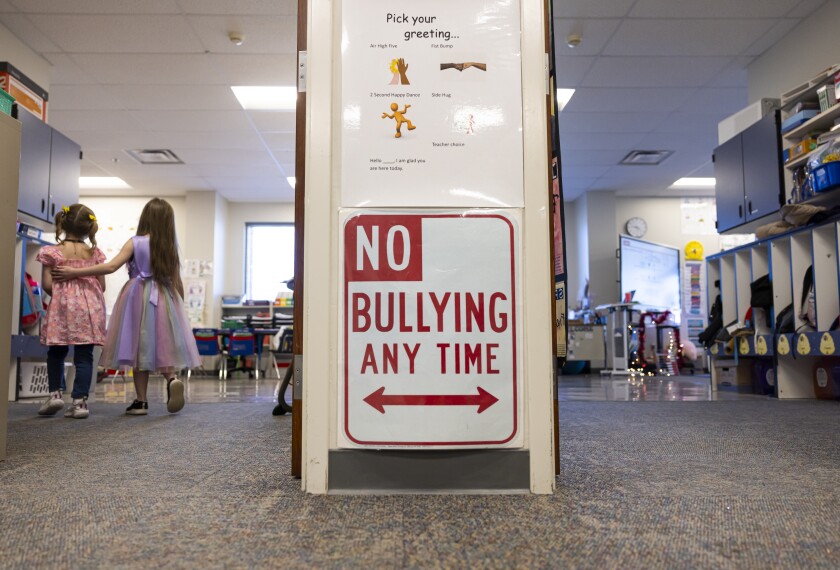
A sign discouraging bullying is seen as two students walk into a classroom at a school in Colorado Springs, Colo., on Feb. 12, 2026. Experts say creating a sense of belonging in school can help curb problems like bullying.
Kevin Mohatt for Education Week
Student Well-Being & Movement Opinion Why a Good School Needs Both Coaches and Referees
If teachers are forced into being referees, they can't fill that role properly or coach well, either.
6 min read
The United States Capitol building as a bookcase filled with red, white, and blue policy books in a Washington DC landscape.
Luca D'Urbino for Education Week