When students return to the Lamar Consolidated schools in Texas after summer break, some will attend a new district-sponsored school that’s on track to become the latest charter school designed specifically to serve a growing population of students with autism.
Bright Futures Academy, in the 45,000-student district southwest of Houston, is slated to open in August, offering a dedicated program for children on the autism spectrum where they can receive therapeutic supports integrated into the school day, without being pulled out of class.
The charter school, which will be located at the Lamar Consolidated school system’s Beasley Elementary School, will start off serving about 100 students ages 3 through 2nd grade who apply and are chosen through a lottery.

Bright Futures’ schedule will carve out dedicated time for therapy and other academic supports, district leaders said, and parents will be welcome to see their kids receiving services.
Lamar won’t be the first to open a charter school designed to serve children with autism as the population of children on the spectrum nationwide has grown. A top special education official at the U.S. Department of Education, for example, founded a network of Arizona charter schools for children with autism as well as a national accelerator to help other autism-focused charter schools open.
The goal in Lamar is twofold: First, as the district’s number of students on the autism spectrum grows, teachers need more support. At Bright Futures, staff will be specially trained to work with students who have disabilities. This takes pressure off educators in mainstream classrooms who are not equipped to handle all students’ unique needs. The specialized focus will include helping students develop self-regulation skills and prepare for independent adulthood.
“We all have our own barriers, and just because you have autism doesn’t mean you can’t go out into the world and be a successful young adult,” said Superintendent Roosevelt Nivens, who was recently named the national superintendent of the year by AASA, The School Superintendents Association. “It’s our job as educators to help and support students and help them learn those skills so they can do exactly that.”
The second goal, Nivens said, is to cut down on families’ out-of-pocket costs for supportive services. At the charter school, families will have direct access to many of those services through district-contracted providers.
One parent he spoke with said she had to sell her home and move into an apartment because her bills to support her child with autism were too high—even with the child receiving special education services under the Individuals with Disabilities Education Act.
“He was in public school, but she would have to take him out and take him to these other places for services and [was] spending all this money, and it just got me thinking, ‘Man, how can we help these families?’” Nivens said. “In my head, that’s what the public school system is supposed to do. We’re supposed to have partnerships. We’re supposed to have programs that support all kids.”

Working more closely with students’ therapists will also ensure that school staff are implementing the same strategies—for emotional regulation, for example—that kids are learning in therapy, said Tiffany Mathis, the district’s director of special education. The schedule will also allow for children’s teachers to attend therapy sessions with them, if necessary.
“We’re trying to combine the two and allow everybody to work together so that we can see progress—to move kids along faster to reach their goals,” she said.
Of the 45,000 students in the Lamar Consolidated district, about 1,700 are identified as having autism, Mathis said, up from just over 700 in 2021.
A different approach to inclusion at a specialized charter school
The Lamar district isn’t the first to design a special program for children with autism or other developmental or intellectual disabilities.
And while it’s an approach often driven by parents’ needs and their desire to support their children, it has also drawn skepticism from experts and advocates who say incorporating students with disabilities as much as possible into general education classrooms benefits all students. That idea, in fact, is enshrined in federal law.
IDEA requires that students with disabilities be taught in the “least restrictive environment” that’s appropriate for their needs. Generally, that means participating in classes alongside their general education peers at least some of the time.
We all have our own barriers, and just because you have autism doesn't mean you can't go out into the world and be a successful young adult.
Specialized charters try to meet the least restrictive environment requirement in different ways. Some recruit a mix of general education and special education students. Others promote interactions with nondisabled peers through special programs or clubs, as the Bright Futures charter school plans to do, which Nivens said is perhaps the most exciting part of the Bright Futures Academy program.
Bright Futures is located about a five-minute drive from the district’s career-and-technical education center, Nivens said, so students in the program can be routinely bused over and they can learn from the older students and have the chance to practice social skills in new situations.
Bright Futures parents, therapists, or teachers can accompany students on these visits and help them practice responding to situations that might feel challenging, overstimulating, or scary.
And students in the CTE program also will get valuable experience working with people with disabilities, Nivens said. Students in the cosmetology program might provide haircuts, facials, or manicures to students from Bright Futures, for example, he said.
“When they leave Lamar CISD, they have on their resume and can say they know how to provide support to people with autism and they will be more sought-after for having that skillset that not many other 18- or 19-year-olds have,” Nivens said.
“All of this kind of intertwines, but the end goal is, when students graduate, they have to go out and be successful young adults. We have to meet every kid where they are to help them do that.”
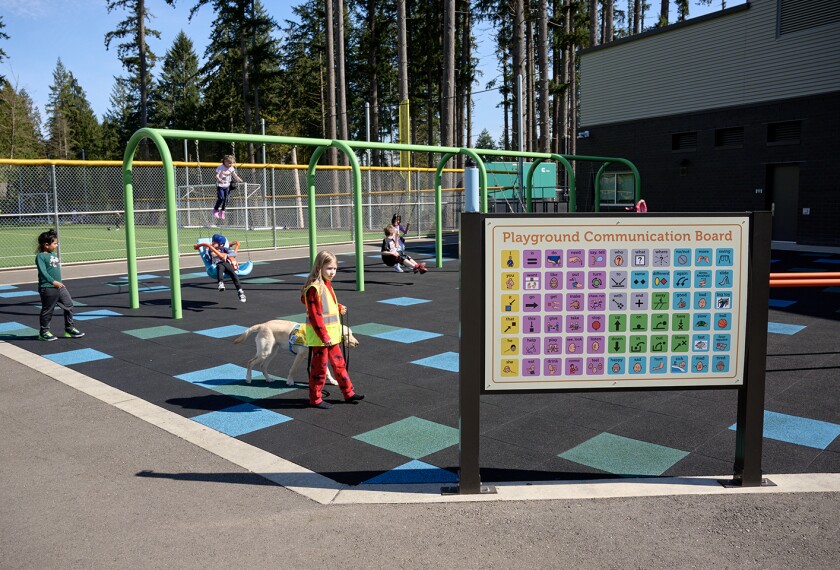
Ultimately, Nivens said, he considered whether the specialized charter approach would be beneficial for students when weighed against research and other districts’ experiences. In the end, the potential positives for families tipped the scales.
“My first thought was that maybe parents wouldn’t want their students to be singled out, or want to make sure they’re in the mainstream with everyone else,” Nivens said. “But these parents who are signing up have realized their child does need these supports and that this setting could be useful to get experiences and build their self-regulation skills for long-term success.”
Bright Futures’ success will be measured in progress on students’ IEPs
Lamar’s investment in the new special education charter comes at a time when districts across the country deal with tightening budgets and the ever-present struggle to pay for costly special education services.
Lamar leaders said they spend about $6 million more than what the federal government provides to the district for special education annually, and have done so for years, pulling dollars from other areas of a total budget of more than $473 million. The district intends to solicit donations from community partners to help fund the work at the Bright Futures charter school, Nivens said.
If the program is successful, Nivens hopes to expand it and add new grade levels at locations across the district.
To measure success, district leaders plan to evaluate each student’s progress against the goals set in their Individualized Education Program, or IEP, Nivens said.
“We’ll have a committee of folks who will say, ‘By the end of the year, this student needs to have fewer negative interactions with his peers,’ or whatever his goal is, and that’s a conversation that we’ll have for every individual student,” he said. “We’ll measure our success that way.”