
Special Education

Little Chefs, Big Gains: Students With Disabilities Cook Toward Independence

By Caitlynn Peetz Stephens — October 05, 2026 3 min read
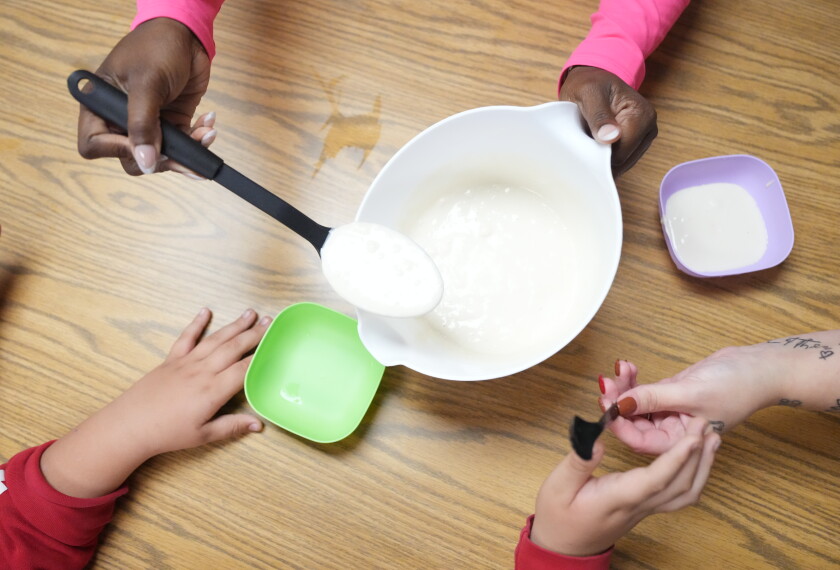
Students get waffle mix for a chicken and Waffles cooking day in the classroom of Gabrielle Carpenter at the Daniel Webster School in Indianapolis, Friday, Oct. 2, 2026.
  • Save to favorites
  • Print

On Fridays, nine tiny chefs are hard at work in Gabrielle Carpenter’s classroom, testing recipes and whipping up meals they can cook all on their own.

For the group—all kindergarten through 2nd grade students with disabilities—the activity teaches them basic kitchen skills that will serve as the building blocks of independence as they grow up.

The little white aprons and spatulas are just a cute bonus.

The cooking operation is part of “FUNctional Fridays” in Carpenter’s special education classroom at Daniel Webster School 46 in Indianapolis.

Every other Friday, students learn a recipe together, tackling everything from chicken and waffles and grilled cheese to Rice Krispies Treats and no-bake cookies.

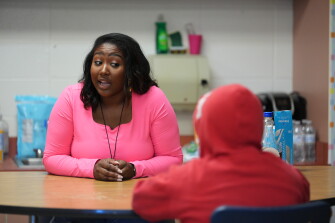
The idea, Carpenter said, is to build the children’s confidence early so they can navigate daily life with ease.

“Yes, they’re kids now, but they will be adults in the future, so I want them to be as independent as possible,” she said.
A5L03796

The recipes Carpenter chooses use ingredients that families can buy at grocery or discount stores, like Dollar General. None require skills the kids can’t manage independently, like cutting with a sharp knife or working on a hot stovetop.

Instead, Carpenter focuses on foods kids can easily put in the microwave or other kitchen gadget, set a timer for, and come back to when it’s done.

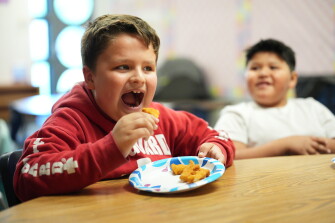
For the class-favorite chicken and waffles, students stirred boxed pancake mix (adding a few drops of food dye for color) and poured it into a waffle maker. They warmed frozen dinosaur-shaped chicken nuggets in an air fryer.

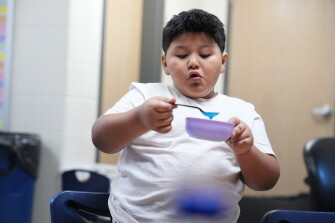
Cooking lets kids practice counting and measuring, follow directions, and develop fine motor skills, Carpenter said.

The activities also create natural opportunities to practice emotional regulation. Sometimes, a student measures an ingredient wrong, and has to start over. Sometimes, waiting their turn to stir or pour is hard when they’re excited. In those moments, Carpenter teaches them how to manage those big emotions, by taking deep breaths or taking a break.

Allyson Peterkin, the school’s principal, said the cooking lessons give “students who previously struggled in traditional school settings a safe, supportive environment to shine, take care of themselves, and build real-world independence.”

“Students demonstrate visible self-assurance, walking down the hallways smiling and genuinely proud of their accomplishments,” she said.
A5L03705

Students will be given a cookbook with their recipes at the end of the year

Carpenter buys the cooking supplies herself, but said the return—knowing her students believe in themselves—is worth every penny.

“It makes me feel a sense of relief because a lot of them, when they came to me, were just not in a good space … and a lot of them came with many people thinking that they weren’t going to be able to do much, or there was too much of a deficit for them to be independent at all,” she said. “If nothing else, now they know how to make something for themselves—especially when they don’t have the language to express what they want—and their adults can trust them to do it safely.”

This year, for the first time, Carpenter plans to make personalized cookbooks to send home with students before summer break. Filled with recipes the class made together, the cookbooks give students a reference point for questions, measurements, or meal inspiration.

Each cookbook will have a customized cover featuring the student’s name and a picture of them wearing an apron and holding a spatula.

Some students have already used their skills at home.

Parents have told Carpenter their children are showing new interest in being in the kitchen. One student now makes breakfast for himself and his younger brother—a bowl of cereal.
A5L03318

Students run a coffee cart business when they’re not cooking

On weeks without cooking, students run a coffee cart for teachers and administrators. On Thursday, students color drink sleeves, and help Carpenter prepare the drinks by reading orders, fetching cups, or organizing supplies.

On Friday, they walk together from classroom to classroom, dropping off the drinks, collecting payments, and interacting with people across the building.

Carpenter got the idea for the coffee cart a few years ago, when several of her students repeatedly tried to run out of the school.

She wanted a fun way to teach them how to navigate the school safely, and help staff get to know them.

“You can’t run if you have a coffee in your hand,” Carpenter joked.

A local coffee shop initially donated supplies to start the program, and students now use sales proceeds to restock. Any additional money funds an end-of-year class party.

“I feel like their independence has skyrocketed,” Carpenter said, “and I love being part of that.”

Events

This content is provided by our sponsor. It is not written by and does not necessarily reflect the views of Education Week's editorial staff.
Sponsor
Artificial Intelligence Webinar
From Passive to Active Reading: Student Engagement in the Age of AI
What the research tells us about active reading and student engagement—and what it means for teaching in an AI-enabled world.
Content provided by Pearson
This content is provided by our sponsor. It is not written by and does not necessarily reflect the views of Education Week's editorial staff.
Sponsor
Professional Development Webinar
Micro-Learning, Macro Results: Reimagining Professional Learning
Rethink professional learning with 3 strategies that personalize professional learning, validate expertise, and support educator retention.
Content provided by Mira Education & Modiv EDU
This content is provided by our sponsor. It is not written by and does not necessarily reflect the views of Education Week's editorial staff.
Sponsor
School Climate & Safety Webinar
There But Not Present: Rethinking Student Engagement
Learn how to recognize the early signs of disengagement and what the behavioral science reveals about which interventions actually work.
Content provided by Frontline Education

EdWeek Top School Jobs

Teacher Jobs
Search over ten thousand teaching jobs nationwide — elementary, middle, high school and more.
View Jobs
Principal Jobs
Find hundreds of jobs for principals, assistant principals, and other school leadership roles.
View Jobs
Administrator Jobs
Over a thousand district-level jobs: superintendents, directors, more.
View Jobs
Support Staff Jobs
Search thousands of jobs, from paraprofessionals to counselors and more.
View Jobs

Read Next

Special Education Spotlight Beyond the Diagnosis: Helping Students With Dyslexia Thrive
Explore what educators need to know about dyslexia—and how the right support can help students build confidence and thrive.
Special Education New Federal Guidance Could Roll Back Special Ed. Transition Services
New DOJ guidance threatens high school transition programs meant to help disabled students live independently.
3 min read
Lois Curtis, left, addresses a group at the state Capitol in Hartford, Conn., to observe the 10th anniversary of a U.S. Supreme Court ruling that qualified patients have the right to receive community-based care rather than to be institutionalized. Curtis was one of the to plaintiffs in the suit, Olmstead v. L.C. and E.W.
Lois Curtis, left, addresses a group at the Connecticut state Capitol in 2009 to mark the 10th anniversary of <i>Olmstead</i> v. <i>L.C.</i>, a U.S. Supreme Court ruling stemming from a lawsuit in which she was a lead plaintiff that established qualified patients' right to community-based care over institutionalization. In June, the U.S. Department of Justice stated it “will not rely upon the <i>Olmstead</i> Guidance in its enforcement” of the Americans with Disabilities Act, a move that advocates fear could upend transition planning for K-12 students who have disabilities.
Bob Child/AP
Special Education Opinion Disability Studies Is a Rich Discipline That Builds Empathy. How to Teach It
A more inclusive world starts with teaching all students the long history of disability rights.
Brittany R. Collins
•
5 min read
A classroom image with aspects of the struggles of disability rights woven through it.
Vanessa Solis/Education Week + Getty
Special Education How Teachers Feel About Adapting Instruction for Students With Disabilities
Both general and special education teachers need more time and support to build confidence in differentiating instruction.
3 min read
Jessica DiMaggio, an education for students with disabilities paraprofessional, watches a Structured Academics and Interpersonal Learning or SAIL student put the tips of his index fingers together at Watkins Elementary on Nov. 4, 2025 , in Wylie, Texas.
Jessica DiMaggio, an education for students with disabilities paraprofessional, watches a Structured Academics and Interpersonal Learning or SAIL student put the tips of his index fingers together at Watkins Elementary on Nov. 4, 2025 , in Wylie, Texas. Most teachers don't feel confident in their ability to adapt instruction to differentiate instruction to meet the needs of students with learning disabilities, according to a new survey by the National Center for Learning Disabilities and West Ed.
Angela Piazza/The Dallas Morning News via TNS
