Student Well-Being & Movement

Digging In

April 20, 2007 1 min read
  • Save to favorites
  • Print

Dozens of nonprofits, growers’ associations, botanical gardens, and other groups offer assistance to teachers interested in starting school gardens. Here are just a few:

The Chicago Botanic Garden gives hands-on help to schools in the Chicago area. Educators elsewhere can use the School Garden Wizard, an online resource with tips for everything from convincing principals to using gardens as teaching tools.
www.schoolgardenwizard.org
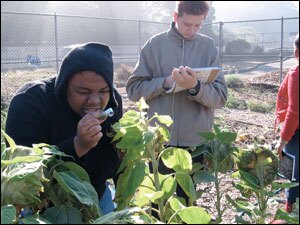
High school kids from June Jordan School for Equity watch ladybugs eat aphids.

The National Gardening Association has a Web page with information for young gardeners and teachers, including projects and success stories. Teachers can subscribe to an e-newsletter, apply for grants, and sign up for conferences.
www.kidsgardening.org

The Edible Schoolyard, a garden and kitchen classroom in Berkeley, California, offers a more philosophical perspective. (“The garden and kitchen provide a context for understanding seasonality and life cycles.”) The 10-year-old program started with the help of acclaimed chef Alice Waters.
www.edibleschoolyard.org

See Also

Return to the main story,

Growing Vegetable Lovers

The Western Growers Association provides step-by-step advice for getting started, such as forming a garden committee, testing soil, and ensuring the garden will get five to eight hours of sun each day.
www.wga.com

Related Tags:

A version of this article appeared in the May 01, 2007 edition of Teacher Magazine as Digging In

Events

This content is provided by our sponsor. It is not written by and does not necessarily reflect the views of Education Week's editorial staff.
Sponsor
Special Education Webinar
Bridging the Math Gap: What’s New in Dyscalculia Identification, Instruction & State Action
Discover the latest dyscalculia research insights, state-level policy trends, and classroom strategies to make math more accessible for all.
Content provided by TouchMath
This content is provided by our sponsor. It is not written by and does not necessarily reflect the views of Education Week's editorial staff.
Sponsor
School Climate & Safety Webinar
Belonging as a Leadership Strategy for Today’s Schools
Belonging isn’t a slogan—it’s a leadership strategy. Learn what research shows actually works to improve attendance, culture, and learning.
Content provided by Harmony Academy
This content is provided by our sponsor. It is not written by and does not necessarily reflect the views of Education Week's editorial staff.
Sponsor
School & District Management Webinar
Too Many Initiatives, Not Enough Alignment: A Change Management Playbook for Leaders
Learn how leadership teams can increase alignment and evaluate every program, practice, and purchase against a clear strategic plan.
Content provided by Otus

EdWeek Top School Jobs

Teacher Jobs
Search over ten thousand teaching jobs nationwide — elementary, middle, high school and more.
View Jobs
Principal Jobs
Find hundreds of jobs for principals, assistant principals, and other school leadership roles.
View Jobs
Administrator Jobs
Over a thousand district-level jobs: superintendents, directors, more.
View Jobs
Support Staff Jobs
Search thousands of jobs, from paraprofessionals to counselors and more.
View Jobs

Read Next

Student Well-Being & Movement Looking for SEL's Benefits? Good Implementation Is Key, Experts Say
How well an SEL program is implemented is critical for achieving the outcomes that research promises.
6 min read
Students visit the Alaqua Animal Rescue in Freeport, Fla., for an SEL-based curriculum on Aug. 23, 2025.
Students visit the Alaqua Animal Rescue in Freeport, Fla., for an SEL lesson on Aug. 23, 2025. Social-emotional learning can be a powerful tool for boosting student engagement and improving behavior and academic performance, but experts say it has to be implemented well.
Micah Green for Education Week
Student Well-Being & Movement Millions of Students Attend Schools Near Toxic Sites, a New Study Shows
The study explores schools' proximity to hazardous sites and students' exposure to pollutants.
4 min read
The Fifth Ward Elementary School and residential neighborhoods sit near the Denka Performance Elastomer Plant, back, in Reserve, La., Friday, Sept. 23, 2022. Less than a half mile away from the elementary school, the plant makes synthetic rubber, emitting chloroprene, listed as a carcinogen in California, and a likely one by the Environmental Protection Agency.
The Fifth Ward Elementary School and nearby residential neighborhoods in Reserve, La., pictured here on Sept. 23, 2022, sit near a synthetic rubber plant that has emitted chloroprene, which California lists as a carcinogen. New research finds thousands of schools are located within a quarter mile of such environmental hazard sites.
Gerald Herbert/AP
Student Well-Being & Movement 3 Driving Questions to Create a Sense of Belonging in Schools
Students who feel they belong in their school are more likely to show up and learn.
5 min read
MVCS 1981
A sign discouraging bullying is seen as two students walk into a classroom at a school in Colorado Springs, Colo., on Feb. 12, 2026. Experts say creating a sense of belonging in school can help curb problems like bullying.
Kevin Mohatt for Education Week
Student Well-Being & Movement Opinion Why a Good School Needs Both Coaches and Referees
If teachers are forced into being referees, they can't fill that role properly or coach well, either.
6 min read
The United States Capitol building as a bookcase filled with red, white, and blue policy books in a Washington DC landscape.
Luca D'Urbino for Education Week